
Table of Contents
ToggleIndia-Japan Defence Cooperation
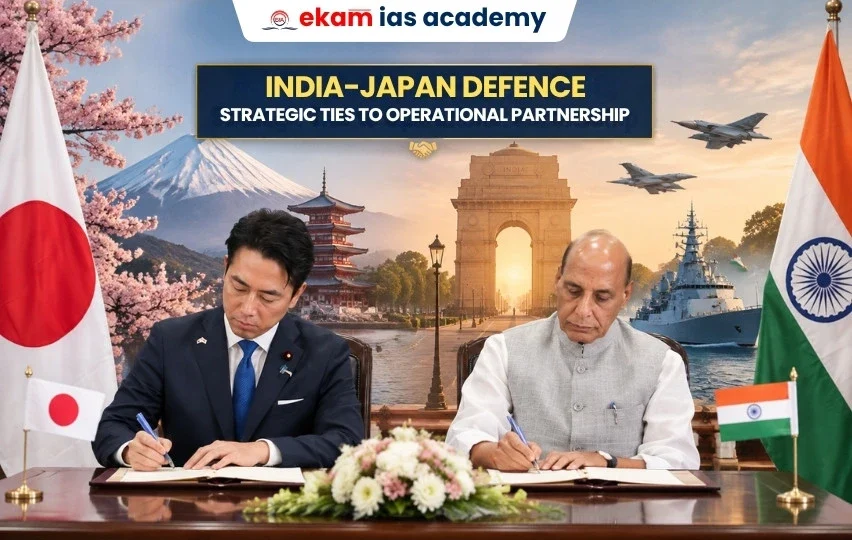
The August 2026 visit of Japanese Defence Minister Shinjiro Koizumi to India marked an important phase in India-Japan defence relations. After more than a decade of building institutional mechanisms, both countries are now seeking to convert strategic convergence into operational capabilities, defence-industrial cooperation and greater military interoperability.
The latest engagement focuses particularly on maritime security, defence technology, military exercises and joint production.
India-Japan Defence Cooperation: From Dialogue to Delivery
India and Japan have developed a strong institutional framework through annual defence dialogues, the 2+2 mechanism, logistics arrangements, military exercises and technology cooperation.
However, implementation has often lagged behind political commitments. The current phase therefore emphasises tangible outcomes rather than additional declarations.
Both countries share concerns about freedom of navigation, maritime security and attempts to alter the regional status quo through force or coercion.
Maritime Cooperation and Domain Awareness
A major focus is strengthening Maritime Domain Awareness (MDA) and information sharing.
India’s strategic position in the Indian Ocean complements Japan’s presence around the East China Sea and western Pacific. Improved information exchange could provide both countries with greater awareness of developments across interconnected maritime regions.
Cooperation is also expanding into naval shipbuilding, ship design and reciprocal ship-repair arrangements. Japanese technological expertise combined with Indian manufacturing capabilities could strengthen defence-industrial cooperation under Make in India.
UNICORN and Defence Technology
The proposed transfer of Japan’s UNICORN integrated communications antenna system has emerged as an important symbol of defence technology cooperation.
An MoU involving Bharat Electronics Limited (BEL) had already been signed in November 2024. The latest engagement therefore focuses on moving the project towards implementation.
Greater cooperation between India’s DRDO and Japan’s Acquisition, Technology and Logistics Agency (ATLA) could also help translate existing technology agreements into concrete projects.
Strengthening Military Exercises
Operational cooperation is another priority. Japanese fighter aircraft are participating in Veer Guardian in India from September 9–22, 2026, according to the provided material.
Both countries intend to make exercises more complex by incorporating unmanned systems, special operations forces and short-notice drills. Such measures can improve interoperability and preparedness between their armed forces.
Strategic Significance for the Indo-Pacific
India-Japan defence cooperation increasingly extends beyond a narrowly China-centric framework. It supports a wider regional architecture involving:
- Maritime security and freedom of navigation
- Resilient supply chains
- Defence manufacturing and technology
- Military logistics
- Economic security and critical technologies
The partnership can combine India’s industrial capacity with Japan’s technological strengths, contributing to a more resilient Indo-Pacific.
Challenges and Way Forward
The biggest challenge remains the implementation deficit. Defence technology agreements and industrial cooperation have not always produced timely results.
India and Japan should therefore prioritise existing projects, expand MDA information sharing, strengthen naval industrial cooperation and conduct more sophisticated military exercises.
Conclusion
The India-Japan defence partnership is shifting from strategic convergence to operational cooperation. Its future credibility will depend on delivering usable military capabilities, successful technology projects and stronger defence-industrial linkages. If implementation keeps pace with ambition, the partnership could become an increasingly important pillar of the Indo-Pacific security architecture.


FAQs: India-Japan Defence Cooperation
Why is India-Japan defence cooperation becoming important?
India-Japan defence cooperation is gaining importance due to shared concerns over maritime security, Indo-Pacific stability, freedom of navigation and maintaining a rules-based regional order.
What are the major areas of India-Japan defence cooperation?
Key areas include maritime information sharing, military exercises, defence technology cooperation, naval shipbuilding, logistics support and defence-industrial partnerships.
What is the significance of Maritime Domain Awareness (MDA) cooperation between India and Japan?
MDA cooperation helps both countries develop a better understanding of maritime activities by sharing information, improving surveillance capabilities and strengthening coordination across the Indian Ocean and Indo-Pacific regions.
What is the UNICORN system in India-Japan defence cooperation?
The UNICORN (Unified Complex Radio Antenna) system is a Japanese integrated communications antenna technology. Its proposed cooperation with India represents growing defence technology collaboration between the two countries.
What are the challenges in India-Japan defence partnership?
Major challenges include the implementation gap in defence agreements, slow technology transfer, limited defence-industrial cooperation and the need for greater operational interoperability between the two militaries.