Table of Contents
ToggleWhy in News?
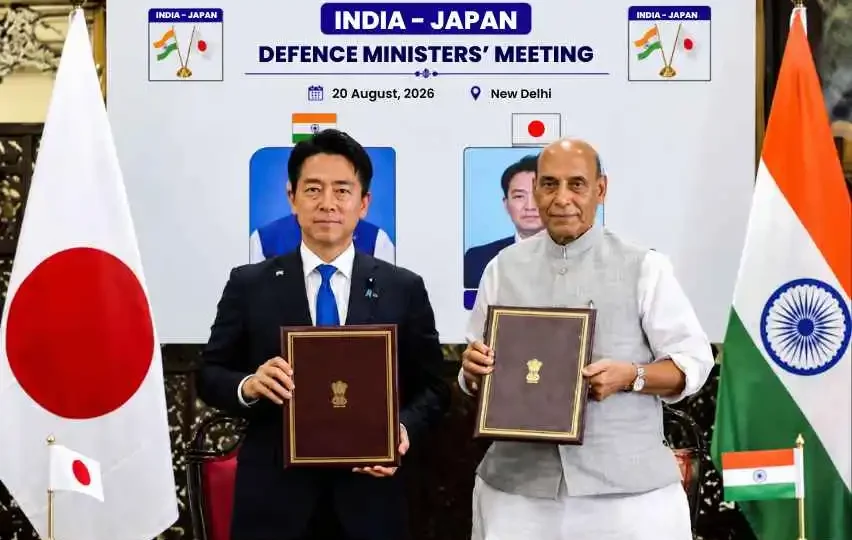
India and Japan recently signed a Memorandum of Arrangement (MoA) on Maritime Security Cooperation during bilateral discussions between the Defence Ministers of both countries in New Delhi.
The agreement aims to further deepen defence and maritime cooperation between the Indian Navy and the Japan Maritime Self-Defense Force (JMSDF) by enhancing coordination in areas such as maritime awareness, disaster response, naval exchanges and defence technology cooperation.
The development reflects the growing strategic convergence between India and Japan in ensuring a free, open and stable Indo-Pacific region.
What is the India–Japan Maritime Security Cooperation Agreement?
The Memorandum of Arrangement provides an institutional framework for expanding cooperation between the Indian Navy and JMSDF.
The agreement focuses on:
- Maritime Domain Awareness (MDA) to improve understanding of activities in the maritime region.
- Search and Rescue (SAR) operations for coordinated response during emergencies.
- Humanitarian Assistance and Disaster Relief (HADR) missions during natural disasters and crises.
The MoA strengthens operational coordination and promotes greater interoperability between the two maritime forces.
Strengthening Sea Lines of Communication (SLOCs)
India and Japan have agreed to enhance cooperation for protecting critical Sea Lines of Communication (SLOCs) that support international trade and energy transportation.
The cooperation includes:
- Reciprocal naval ship visits.
- Joint maritime exercises.
- Exchange of naval personnel and experts.
- Port access and logistics support.
- Maintenance and repair facilities.
Secure maritime routes are essential for both countries due to their dependence on uninterrupted trade and energy supplies through the Indo-Pacific.
Cooperation in Naval Shipbuilding and Repair
India and Japan plan to explore collaboration in naval shipbuilding and design.
The partnership aims to combine:
- Japan’s advanced technological capabilities.
- India’s growing defence manufacturing capacity.
The two countries will also promote:
- Reciprocal ship-repair arrangements.
- Greater utilisation of Indian shipyards.
- Strengthening of the Make in India initiative in the defence sector.
This cooperation can contribute to developing a stronger indigenous maritime industrial base.
Expansion of Military Exercises
India and Japan will further enhance their bilateral military exercises to improve operational readiness and coordination.
Major exercises include:
Dharma Guardian
- A joint military exercise between the Indian Army and Japan Ground Self-Defense Force.
JAIMEX
- A bilateral naval exercise aimed at improving maritime cooperation between the Indian Navy and JMSDF.
The planned Veer Guardian 26 exercise will mark the participation of Japanese fighter aircraft in an air exercise in India for the first time.
Both countries also plan to conduct more advanced exercises involving:
- Unmanned systems.
- Complex operational scenarios.
- Short-notice deployment drills.
Defence Technology and Industrial Cooperation
India’s Defence Research and Development Organisation (DRDO) and Japan’s Acquisition, Technology & Logistics Agency (ATLA) will strengthen cooperation in advanced defence technologies.
The partnership will focus on:
- Joint technology development.
- Defence innovation.
- Industrial collaboration.
A dedicated Defence Industry Forum will promote cooperation between defence companies of both nations.
UNICORN Project: Advancing Defence Equipment Cooperation
The UNICORN (Unified Complex Radio Antenna) integrated communications antenna system has emerged as an important symbol of India–Japan defence cooperation.
The project is being pursued as the first defence equipment transfer initiative between India and Japan.
It represents a significant step towards expanding defence technology exchange and industrial collaboration between the two countries.
Special Operations Forces and Theatre Command Cooperation
India and Japan have agreed to increase cooperation between their respective Special Operations Forces.
The partnership will include:
- Greater exchange of expertise.
- Joint training opportunities.
- Operational cooperation.
Japan will also explore cooperation with India’s proposed integrated theatre commands after their establishment.
This reflects increasing focus on modern military structures and joint operational capabilities.
India–Japan Cooperation in the Indo-Pacific
Both countries reaffirmed their commitment towards maintaining a:
- Free
- Open
- Inclusive
- Rules-based Indo-Pacific
India and Japan opposed:
- Unilateral attempts to change the status quo through force.
- Actions that threaten freedom of navigation.
They also agreed to strengthen cooperation with other countries through initiatives such as the Indo-Pacific Logistics Network and multilateral military exercises.
Institutional Mechanism for Cooperation
To ensure effective implementation of defence cooperation, India and Japan will establish a Director-General/Joint Secretary-level Working Group.
The mechanism will coordinate cooperation in areas such as:
- Defence operations.
- Intelligence sharing.
- Equipment collaboration.
- Technology development.
- Defence industries.
Both nations will also accelerate preparations for the fourth India–Japan 2+2 Foreign and Defence Ministerial Dialogue to be held in Tokyo.
Significance of India–Japan Maritime Partnership
The growing India–Japan defence partnership has strategic importance because:
- Both countries share concerns regarding maritime security challenges in the Indo-Pacific.
- It enhances regional stability and freedom of navigation.
- It strengthens India’s defence capabilities through technology cooperation.
- It supports diversification of defence partnerships and supply chains.
Conclusion
The India–Japan Maritime Security Cooperation Agreement marks another important milestone in the evolving strategic partnership between the two countries.
By combining naval cooperation, defence technology, maritime infrastructure and Indo-Pacific coordination, India and Japan are working towards building a secure and resilient maritime environment.
The partnership will play an important role in maintaining regional stability and strengthening a rules-based order in the Indo-Pacific.
India–Japan Maritime Security Cooperation-FAQs Answered
What is India–Japan Maritime Security Cooperation?
It is a defence cooperation framework between India and Japan to improve coordination between the Indian Navy and Japan Maritime Self-Defense Force.
What areas are covered under the maritime cooperation MoA?
The MoA covers Maritime Domain Awareness, Search and Rescue, Humanitarian Assistance and Disaster Relief, naval exchanges and operational coordination.
Why are Sea Lines of Communication important?
SLOCs are vital maritime routes for global trade and energy supplies, especially in the Indo-Pacific region.
What is the UNICORN Project?
UNICORN is an integrated communications antenna system linked to India–Japan defence equipment cooperation and naval technology collaboration.
Why is India–Japan maritime cooperation important for UPSC?
It connects Indo-Pacific strategy, maritime security, defence technology, SLOC protection, Make in India, disaster response and India’s strategic partnerships.