Table of Contents
ToggleWhy in News?
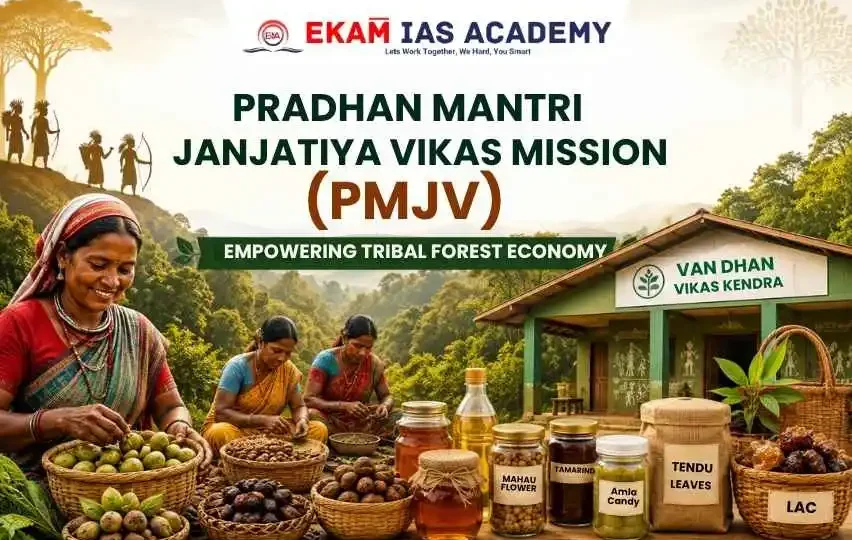
The Government has highlighted the role of the Pradhan Mantri Janjatiya Vikas Mission (PMJVM) in transforming India’s tribal forest economy by organising tribal communities into Van Dhan Vikas Kendras (VDVKs) and enabling them to move beyond selling raw forest produce towards value-added production and entrepreneurship.
The Mission aims to improve income opportunities for tribal communities by strengthening procurement, processing, branding, marketing and market linkages for Minor Forest Produce (MFP).
What is Pradhan Mantri Janjatiya Vikas Mission (PMJVM)?
The Pradhan Mantri Janjatiya Vikas Mission (PMJVM) is a Central Sector Scheme implemented by the Ministry of Tribal Affairs to promote sustainable livelihoods and entrepreneurship among tribal communities.
The scheme was created by merging:
- Mechanism for Marketing of Minor Forest Produce (MFP) through Minimum Support Price (MSP)
- Development of Value Chain for MFP
- Institutional Support for Development and Marketing of Tribal Products/Produce
The Mission focuses on creating a complete ecosystem from collection of forest produce to processing, value addition and marketing.
Objectives of PMJVM
The primary objective of PMJVM is to enhance tribal income by creating sustainable livelihood opportunities through forest-based enterprises.
The Mission aims to:
- Promote tribal entrepreneurship through production and processing of forest products.
- Provide better market access and fair prices to tribal gatherers.
- Develop backward and forward linkages for tribal products.
- Reduce dependence on middlemen by strengthening community-based institutions.
Implementation and Major Components
The Tribal Cooperative Marketing Development Federation of India (TRIFED) is the central implementing agency for PMJVM.
TRIFED works directly or through State Implementing Agencies to implement various components of the scheme.
Major components include:
- Minimum Support Price (MSP)-based procurement of Minor Forest Produce.
- Establishment of Van Dhan Vikas Kendras (VDVKs).
- Creation of Van Dhan Producer Enterprises (VDPEs).
- Skill development and capacity building.
- Product branding, packaging and marketing support.
- Promotion of e-commerce platforms.
Financial Support under PMJVM
The Mission provides financial assistance to develop tribal enterprises and improve processing capabilities.
Key financial provisions include:
- Up to ₹15 lakh assistance for establishing a Van Dhan Vikas Kendra.
- Up to ₹64 lakh support over three years for Van Dhan Producer Enterprises for enterprise development and capacity building.
Special attention is given to:
- Aspirational Districts
- Particularly Vulnerable Tribal Groups (PVTGs)
- Forest Rights Act (FRA), 2006 land-title holders
Minor Forest Produce (MFP) and Tribal Livelihoods
Minor Forest Produce refers to non-timber forest products collected from forests that provide an important source of livelihood for tribal communities.
According to the Forest Rights Act (FRA), 2006, MFP includes:
- Bamboo and cane
- Honey and wax
- Tendu leaves
- Mahua flowers
- Tamarind
- Lac
- Medicinal plants
- Roots, tubers and wild herbs
- Tussar cocoons
For many forest-dependent tribal families, MFP contributes significantly to household income and provides both subsistence and cash earnings.
However, tribal gatherers often face exploitation by middlemen and are forced to sell produce at low prices.
Legal Rights and MSP Support for MFP
The Forest Rights Act, 2006 recognises the traditional dependence of forest communities on forest resources and grants rights over the collection and sale of Minor Forest Produce.
The Panchayats (Extension to Scheduled Areas) Act, 1996 (PESA) provides ownership rights over MFP to tribal Gram Panchayats in Scheduled Areas.
Under PMJVM:
- The government has notified MSP for 87 Minor Forest Produce items.
- TRIFED procures MFP through State agencies at the predetermined MSP.
- The mechanism protects tribal collectors from distress sales.
Since 2013–14, State governments have procured around 2.68 lakh metric tonnes of MFP worth ₹693.98 crore under the scheme.
Role of Van Dhan Vikas Kendras (VDVKs)
Van Dhan Vikas Kendras form the foundation of PMJVM’s entrepreneurship model.
Under this initiative:
- Tribal gatherers are organised into Self-Help Groups (SHGs).
- These groups are clustered into VDVKs.
- Each Kendra generally consists of around 300 members, with at least 60% Scheduled Tribe representation.
The VDVK model helps tribal communities undertake:
- Scientific harvesting
- Primary processing
- Packaging
- Branding
- Marketing of forest products
Skill Development and Market Support
PMJVM provides training and infrastructure support to improve the quality and value of tribal products.
Support includes:
- Training in sustainable harvesting techniques.
- Processing equipment and tools.
- Packaging and storage facilities.
- Working capital assistance.
- Transportation and banking linkages.
For marketing, VDVKs are connected with:
- Tribal Haat Bazaars
- Exhibitions
- Private and non-profit organisations
- E-commerce platforms
TRIFED provides market information, price updates and branding support to improve product visibility.
Progress and Impact of PMJVM
The Mission has expanded tribal participation in value-added forest enterprises.
As of 31 July 2026:
- 4,172 Van Dhan Vikas Kendras were sanctioned.
- 2,911 VDVKs became functional.
- Around 12.48 lakh tribal members were linked with the initiative.
- Total sales generated were approximately ₹168 crore.
Conclusion
The Pradhan Mantri Janjatiya Vikas Mission represents a shift from traditional forest produce collection towards community-owned tribal enterprises.
By combining MSP support, value addition, skill development, branding and market access, PMJVM aims to enhance tribal incomes and strengthen the forest-based economy.
The Mission reflects the broader vision of inclusive growth and tribal empowerment by enabling tribal communities to become entrepreneurs rather than merely suppliers of raw forest produce.
PMJVM-FAQs Answered
What is Pradhan Mantri Janjatiya Vikas Mission?
PMJVM is a Central Sector Scheme of the Ministry of Tribal Affairs that promotes tribal livelihoods, entrepreneurship, value addition and marketing of tribal products.
Who implements PMJVM?
PMJVM is implemented through the Tribal Cooperative Marketing Development Federation of India, commonly known as TRIFED.
What are Van Dhan Vikas Kendras?
Van Dhan Vikas Kendras are community-based tribal enterprise centres that help tribal gatherers process, package, brand and market Minor Forest Produce.
What is Minor Forest Produce?
Minor Forest Produce includes non-timber forest products such as bamboo, honey, tendu leaves, mahua flowers, tamarind, lac, medicinal plants and wild herbs.
Why is PMJVM important for UPSC?
PMJVM is important because it connects tribal welfare, forest economy, Minor Forest Produce, MSP support, TRIFED, rural livelihoods, inclusive growth and current affairs.