Table of Contents
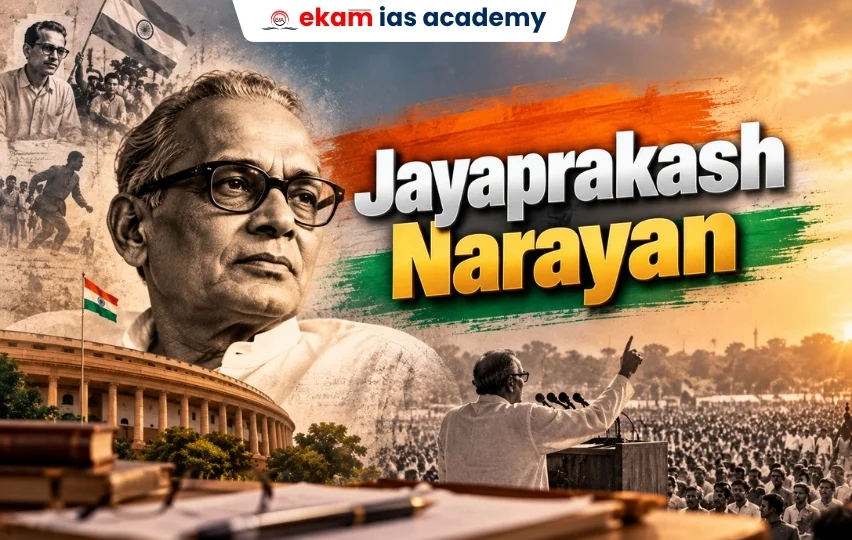
ToggleJayaprakash Narayan Death Anniversary 2026 will be observed on 8 October 2026, marking 47 years since the death of the prominent freedom fighter, socialist thinker and political leader. Popularly known as JP, he played an important role in the freedom struggle, the Quit India Movement and later movements for democratic reform.
Who Was Jayaprakash Narayan?
Jayaprakash Narayan was born on 11 October 1902 at Sitabdiara in the Saran region of the Bengal Presidency. His early exposure to the national movement influenced his political outlook.
He left college during the Non-Cooperation Movement and joined Bihar Vidyapeeth. Later, while studying in the United States, he encountered socialist and Marxist ideas. Returning to India in 1929, he joined the Indian National Congress and gradually emerged as an important socialist leader.
Jayaprakash Narayan’s Role in the Freedom Struggle
Narayan helped establish the Congress Socialist Party (CSP) in 1934, with Acharya Narendra Deva as president and himself as general secretary.
He was imprisoned during the Civil Disobedience Movement and later became a prominent underground leader during the Quit India Movement of 1942. He escaped from Hazaribagh Central Jail on 9 November 1942 and worked with other revolutionaries, including Ram Manohar Lohia, to organise resistance against British rule.
After Independence, Narayan gradually moved away from conventional party politics and became associated with the Sarvodaya and Bhoodan movements led by Vinoba Bhave. He promoted decentralised democracy, social equality and greater public participation.
Bihar Movement and Total Revolution
Narayan returned to national politics during the Bihar Movement of 1974, which emerged amid concerns over inflation, unemployment, shortages and corruption.
On 5 June 1974, addressing a large gathering at Gandhi Maidan in Patna, he called for “Total Revolution” (Sampoorna Kranti).
His vision extended beyond changing governments. He advocated transformation in political, social, economic, educational and moral spheres, with greater accountability and citizen participation.
Jayaprakash Narayan and the Emergency
Narayan became a leading critic of the Emergency imposed in June 1975. He advocated democratic rights and political accountability while opposing restrictions on civil liberties.
He was detained during the Emergency, and his health deteriorated significantly during imprisonment. Despite serious health problems, he remained an influential figure in the opposition movement.
Janata Movement and 1977 Election
Following the end of the Emergency, opposition groups united under the Janata Party. Narayan provided important moral and political leadership to this movement.
The Janata Party won the 1977 general election and formed India’s first non-Congress government at the Centre. Narayan himself did not seek political office.
Jayaprakash Narayan Death and Legacy
Jayaprakash Narayan died on 8 October 1979 following prolonged health complications. He was posthumously awarded the Bharat Ratna in 1999.
His legacy encompasses the freedom struggle, socialist politics, Sarvodaya, Total Revolution and the defence of democratic freedoms. His political journey remains significant in understanding India’s evolution from the freedom movement to post-Independence democratic mobilisation.


FAQs: Jayaprakash Narayan Death Anniversary 2026
Who was Jayaprakash Narayan?
Jayaprakash Narayan (1902–1979), popularly known as Lok Nayak or JP, was an Indian freedom fighter, socialist thinker and political leader. He played a significant role in the Quit India Movement and advocated democratic reforms through his concept of Total Revolution.
When is Jayaprakash Narayan Death Anniversary observed?
Jayaprakash Narayan’s death anniversary is observed on 8 October every year. In 2026, India commemorates his 47th death anniversary, remembering his contributions to the freedom struggle and democracy.
What was Jayaprakash Narayan's Total Revolution?
Total Revolution (Sampoorna Kranti) was a movement launched by Jayaprakash Narayan on 5 June 1974 in Patna. It called for comprehensive transformation in political, social, economic, educational and moral spheres.
What was Jayaprakash Narayan's role during the Emergency of 1975?
Jayaprakash Narayan strongly opposed the Emergency imposed in June 1975 and advocated the restoration of democratic rights and civil liberties. He was arrested during the Emergency and became a prominent symbol of democratic resistance.
Why is Jayaprakash Narayan important for UPSC preparation?
Jayaprakash Narayan is important for UPSC Modern Indian History and Polity, particularly the Quit India Movement, Congress Socialist Party, Bihar Movement, Total Revolution, Emergency of 1975 and the formation of India’s first non-Congress central government in 1977.