Table of Contents
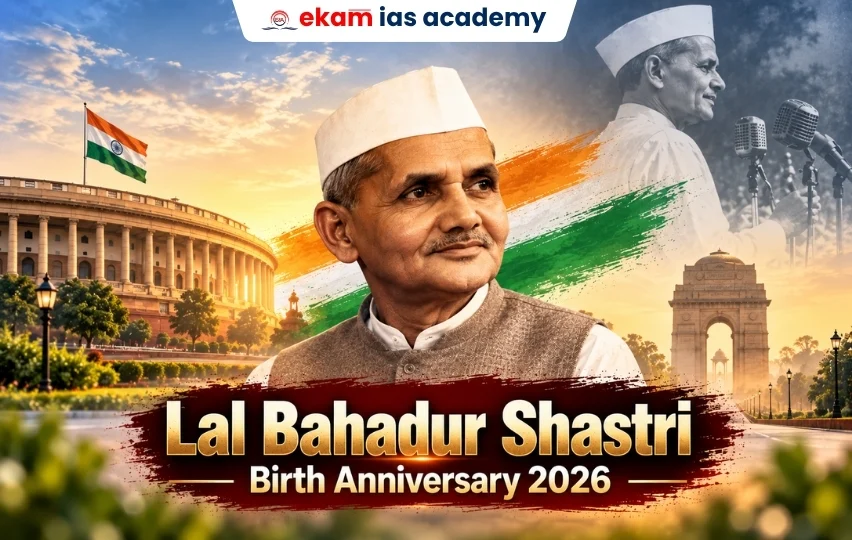
ToggleLal Bahadur Shastri Jayanti 2026 will be observed on 2 October, marking the 122nd birth anniversary of India’s second Prime Minister. Born in 1904, Shastri played an important role in the freedom movement and later in strengthening India’s food security, agriculture and national defence. His birth anniversary coincides with Gandhi Jayanti.
Lal Bahadur Shastri Biography
Lal Bahadur Shastri’s public life was shaped by the values of simplicity, discipline, public service and accountability.
- Born: 2 October 1904, Mughalsarai, Uttar Pradesh.
- Education: Studied at Kashi Vidyapith and received the title Shastri, meaning scholar.
- Freedom Movement: Participated in the Non-Cooperation, Civil Disobedience and Quit India Movements.
- Congress: Joined the Indian National Congress in 1928 and worked with the Servants of the People Society.
- Post-Independence: Held important positions in Uttar Pradesh and later served as Railway and Transport, Industry and Home Minister at the Union level.
- Prime Minister: Became India’s second Prime Minister on 9 June 1964, following Jawaharlal Nehru’s death.
- Tenure: Served until 11 January 1966.
Lal Bahadur Shastri’s Major Contributions
Jai Jawan Jai Kisan
During the 1965 India-Pakistan War and a period of food shortages, Shastri gave the famous slogan “Jai Jawan, Jai Kisan.” It highlighted the complementary roles of India’s armed forces and farmers in strengthening national security and self-reliance.
Food Security and Green Revolution
India faced serious food shortages during Shastri’s tenure. His government gave greater priority to agricultural production, irrigation, improved seeds and institutional support for farmers, helping create conditions for the subsequent Green Revolution.
Two important institutions associated with this period were the Food Corporation of India (FCI), established in 1965, and the Commission for Agricultural Costs and Prices (CACP).
White Revolution
Shastri also supported greater dairy production and encouraged the cooperative model associated with Amul. The National Dairy Development Board (NDDB) was established in 1965, laying an institutional foundation for the expansion of India’s dairy sector.
Accountability in Public Life
As Railway Minister, Shastri resigned following a major railway accident, accepting moral responsibility for the incident. His resignation is often cited in discussions on ministerial accountability.
1965 India-Pakistan War
During the 1965 conflict, Shastri provided political leadership to India. Following the war, he and Pakistan’s President Ayub Khan signed the Tashkent Declaration on 10 January 1966.
Death and Legacy
Shastri died in Tashkent on 11 January 1966, shortly after signing the declaration, at the age of 61. He was posthumously awarded the Bharat Ratna in 1966.
His legacy is closely associated with national security, agricultural self-reliance, cooperative development, administrative accountability and public service.


FAQs: Lal Bahadur Shastri Birth Anniversary 2026
When is Lal Bahadur Shastri Jayanti celebrated?
Lal Bahadur Shastri Jayanti is observed every year on 2 October. In 2026, it marks his 122nd birth anniversary and coincides with Gandhi Jayanti.
What is Lal Bahadur Shastri famous for?
Lal Bahadur Shastri is remembered as India’s second Prime Minister, for his leadership during the 1965 India-Pakistan War, emphasis on food self-reliance, and the slogan “Jai Jawan, Jai Kisan.”
What was Lal Bahadur Shastri’s contribution to Indian agriculture?
His government promoted agricultural production, irrigation and institutional support for farmers during a period of severe food shortages. The Food Corporation of India (FCI) was also established in 1965.
What was Lal Bahadur Shastri’s role in the White Revolution?
Shastri encouraged the dairy cooperative model and greater milk production. The National Dairy Development Board (NDDB) was established in 1965, providing an institutional foundation for India’s dairy development.
What was the Tashkent Declaration associated with Lal Bahadur Shastri?
The Tashkent Declaration was signed by Lal Bahadur Shastri and Pakistan President Ayub Khan on 10 January 1966 following the 1965 India-Pakistan War. Shastri died in Tashkent the following day.