

Table of Contents
ToggleHousehold Debt in India: Trends, Causes and Macroeconomic Impact
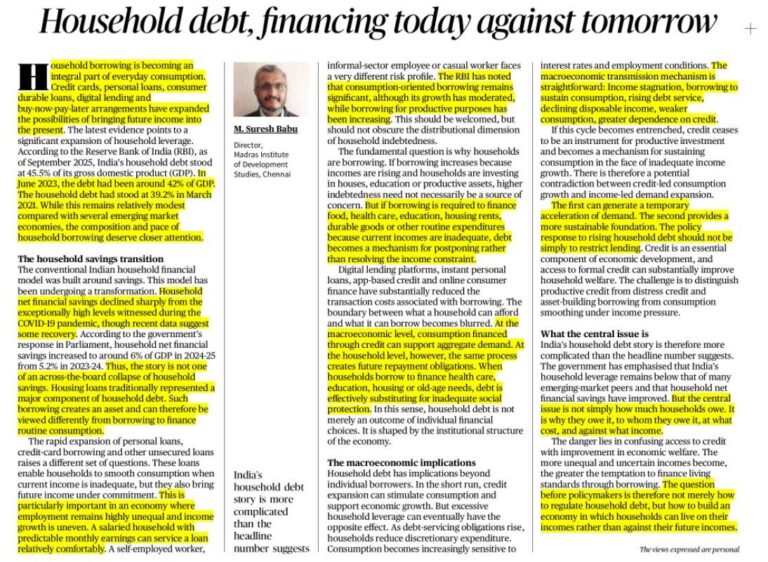
India’s household borrowing has become an increasingly important part of household consumption and financial behaviour. According to the article, India’s household debt stood at 45.5% of GDP in September 2025, compared with around 42% in June 2023 and 39.2% in March 2021. While the level remains relatively modest compared with several emerging economies, the changing composition of household debt requires attention.
Changing Household Borrowing in India
India’s household financial system has traditionally been built around savings. However, household borrowing has increasingly expanded through personal loans, credit cards, consumer durable loans, digital lending and buy-now-pay-later arrangements.
The article highlights a transition in household savings, with net financial savings declining sharply during the COVID-19 period before showing some recovery. At the same time, borrowing for housing, education and productive assets can create long-term assets and may be viewed differently from borrowing for routine consumption.
Rise of Consumption-Oriented Borrowing
The expansion of unsecured personal loans and digital credit has made borrowing more accessible. These instruments can help households manage temporary income constraints, but excessive consumption-oriented borrowing can create future repayment obligations.
The Reserve Bank of India has noted the significance of consumption-oriented borrowing, although its growth has moderated. A key concern is distinguishing productive credit from credit used primarily to finance everyday consumption.
Macroeconomic Implications
Household debt can influence the wider economy through the credit-demand-consumption cycle. In the short term, increased borrowing can support consumption and economic activity. However, excessive debt servicing can reduce households’ discretionary expenditure and make consumption more sensitive to interest rates and employment conditions.
If income growth remains weak while borrowing continues to support consumption, households may experience greater repayment pressure. This can create a difficult macroeconomic situation involving income stagnation, rising debt servicing, weaker consumption and greater dependence on credit.
Conclusion
India’s household debt story needs to be understood beyond the headline debt-to-GDP ratio. The purpose of borrowing, household income, repayment capacity and type of credit are equally important. The challenge is to expand access to formal credit while ensuring that borrowing supports productive investment and household welfare rather than becoming a substitute for inadequate income growth.
Vocabulary
1. Household Leverage – Household debt relative to its financial capacity.
2. Unsecured Credit – Loans without collateral.
3. Debt Servicing – Repayment of principal and interest.
Prelims MCQs
MCQ 1
Which of the following may indicate household financial stress?
1. Rising unsecured borrowing
2. Borrowing for routine consumption
3. Increasing debt-servicing obligations
A) 1 and 2 only
B) 2 and 3 only
C) 1 and 3 only
D) 1, 2 and 3
Answer: D
UPSC Mains Question
“The concern with household debt is not merely how much households owe, but why they borrow and against what income.” Discuss. (10 Marks)
Frequently Asked Questions (FAQs)
What is household debt?
Household debt refers to the outstanding borrowings of households through instruments such as housing loans, personal loans, consumer credit and other forms of borrowing.
What was India’s household debt-to-GDP ratio mentioned in the article?
The article states that household debt stood at 45.5% of GDP in September 2025.
Why is consumption-oriented borrowing a concern?
Borrowing for consumption can help households manage temporary income shortages, but excessive borrowing may create future repayment obligations and debt-servicing pressure.
How can household debt affect the economy?
Higher borrowing can initially support consumption and economic activity, while excessive debt servicing can later reduce discretionary spending and make consumption more sensitive to interest rates and employment conditions.
What is the key policy challenge regarding household debt?
The key challenge is to distinguish productive credit from distress-driven or consumption-oriented borrowing and ensure that credit access contributes to sustainable household welfare.
Source From : The Hindu
ECI and Court: Challenges to Trust in Independent Institutions
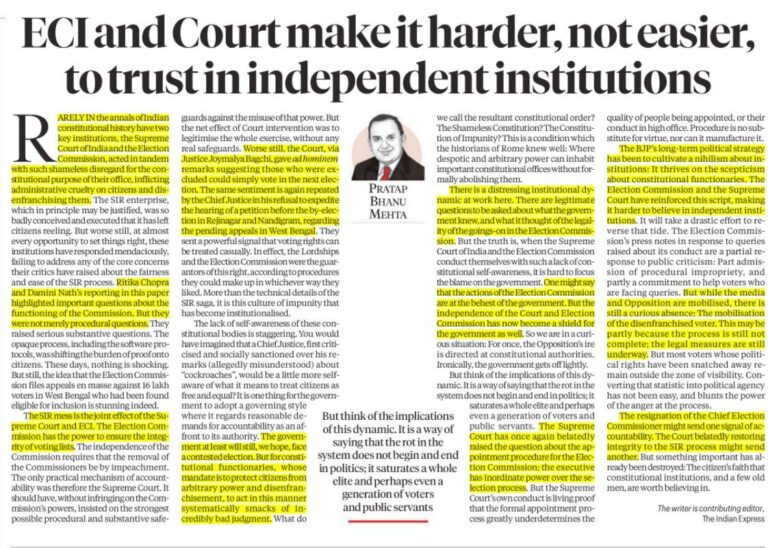
The Election Commission of India (ECI) and the judiciary are central constitutional institutions responsible for protecting democratic processes and the rule of law. Recent debates surrounding the Special Intensive Revision (SIR) of electoral rolls have brought renewed attention to questions of institutional independence, transparency, accountability and public confidence. The ECI states that SIR is intended to ensure that no eligible elector is excluded and no ineligible person is included in electoral rolls.
ECI, Electoral Rolls and Institutional Trust
The Election Commission derives its constitutional authority primarily from Article 324, while electoral-roll revision is also governed by the Representation of the People Act, 1950 and the Registration of Electors Rules, 1960. The ECI has described accurate and updated electoral rolls as fundamental to the democratic process.
The SIR exercise has nevertheless generated debate over the procedures used to verify electors and address exclusions. The Supreme Court’s 2026 judgment concerning Bihar’s SIR examined whether the ECI had the power to conduct the exercise, whether the process was proportionate, and whether the Commission could undertake a limited inquiry into citizenship for electoral-roll eligibility. The Court ultimately upheld the Bihar SIR while recognising procedural safeguards under electoral law.
Why Institutional Independence Matters
Independent constitutional institutions are expected to exercise their powers impartially and transparently. Public trust depends not only on the formal powers granted to institutions but also on due process, reasoned decisions, transparency and accountability.
The article highlights concerns that prolonged controversies surrounding electoral-roll revision can influence perceptions of institutional credibility. At the same time, the ECI has introduced mechanisms such as Special Roll Observers and public access to electoral-roll information during SIR exercises.
India and Global AI Governance
The debate over ECI, SIR and electoral reforms ultimately highlights the importance of balancing electoral integrity with procedural fairness. A credible electoral system requires accurate voter rolls, transparent verification, opportunities for claims and objections, and effective judicial oversight. Strengthening these safeguards can help ensure that electoral administration remains consistent with constitutional principles and sustains public confidence in democratic institutions.
Vocabulary
1. Disenfranchisement – Denial of voting rights.
2. Institutional Integrity – Adherence to constitutional duties.
3. Accountability – Responsibility for official actions.
Prelims MCQs
MCQ 1
Consider the following:
1. Article 324 empowers the ECI.
2. Electoral-roll integrity supports free and fair elections.
A) 1 only
B) 2 only
C) Both 1 and 2
D) Neither
Answer: C
UPSC Mains Question
“Institutional independence and accountability are essential for public trust.” Discuss. (10 Marks)
Frequently Asked Questions (FAQs)
What is the Special Intensive Revision (SIR) of electoral rolls?
SIR is an intensive exercise to verify and update electoral rolls, with the stated objective of ensuring that eligible citizens are included and ineligible persons are excluded.
Which Constitutional Article gives powers to the Election Commission?
Article 324 provides for the superintendence, direction and control of elections to Parliament, State Legislatures, and the offices of President and Vice-President.
Why is electoral-roll accuracy important?
Accurate electoral rolls help ensure that eligible voters can participate in elections while preventing duplicate or otherwise ineligible entries.
What did the Supreme Court examine regarding SIR?
The Court examined the ECI’s authority to conduct SIR, the legitimacy and proportionality of the exercise, procedural compliance, and the scope of citizenship-related inquiry.
How can public trust in electoral institutions be strengthened?
Greater transparency, procedural safeguards, accessible claims and objections, reasoned decisions and effective judicial review can strengthen confidence in electoral administration.