
Table of Contents
ToggleMecca Joint Defence Agreement
August 2026, marking a new phase of defence cooperation among three influential Muslim-majority countries.
The agreement aims to establish a framework for collective defence, strategic coordination and regional security cooperation amid growing geopolitical tensions in West Asia.
The pact has gained significance due to the strategic combination of Saudi Arabia’s economic and energy influence, Türkiye’s military capabilities and Pakistan’s nuclear capability.
What is the Mecca Joint Defence Agreement?
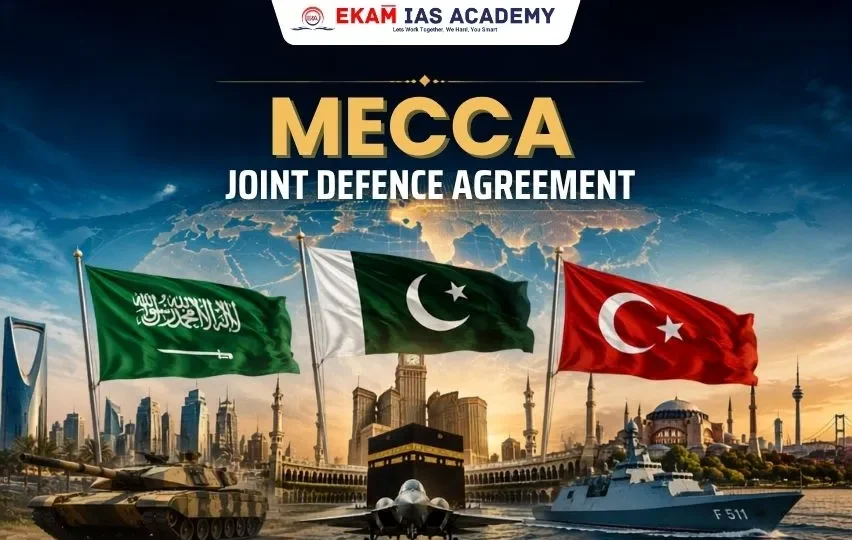
The Mecca Joint Defence Agreement is a trilateral defence pact between:
- Saudi Arabia
- Pakistan
- Türkiye
The agreement is designed to strengthen collective deterrence against external threats and promote peace, security and stability in the region.
It builds upon the earlier Saudi Arabia–Pakistan Strategic Mutual Defence Agreement signed in 2025, which focused on mutual support in case of external aggression.
Objectives of the Agreement
The key objectives of the Mecca Defence Pact include:
Collective Security
The agreement establishes the principle that an armed attack against one member country would be considered an attack against all three members.
Defence Cooperation
It seeks to enhance cooperation in areas such as:
- Military coordination
- Defence planning
- Security collaboration
- Strategic preparedness
Regional Stability
The pact aims to strengthen deterrence and contribute towards maintaining peace and security in West Asia and surrounding regions.
Key Features of the Mecca Defence Pact
Mutual Defence Clause
The central feature of the agreement is the collective defence principle:
- Any armed aggression against one member would trigger support from the other two members.
- The clause reflects the concept of collective security followed by alliances such as NATO.
However, the agreement does not clearly define the exact military commitments or response mechanisms of each country.
Enhanced Defence Partnership
The pact provides a platform for:
- Greater military cooperation
- Exchange of defence expertise
- Joint strategic coordination
It aims to improve cooperation among three countries with significant geopolitical influence.
Strategic Importance of the Three Countries
Saudi Arabia
- The leading military power in the Gulf region.
- One of the world’s largest oil exporters.
- Holds significant economic and diplomatic influence in West Asia.
Türkiye
- A member of NATO.
- Possesses one of the largest militaries within the alliance.
- Plays a major role in regional security affairs.
Pakistan
- The only nuclear-armed Muslim-majority country.
- Brings significant military capability and strategic importance to the partnership.
Together, the three countries create a strategic triangle combining:
Saudi Arabia → Energy and financial influence
Türkiye → NATO-linked military capability
Pakistan → Nuclear capability and military strength
Regional Context of the Agreement
The pact comes at a time of increasing instability in West Asia.
Major factors influencing the agreement include:
- Rising tensions between Iran and Saudi Arabia.
- Security concerns among Gulf countries.
- Threats from regional conflicts and non-state armed groups.
The agreement is projected as a defensive arrangement aimed at strengthening regional deterrence.
Why Does the Agreement Matter for India?
Impact on India’s Strategic Interests
India maintains important relations with:
- Saudi Arabia
- Türkiye
- Iran
- Israel
- Gulf Cooperation Council (GCC) countries
The emergence of a new defence grouping may require India to carefully balance its diplomatic engagements in West Asia.
Energy Security
West Asia is a crucial source of crude oil and natural gas for India.
Any increase in regional instability could impact:
- Oil prices
- Energy supplies
- India’s economic stability
Indian Diaspora Concerns
Millions of Indians live and work in Gulf countries.
Regional conflicts can affect:
- Employment opportunities
- Safety of Indian citizens
- Remittance flows
Pakistan Factor
The agreement may enhance Pakistan’s strategic importance beyond South Asia.
India will closely monitor whether the pact influences Pakistan’s regional and international positioning.
Key Uncertainties and Challenges
Despite its strategic significance, several questions remain:
Lack of Clear Operational Mechanism
The agreement does not specify:
- Military obligations
- Deployment mechanisms
- Nature of assistance during conflicts
Internal Differences
Differences in foreign policy priorities among Saudi Arabia, Pakistan and Türkiye could affect the practical implementation of the pact.
Comparison with NATO
Although the agreement follows a collective defence principle, it is not equivalent to NATO.
Unlike NATO:
- It does not have an integrated military command structure.
- It does not establish a permanent joint defence organisation.
Mecca Agreement and NATO Article 5: A Comparison
NATO Article 5
- Based on collective defence.
- An attack against one NATO member is considered an attack against all members.
- Provides a formal alliance framework.
Mecca Joint Defence Agreement
- Also follows the principle of collective defence.
- However, it is a regional trilateral arrangement.
- Specific commitments and operational mechanisms remain undefined.
Conclusion
The Mecca Joint Defence Agreement represents a significant development in West Asian security dynamics by bringing together three strategically important nations.
While the pact has the potential to enhance defence coordination and regional deterrence, its actual impact will depend on the clarity of military commitments, geopolitical developments and the ability of the three countries to maintain strategic cooperation.
For India, the agreement highlights the need for continued diplomatic engagement with West Asia while safeguarding interests related to energy security, trade, diaspora protection and regional stability.



FAQ: Mecca Joint Defence Agreement
What is the Mecca Joint Defence Agreement?
The Mecca Joint Defence Agreement is a trilateral defence pact between Saudi Arabia, Pakistan and Türkiye aimed at strengthening collective security and defence cooperation.
What is the main objective of the Mecca Defence Pact?
The agreement aims to enhance collective deterrence, improve military coordination and promote regional peace and stability in West Asia.
What is the key feature of the Mecca Joint Defence Agreement?
The central feature is the collective defence principle, where an armed attack against one member is considered a threat to all three members.
How is the Mecca Defence Pact different from NATO?
Unlike NATO, the pact does not have an integrated military command structure, permanent defence organisation or clearly defined military response mechanisms.
Why is the Mecca Joint Defence Agreement important for India?
The agreement is significant for India due to its impact on energy security, Gulf relations, Indian diaspora interests and regional strategic stability.