

Table of Contents
ToggleGUJARAT PORT CONCESSIONS AND BOOT MODEL
TOPIC: (GS3) ECONOMY: THE HINDU
Gujarat’s first generation of private ports are nearing the end of their 30year BOOT concession periods. The state government has yet to announce a clear extension framework, raising concerns over investment certainty and the future of port policy.
BOOT Model and Public Private Partnership
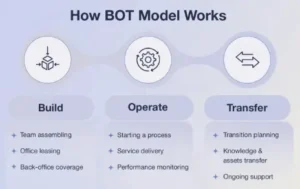
- BuildOwnOperateTransfer (BOOT): Private developer builds and owns infrastructure for a fixed period, operates it to recover costs, then transfers it back to the government.
- Ensures private capital infusion while preserving longterm public ownership of strategic assets.
- Widely used in ports, highways, and power projects across India.
Public–Private Partnership (PPP)
- PPP is a contractual agreement where the private sector invests, builds, and operates projects, while the government provides regulatory oversight and ownership rights.
- It balances public interest with private efficiency and capital infusion.
Key Features
- Risk Sharing: Risks (financial, operational, technical) are shared between government and private partner.
- Longterm Contracts: Usually 20–60 years depending on project type.
- Ownership: Varies by model — BOT, BOOT, HAM, EPC, etc.
- Revenue Mechanism: User charges (tolls, tariffs), annuity payments, or government support.
Gujarat’s Port Privatisation Framework
- Introduced in 1997, Gujarat pioneered BOOT concessions for maritime projects.
- Helped Gujarat emerge as India’s largest maritime state, handling a major share of cargo traffic.
- Attracted billions in private investment, making ports like Mundra global hubs.
Ports in Focus
- Pipavav Port: Operated by APM Terminals; concession ends Sept 2028.
- Mundra Port: Operated by Adani Ports; concession ends Feb 2031.
- Both require clarity on extension to justify fresh capital commitments in dredging, mechanisation, and connectivity.
Investment Concerns
- Longterm projects need policy certainty for payback.
- APM Terminals signed a ₹17,000crore MoU but deferred major investments pending clarity.
- Adani Ports expects Pipavav’s decision to set precedent for Mundra.
Comparison with Other States
- Andhra Pradesh: 30 years + 20year extension (up to 50 years).
- Kerala (Vizhinjam): 40 years + 20year extension (up to 60 years).
- Odisha (Dhamra): 34 years, extendable.
- Longer concessions elsewhere highlight Gujarat’s need to match rivals for competitiveness.
Signals from Gujarat’s Shipbuilding Policy
- New shipyards can secure 50year waterfront concessions.
- Upcoming greenfield ports (Nana Layja, Vadhera, Damka, Lakhanka, Bhogat, etc.) may get 30–50 year tenures.
- Indicates recognition that multibillion investments require long horizons.
Significance
- Shapes Gujarat’s role in India’s maritime economy.
- Provides a template for PPP models in strategic infrastructure.
- Impacts FDI inflows, logistics competitiveness, and coastal employment.
MAJOR PPP MODELS
BOT – BuildOperateTransfer
- Private entity builds and operates the project for a fixed period.
- Ownership remains with the government throughout.
- Example: Many national highways under NHAI were developed using BOT.
BOOT – BuildOwnOperateTransfer
- Variant of BOT where the private player owns the asset during concession.
- At the end of tenure, ownership reverts to the government.
- Example: Pipavav and Mundra Ports in Gujarat.
BOLT – BuildOwnLeaseTransfer
- Private party builds and owns the asset, then leases it to the government for use.
- After lease period, asset is transferred back.
- Example: Certain railway projects and telecom infrastructure.
Conclusion:
Gujarat’s decision on port concessions will be a litmus test of policy certainty, determining whether India can sustain private investment while safeguarding longterm public control of strategic maritime assets.
DELIMITATION DEBATE AND THE 2027 CENSUS
TOPIC: (GS2) POLITY: THE HINDU
The Union Government is preparing for a fresh delimitation exercise after the 2027 Census, which will reallocate Lok Sabha seats among States. The debate has intensified as proposals include raising Lok Sabha strength to 850 seats and reserving onethird seats for women.
What is Delimitation
- It is the process of fixing seat numbers and redrawing constituency boundaries based on Census data.
- Two parts:
- Reallocation of seats among States/UTs.
- Redrawing boundaries within States.
- Conducted by an independent Delimitation Commission, whose orders carry the force of law.
Constitutional Provisions
- Article 81: Lok Sabha composition; seats allocated on national average population per seat.
- Article 82: Readjustment after every Census.
- Ceiling: Maximum Lok Sabha seats capped at 550 (currently 543 elected).
Freeze on Seat Reallocation
- Last reallocation: 1973 (1971 Census).
- 42nd Amendment (1976) and 84th Amendment (2001) froze seat reallocation until after the 2026 Census.
- The 2002 Delimitation Commission only redrew boundaries within States, implemented in 2008 elections.
Current Proposals
- Expand Lok Sabha to 850 seats.
- Use 2011 Census for reallocation (requires amendment).
- Implement women’s reservation alongside delimitation.
Likely Gains and Losses
- Northern States (UP, Bihar, Rajasthan): Likely to gain seats due to higher population growth.
- Southern States (Kerala, Tamil Nadu, Andhra Pradesh, Karnataka): May lose relative share as they stabilised population earlier.
- Creates tension between federal fairness and democratic equality.
Federalism vs Democracy
- Federalism: States should not be penalised for successful population control.
- Democracy: Principle of “one person, one vote, one value” demands equal weight for every vote.
- Balancing these principles is the core challenge.
Gerrymandering Concerns
- Manipulation of boundaries can distort representation even with equal population per seat.
- Cracking and Packing examples show how constituency design can alter electoral outcomes.
- Independent oversight and transparency are essential safeguards.
Way Forward
- Build broad political consensus before amendments.
- Ensure transparent criteria for seat allocation and boundary drawing.
- Provide compensatory mechanisms (e.g., Rajya Sabha seats, fiscal transfers) for States with stabilised populations.
- Public awareness campaigns to explain implications for representation.
Conclusion:
The upcoming delimitation will be a defining test of India’s ability to balance democratic equality with federal fairness, shaping the future of parliamentary representation.
BANKERS’ BOOKS EVIDENCE BILL 2026 AND LEGAL SAFEGUARDS
TOPIC: (GS3) ECONOMY: THE HINDU
The Lok Sabha has passed the Bankers’ Books Evidence Bill, 2026, replacing the colonialera 1891 Act. The Bill modernises rules for admitting digital banking records as evidence but raises concerns over data privacy and cyber safeguards.
Why the Old Law Needed Change
- The 1891 Act dealt with physical ledgers and microfilm records.
- With banking now digital, courts required a framework for electronic records, cloud storage, and virtual databases.
- The new Bill aligns with contemporary banking practices and reduces reliance on physical production of documents.
Key Provisions of the 2026 Bill
- Expanded Definition: “Bankers’ books” now include electronic and cloudbased records.
- Digital Evidence Standards: Introduces certificate formats similar to Section 63 of Bharatiya Sakshya Adhiniyam, ensuring authenticity of electronic copies.
- Special Cause Defined: Courts can compel bank officers only if records are doubtful, interrupted, or inspection orders ignored.
- Police Powers: Court orders for record production equated to those from a Superintendent of Police, continuing earlier provisions.
Benefits of the Bill
- Reduces delays in litigation (e.g., cheque bounce cases).
- Prevents unnecessary summoning of bank officials.
- Standardises digital evidence formats, improving judicial efficiency.
- Recognises modern banking realities like cloud storage and centralised databases.
Concerns Raised
- Data Privacy Risks: Electronic records are easier to copy and leak compared to physical ledgers.
- No Hash Value Verification: Absence of digital fingerprints to prove files are tamperproof.
- Certification Burden: Branch heads asked to certify cybersecurity, though they lack technical knowledge of centralised systems.
- Section 4 Issue: Government can extend provisions to fintechs or digital lenders via notification, risking misuse without Parliamentary scrutiny.
- Litigation Risk: Wholesale replacement may cause confusion in ongoing trials.
Way Forward
- Introduce tamperproof safeguards like hash values for digital files.
- Shift certification responsibility to technical officers instead of branch managers.
- Ensure court oversight before police access to sensitive records.
- Build a data protection framework aligned with the DPDP Act, 2023.
- Provide clarity for pending cases to avoid interpretational disputes.
Conclusion:
The Bill modernises India’s evidence law for the digital banking era, but without strong privacy and cybersecurity safeguards, it risks opening new vulnerabilities even as it resolves old ones.
INDIA’S MODEL BILATERAL INVESTMENT TREATY (BIT)
TOPIC: (GS3) ECONOMY: THE HINDU
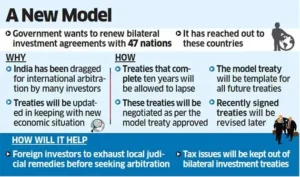
The Union Finance Ministry is reviewing India’s 2015 Model Bilateral Investment Treaty (BIT) to make it more investorfriendly while protecting sovereign interests. The revised draft will soon be placed before the Union Cabinet for approval.
Background of BIT
- A BIT is an agreement between two countries to promote and protect investments made by investors of each nation.
- It ensures fair treatment, protection against unlawful expropriation, and allows InvestorState Dispute Settlement (ISDS) through international arbitration.
- Unlike trade agreements, BITs permit investors to directly sue host governments, increasing legal exposure but enhancing investor confidence.
Why the Review is Needed
- Experience from past negotiations revealed restrictive clauses that deterred new BITs.
- Global best practices now emphasize balanced investor protection and hoststate autonomy.
- Rising Overseas Direct Investment (ODI) by Indian firms demands reciprocal protection abroad.
- India’s shift from a capitalimporting to a capitalexporting economy requires updated treaty safeguards.
Key Issues in the 2015 Model BIT
- The Local Remedies Clause mandates investors to exhaust domestic legal options for five years before arbitration — seen as restrictive by developed nations.
- This clause slowed India’s ability to conclude new BITs.
- The government now considers a negativelist approach, keeping only critical sovereign concerns nonnegotiable while offering flexibility elsewhere.
FDI and ODI Trends
- Gross FDI: Rose from $82 billion (202021) to $95 billion (202526).
- Net FDI: Fell from $44 billion (202021) to below $1 billion (202425), recovering to $7 billion (202526).
- ODI: Increased from $11 billion (202021) to $34 billion (202526).
- The decline in net FDI reflects largescale repatriation exceeding $105 billion (202425 – 202526).
Significance of Revision
- Modernised Investment Framework: Updates India’s treaty model to align with evolving global standards and investor expectations.
- Investor Confidence & Predictability: Creates a transparent and stable environment for both domestic and foreign investors.
- Protection for Indian Firms Abroad: Extends safeguards to Indian enterprises investing overseas, reflecting India’s growing global footprint.
- Macroeconomic Stability: Supports Balance of Payments resilience by ensuring steady capital flows and reducing volatility.
- Regulatory Balance: Strikes equilibrium between sovereign policy space and investor protection, ensuring sustainable governance.
Challenges Ahead
- Investor Rights vs Sovereignty: Finding the right balance between protecting investors and preserving national regulatory autonomy.
- Global Acceptance: Negotiating terms that appeal to developed economies while safeguarding India’s interests.
- Legal Prudence: Preventing misuse of InvestorState Dispute Settlement mechanisms and limiting costly international arbitration.
- Reviving Net FDI: Addressing declining net FDI amid global localisation and supplychain realignment trends.
Conclusion:
India’s review of the Model BIT marks a strategic shift — from merely protecting foreign investors to empowering Indian enterprises globally, ensuring a fair, transparent, and sovereignfriendly investment regime.
DPDP ACT VS RTI ON TRANSPARENCY AND PRIVACY
TOPIC: (GS2) POLITY: THE HINDU
The Supreme Court is examining whether the Digital Personal Data Protection (DPDP) Act, 2023 undermines the Right to Information (RTI) Act, 2005.
Core Legal Question
- Both RTI and DPDP Acts are central legislations, requiring harmonisation.
- RTI allows disclosure with a publicinterest override, while DPDP imposes a blanket embargo on personal data.
- The Court is assessing whether the later law is repugnant to the earlier RTI framework.
Scope of the Two Laws
- RTI Act (2005): Covers all forms of data — physical and digital.
- DPDP Act (2023): Applies only to digital data, but since most data today is digital, its impact is wide.
- Concern: DPDP’s restrictive approach may effectively dilute RTI’s transparency mandate.
Section 44(3) Change
- Earlier RTI Clause: Personal data could be denied only if unrelated to public activity or an invasion of privacy, but disclosure was allowed if public interest outweighed privacy.
- After Amendment: The publicinterest override is removed. All personal data is exempt, regardless of its relevance to corruption or misconduct.
- This shifts RTI from a casebycase balancing test to a blanket exemption.
Impact on RTI and Journalism
- Transparency Concerns: Information exposing corruption or misuse of power can now be denied by labelling it “personal.”
- Investigative Journalism: Journalists must seek consent of the “data principal” and face erasure requests, undermining reporting.
- No Special Status: The Court clarified journalists are not a separate category under RTI or constitutional jurisprudence, but acknowledged the chilling effect on press freedom.
Significance of the Case
- Tests India’s ability to balance privacy rights (Article 21) with citizens’ right to information (Article 19(1)(a)).
- Determines whether data protection safeguards meant for citizens can be misused by the State to avoid accountability.
- Impacts governance, transparency, and the role of media in a digital age.
RIGHT TO PRIVACY
The Right to Privacy in India is a constitutionally protected fundamental right, primarily derived from Article 21 (Right to Life and Personal Liberty), and reinforced through judicial interpretation linking it with Articles 14 and 19. It safeguards dignity, autonomy, and freedom from arbitrary state intrusion.
Constitutional Basis
- Article 21: Protects life and personal liberty; interpreted to include privacy as intrinsic to dignity and autonomy.
- Article 14: Equality before law — privacy ensures protection against arbitrary state action.
- Article 19: Freedom of speech, association, and movement — privacy is essential for exercising these freedoms without undue interference.
Judicial Evolution
- M.P. Sharma v. Satish Chandra (1954): Initially held privacy was not a fundamental right.
- Kharak Singh v. State of U.P. (1962): Reiterated no explicit privacy right, but hinted at personal liberty protection.
- Govind v. State of M.P. (1975): Recognised privacy as a fundamental right, subject to reasonable restrictions.
- Justice K.S. Puttaswamy v. Union of India (2017): Landmark 9judge bench ruling — privacy declared a fundamental right under Articles 14, 19, and 21. Established the threefold test:
- Legality – backed by law.
- Legitimate Aim – serves a valid state objective.
- Proportionality
Conclusion:
The Supreme Court’s ruling will define whether India’s digital privacy law strengthens citizen rights or becomes a tool for shielding the State from scrutiny, shaping the future of transparency and journalism.
JANTAR MANTAR ASTRONOMICAL HERITAGE AND DELHI’S PROTEST DEBATE
TOPIC: (GS2) POLITY: THE HINDU
The Delhi High Court has raised concerns about the continued use of Jantar Mantar Road as a protest site.
Historical and Scientific Significance
- Built in 1724 by Maharaja Sawai Jai Singh II, Jantar Mantar is part of a network of five observatories (Delhi, Jaipur, Ujjain, Varanasi, Mathura).
- The term derives from Sanskrit: Yantra (instrument) + Mantra (formula).
- Instruments include:
- Samrat Yantra – giant sundial for time measurement.
- Jai Prakash Yantra – determines celestial positions.
- Ram Yantra – measures altitude and azimuth.
- Misra Yantra – compares local time with other regions.
- Delhi’s Jantar Mantar is protected by the Archaeological Survey of India (ASI), while Jaipur’s is a UNESCO World Heritage Site.

Evolution as a Protest Site
- Initially, Boat Club lawns (Kartavya Path) hosted major rallies postIndependence.
- After the 1988 farmers’ rally led by Mahendra Singh Tikait and security concerns during the Ram Janmabhoomi movement, protests shifted.
- By 1993, Delhi Police began directing demonstrations to Jantar Mantar for crowd control.
- Formal regulation came through Standing Order 309 (2003) and later Standing Order 10 (2018), limiting Jantar Mantar protests to 1,000 participants.
Major Movements at Jantar Mantar
- Anna Hazare’s anticorruption movement (2011).
- Nirbhaya protests (2012).
- One Rank One Pension (OROP) agitation.
- Farmers, students, women’s groups, and civil society organisations have used the site.
Contentious Issues
- Traffic congestion and noise pollution in central Delhi.
- Security concerns near Parliament and government offices.
- NGT (2017) ordered a ban citing residential zoning and pollution.
- Supreme Court (2018) ruled protests cannot be completely prohibited, directing guidelines to balance citizens’ rights with public order.
Current Debate
- The High Court suggested shifting protests to Ramlila Maidan, which can host larger gatherings but requires payment (~₹50,000/day).
- Jantar Mantar remains symbolic for grassroots democratic expression, but authorities stress the need to protect heritage and reduce disruption.
Conclusion:
Jantar Mantar embodies both India’s scientific heritage and its democratic spirit, making the current debate a test of how India balances heritage preservation, public order, and citizens’ right to protest.

CENTRALISED PUBLIC GRIEVANCE REDRESS AND MONITORING SYSTEM (CPGRAMS)
TOPIC: (GS2) POLITY: THE HINDU
Over the last decade, CPGRAMS has grown into one of the world’s largest digital grievance redressal platforms. The system is being highlighted for its role in citizencentric governance and accountability.
About CPGRAMS
- Flagship grievance redressal portal of the Government of India, developed by the Department of Administrative Reforms and Public Grievances (DARPG).
- Functions as a 24×7 digital ecosystem connecting all Central Ministries, Departments, States, and Union Territories.
- Promotes citizen participation and administrative accountability.
Key Features
- One Nation–One Portal: Unified grievance system integrating state portals.
- Language Inclusivity: Supports submissions in 22 scheduled languages plus English.
- Timebound Resolution: Complaints must be resolved within 21 days.
- Tracking Facility: Citizens can monitor grievance status using a unique registration ID.
- Appeal Mechanism: If dissatisfied, complainants can rate the resolution and file an appeal; appeals are also trackable.
Significance
- Strengthens digital governance and citizen trust.
- Reduces bureaucratic delays by providing direct access to ministries.
- Encourages feedbackbased accountability, aligning with Good Governance Index principles.
- Acts as a model for egovernance reforms, comparable to grievance systems in advanced democracies.
Conclusion:
CPGRAMS exemplifies India’s push towards transparent, responsive, and citizencentric governance, making grievance redressal accessible to every citizen in the digital era.