
Table of Contents
ToggleJagannath Festival
Why in News?
Ahead of Rath Yatra 2026, which began on 16 July in Puri, President Droupadi Murmu shared her personal devotion to Lord Jagannath. She recalled how Lord Jagannath’s message of equality, compassion and selfless service guided her through personal hardships and continues to inspire her public life.
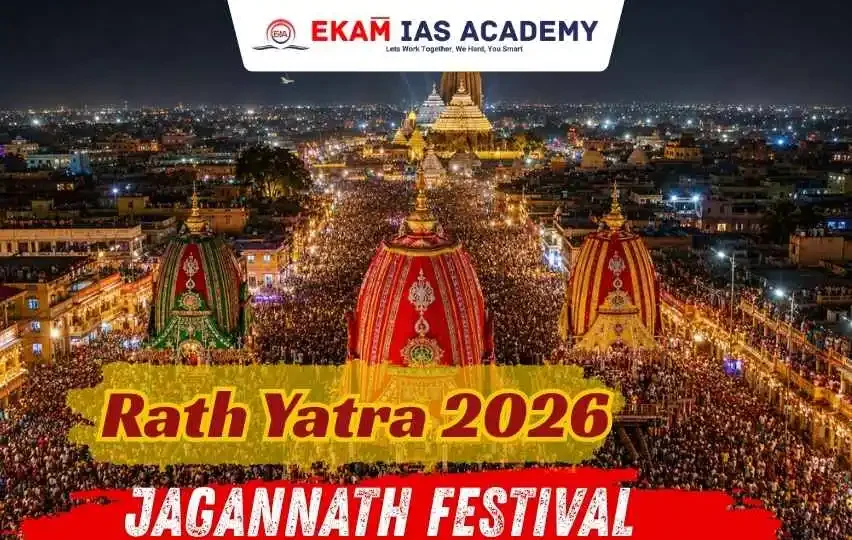
The festival marks the ceremonial journey of Lord Jagannath, Lord Balabhadra, Devi Subhadra and Sudarshana from the sanctum of the Jagannath Temple to the Gundicha Temple. Rath Yatra 2026 began in Puri with lakhs of devotees joining the grand chariot procession.
What is Jagannath Rath Yatra?
Jagannath Rath Yatra is one of India’s most important religious festivals, celebrated every year in Puri, Odisha. It marks the annual journey of Lord Jagannath, Lord Balabhadra and Goddess Subhadra from the main Jagannath Temple to the Gundicha Temple, located around three kilometres away.
The festival begins on Ashadha Shukla Dwitiya, the second day of the bright fortnight of the Hindu month of Ashadha. It is a nine-day celebration and attracts devotees from across India and abroad.
Symbolism of Rath Yatra
Rath Yatra carries deep spiritual and social symbolism. During the festival, the deities come out of the sanctum and move among devotees. This reflects the idea that divinity is accessible to all, beyond barriers of caste, class or social position.
The festival symbolises:
- Equality
- Universal accessibility
- Devotion
- Compassion
- Public participation in faith
- Cultural unity
It also reflects the inclusive philosophy of Lord Jagannath, who is seen as a deity of the masses.
Architecture of Jagannath Temple, Puri
The Jagannath Temple in Puri is one of India’s most sacred temples and an outstanding example of Kalinga architecture. It is also one of the four major Char Dham pilgrimage centres, along with Badrinath, Dwarka and Rameswaram.
The temple is often referred to as the “White Pagoda.” It is traditionally associated with King Anantavarman Chodaganga Deva of the Eastern Ganga dynasty in the 12th century CE.
Important Architectural Features
The temple is designed in the Kalinga architectural style, known for its curvilinear shikhara, sculptural decoration and intricate carvings.
The temple complex has four entrances facing the four cardinal directions. These entrances are guarded by symbolic animal figures and reflect the temple’s grand sacred geography.
The main temple consists of four principal structures:
| Structure | Significance |
|---|---|
| Vimana or Deula | Sanctum sanctorum housing the deities |
| Jagamohana | Assembly or prayer hall |
| Nata Mandira | Festival and dance hall |
| Bhoga Mandapa | Hall where offerings are prepared and presented |
These elements are key features of Odisha’s temple architecture and show the advanced sacred design tradition of medieval eastern India.
Cultural Significance
Rath Yatra is not only a religious event but also a major cultural expression of Odisha. It brings together devotion, music, rituals, temple traditions, craftsmanship and public participation.
The construction of chariots, ceremonial pulling of the raths, participation of devotees and rituals linked to the journey make it one of the largest living traditions in India.
Conclusion
Rath Yatra 2026 highlights the living cultural heritage of India. The festival reflects devotion, equality and inclusiveness, while the Jagannath Temple stands as a magnificent example of Kalinga architecture. For UPSC aspirants, this topic is important for understanding India’s temple traditions, religious festivals and the continuity of cultural practices in public life.



Rath Yatra-FAQs Answered
Why is Rath Yatra 2026 in news?
Rath Yatra 2026 is in news because President Droupadi Murmu shared her personal devotion to Lord Jagannath ahead of the festival beginning on 16 July in Puri.
What is Jagannath Rath Yatra?
Jagannath Rath Yatra is the annual chariot festival in which Lord Jagannath, Lord Balabhadra and Devi Subhadra travel from the Jagannath Temple to the Gundicha Temple in Puri.
When does Rath Yatra begin?
Rath Yatra begins on Ashadha Shukla Dwitiya, the second day of the bright fortnight of the Hindu month of Ashadha.
What does Rath Yatra symbolize?
Rath Yatra symbolizes equality, inclusiveness, universal accessibility, compassion and devotion, as the deities come out of the temple sanctum to bless devotees.
What is special about Jagannath Temple architecture?
Jagannath Temple is built in the Kalinga architectural style and includes key structures such as the Vimana, Jagamohana, Nata Mandira and Bhoga Mandapa.