

...
Daily Current affairs 17 July 2026

Daily Current Affairs 17-July-2026

Share this Post

CABINET CLEARS SEMICON 2.0, MOBILE MANUFACTURING, UREA PLANTS AND HIGHWAY PROJECTS

TOPIC: (GS3) ECONOMY: THE HINDU

The Cabinet Committee on Economic Affairs (CCEA) approved major schemes including Semicon Mission 2.0 (₹1.27 lakh crore), a new mobile manufacturing scheme, nine gasbased urea plants, and highway projects in Varanasi.

Semicon Mission 2.0

  • Outlay: ₹1.27 lakh crore; expected to attract ₹4 lakh crore investment.
  • Goal: Build endtoend semiconductor ecosystem — design, development, production, raw materials, AIchip requirements.
  • Comparison: ISM 1.0 had ₹76,000 crore; approved 12 projects including Tata Electronics.
  • Strategic timing: Global chip shortages and rising AI demand make domestic capacity critical.

Mobile Phone Manufacturing Scheme (MPMS)

  • Outlay: ₹62,500 crore.
  • Features: Incentives 2.25–5% on sales; extra 1.5% for local sourcing; 3% for R&D and design.
  • Expected outcomes: ₹39 lakh crore cumulative production, export growth, 60,000 direct jobs, patents in design.
  • Focus: Build strong Indian brands and reduce dependence on imports.

National Investment Policy for Urea (NIPU 2026)

  • Plan: Nine new gasbased plants with 10 million tonnes capacity.
  • Current gap: Demand ~40 MT; domestic output ~30 MT; imports ~10 MT.
  • Policy changes: Transparent cost separation, RoE band (12–16%), forex risk mitigation.
  • Savings: ~₹250 crore per plant compared to NIP 2012.
  • Significance: Fertiliser security for agriculture; equal incentives for private, cooperative and government projects.

Highway Projects

  • Location: Varanasi region.
  • Impact: Better connectivity, reduced congestion, alignment with PM Gati Shakti for integrated infrastructure.
  • Focus: Timely completion, environmental safeguards, sustainable maintenance.

Significance of Cabinet Decisions

  • Manufacturing: Boosts indigenous production in semiconductors, mobiles, fertilisers.
  • Economic growth: Attracts large investments, creates jobs, enhances exports.
  • Strategic autonomy: Reduces vulnerability to global supply shocks, ensures food and tech security.
  • Infrastructure: Strengthens connectivity and logistics efficiency.

Conclusion:

These Cabinet approvals mark a decisive step toward Atmanirbhar Bharat, combining industrial selfreliance with infrastructure expansion to secure India’s economic and strategic future.

INDIA–UK CETA AND ECONOMIC RELATIONS

TOPIC: (GS2) INTERNATIONAL RELATIONS: THE HINDU

The India–UK Comprehensive Economic and Trade Agreement (CETA) came into force on 15 July 2026, alongside the Double Contribution Convention (DCC). It is India’s first fullscale trade pact with a developed country, hailed as a “gold standard” FTA.

India–UK CETA

  • Agreement: Covers 30 chapters — tariffs, digital trade, MSMEs, labour, gender, environment, and procurement.
  • Tariff Elimination by UK: UK removed duties on 99% of Indian exports, giving Indian goods neartotal access.
  • Tariff Elimination by India: India reduced tariffs on ~90% of UK goods, with phased cuts and quotabased concessions.
  • NonTariff Barriers: Agreement addresses SPS (Sanitary & Phytosanitary) and TBT (Technical Barriers to Trade) standards, making compliance easier for exporters.

Gains for India

  • Labourintensive exports: Removal of UK tariffs boosts textiles, footwear, gems & jewellery.
  • Steel exports: Quotas expected to raise exports beyond $1 billion.
  • Services access: Indian IT, consultancy and environmental firms can establish UK branches.
  • Government procurement: Indian suppliers gain entry into UK’s £90 bn market, while retaining preference at home.
  • Worker relief via DCC: 75,000 Indian professionals exempted from double socialsecurity payments, saving ~23% of salaries.

Gains for the UK and Consumers

  • Cheaper imports for India: Tariffs on British cars, whisky, chocolates, cosmetics reduced.
  • Automobiles: Duties on cars cut from 110% to 30% initially, falling to 10% by year five.
  • Alcohol: Whisky tariffs reduced from 150% to 75%, then 40% by year ten.
  • Services: UK firms gain access to Indian markets in accounting, finance, telecom; recognition of UK professional qualifications.

Customs and Regulatory Innovations

  • Selfdeclaration of origin: First time in an Indian FTA, exporters can certify origin themselves.
  • Medical devices: Tariffs removed, reducing dependence on Chinese imports.
  • Precedent: Sets template for future FTAs with EU and US.

Challenges Ahead

  • Carbon Border Adjustment Mechanism (CBAM): India did not secure exemption from UK’s carbon levy starting 2027.
  • Compliance costs: Exporters in steel and cement may face higher costs.
  • Implementation: Requires strong monitoring to ensure SMEs benefit.

Conclusion:

The India–UK CETA is a landmark in India’s trade diplomacy — expanding markets, protecting workers, and setting new standards, though climatelinked trade barriers remain unfinished business.

LADAKH HILL COUNCILS

TOPIC: (GS2) POLITY: THE HINDU

The Ladakh administration has announced Autonomous Hill Development Councils (AHDCs) in all seven districts, expanding beyond Leh and Kargil. Civil society groups, however, oppose the move, citing risks of fragmented authority while talks on an Article 371based framework are still ongoing.

What Has Been Announced

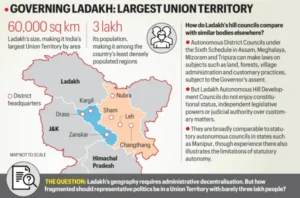
  • Seven AHDCs: New councils in Drass, Sham, Nubra, Changthang and Zanskar, in addition to Leh and Kargil.
  • Government view: Step towards democratic decentralisation; legally permitted under Section 3 of the LAHDC Act, 1997.
  • Parallel plan: Centre and UT exploring a UTlevel representative body under Article 371 with legislative and financial powers.
Ladakh Hill Councils

Why Decentralisation Matters in Ladakh

  • Geography: Largest UT by area (~60,000 sq km) but sparsely populated (~3 lakh).
  • Accessibility: Villages separated by mountain passes; decentralised administration seen as essential for service delivery.
  • Historic demand: Local groups have long sought stronger grassroots governance.

Opposition from Civil Society

  • Groups involved: Apex Body Leh (ABL) and Kargil Democratic Alliance (KDA).
  • Concerns:
    • Seven councils may weaken the proposed Article 371 body.
    • Risk of “maximum government, minimum governance” as existing councils already lack power.
    • Institutional overlap between councils, Panchayats, UT administration and future Article 371 authority.
  • Trust deficit: Linked to UT status in 2019, slow progress on safeguards, Leh protests (2025), detention of Sonam Wangchuk, and perceived favouritism in new district boundaries.

Powers of Hill Councils (on paper vs reality)

  • Statutory powers: District planning, budgets, land management, taxation.
  • Ground reality: Since UT status, decisionmaking shifted to LG’s secretariat; council budgets and staff reduced.
  • Paradox: Government proposes more councils while existing ones remain weak.

Comparison with Other Models

  • Sixth Schedule councils (NE states): Constitutional status, legislative powers, judicial authority over customary matters.
  • LAHDCs: Statutory bodies without constitutional protection; closer to Manipur’s autonomous councils, which face financial dependence and limited autonomy.

Conclusion:

The sevencouncil plan raises a deeper question — whether Ladakh’s future lies in multiple district bodies or a unified Article 371 framework; until clarity emerges, decentralisation will remain entangled in mistrust between the Centre and Ladakh’s civil society.

RAVIDASSIAS

TOPIC: (GS1) INDIAN ART AND CULTURE: THE HINDU

Members of the Ravidassia community in Punjab renewed their demand for recognition of a separate “Ravidassia religion” category in the upcoming Census. The issue reflects wider debates on identity, representation, and castelinked socioreligious movements in India.

About the Ravidassias

  • Community: Dalit group primarily concentrated in Punjab’s Doaba region (districts like Jalandhar, Hoshiarpur, Kapurthala, Nawanshahr).
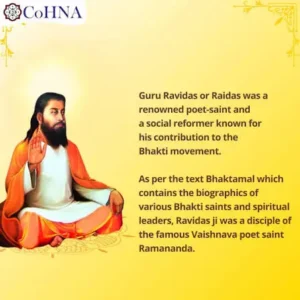
  • Spiritual base: Followers of Guru Ravidas (1377–1527 CE), a Bhakti saint who rejected caste hierarchy and preached equality.
  • Holy text: Amrit Bani of Guru Ravidas, containing ~200 hymns.
  • Sacred site: Seer Goverdhanpur, Varanasi — major pilgrimage centre.

Teachings of Guru Ravidas

  • Begampura vision: An ideal society free from sorrow, fear, and inequality.
  • Philosophy: Emphasis on nirguna bhakti (formless divine), dignity of labour, and human rights.
  • Bhakti movement role: Contemporary of Kabir; disciple of Ramananda; contributed to egalitarian spiritual traditions.
Ravidassias

Current Issues and Demands

  • Separate religion status: Community leaders argue for distinct recognition in Census to preserve identity.
  • Social context: Dalit assertion in Punjab politics; demand linked to representation and dignity.
  • Trust deficit: Concerns that existing categories (Hindu/Sikh) dilute their distinct spiritual identity.

Conclusion:

The Ravidassia demand highlights how spiritual identity and caste emancipation intersect with modern questions of representation and recognition in India’s democracy.

GREATER TUNB ISLAND

TOPIC: (GS2) INTERNATIONAL RELATIONS: THE HINDU

The U.S. Central Command confirmed recent airstrikes on Greater Tunb Island, targeting Iranian defence sites. The incident highlights the island’s strategic role and the longstanding sovereignty dispute between Iran and the UAE.

Location and Features

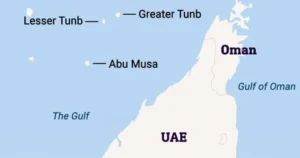
  • Geography: Small island (~10.3 sq km) in the Persian Gulf, near the Strait of Hormuz.
  • Facilities: Iran has built naval bases and an airstrip; used for monitoring maritime traffic.
  • Strategic role: Along with Lesser Tunb and Abu Musa, controls access to the Strait of Hormuz — a chokepoint for ~20% of global oil trade.
Greater Tunb Island

Historical Context

  • 1971 takeover: Iran assumed control of Greater Tunb, Lesser Tunb, and Abu Musa just before UAE’s independence.
  • UAE claim: Abu Dhabi continues to assert sovereignty; the issue remains unresolved in regional diplomacy.
  • Dispute status: Unlike Sixth Schedule or Article 371 protections in India’s federal system, these islands lack any international arbitration framework.

Strategic Importance

  • Energy security: Strait of Hormuz is vital for India’s crude imports and global energy flows.
  • Military leverage: Control of islands allows Iran to monitor and potentially restrict shipping lanes.
  • Regional tensions: Adds to U.S.–Iran rivalry and Gulf security dilemmas.

Conclusion:

Greater Tunb Island exemplifies how small territories can carry outsized strategic weight, making their control central to both regional disputes and global energy security.


MOBILE PHONE MANUFACTURING SCHEME

TOPIC: (GS3) ECONOMY: THE HINDU

The Union Cabinet has approved the Mobile Phone Manufacturing Scheme (MPMS) with an outlay of ₹62,500 crore. The scheme aims to strengthen India’s mobile ecosystem, build indigenous brands, and boost R&Ddriven value addition.

About the Scheme

  • Launch: Approved in 2026 under the Digital India and Atmanirbhar Bharat framework.
  • Tenure: Five years (FY 202627 to FY 203031).
  • Objective: Scale up production, deepen domestic supply chains, and create patents in design and innovation.

Key Features

  • Incentives on sales: Support ranging from 2.25% to 5% for eligible production.
  • Domestic sourcing bonus: Extra 1.5% incentive for using locally made components and subassemblies.
  • R&D push: Additional 3% incentive for design and research to encourage Indian brands.
  • Coverage: Targets both global manufacturers and Indian firms to expand exports and reduce import dependence.

Significance

  • Economic impact: Expected to generate largescale employment and enhance India’s share in global smartphone exports.
  • Strategic autonomy: Reduces reliance on imported components, especially from East Asia.
  • Innovation ecosystem: Encourages patents, indigenous chipsets, and design capabilities.
  • Supply chain resilience: Strengthens local vendors and MSMEs in electronics manufacturing.

Conclusion:

The MPMS is a crucial step towards making India not just a mobile assembly hub but a global leader in design, innovation and technological sovereignty.

CAPACITIES PROGRAMME

TOPIC: (GS3) ECONOMY: THE HINDU

An event titled “Scaling Urban Climate Resilience: The CapaCITIES Legacy and Way Forward” marked a decade of the CapaCITIES programme, showcasing its achievements in strengthening urban climate action. The initiative highlights India’s growing focus on lowcarbon and resilient city development.

About the Programme

  • Launch: Started in 2016 as the Capacity Building Project on Low Carbon and Climate Resilient City Development.
  • Funding: Supported by the Embassy of Switzerland to India and Bhutan.
  • Implementation: Led by ICLEI South Asia, with partners South Pole and econcept; knowledge support from National Institute of Urban Affairs (NIUA).
  • Phases: Phase I (2016–19) and Phase II (2019–23).

Key Features

  • Capacity building: Equipped cities with tools and institutional frameworks for climateresilient governance.
  • City support: Worked with Coimbatore, Tiruchirappalli, Tirunelveli, Ahmedabad, Rajkot, Vadodara, Udaipur, Siliguri, and state governments of Tamil Nadu and Gujarat.
  • Institutional governance: Established permanent NetZero and Climate Action Cells in six cities for longterm monitoring and budgeting.
  • Mainstreaming: Integrated climate resilience into urban planning, infrastructure, and service delivery.

Significance

  • Urban resilience: Helps cities adapt to heatwaves, floods, and air pollution.
  • Policy alignment: Complements National Action Plan on Climate Change (NAPCC) and State Action Plans.
  • Global cooperation: Reflects India’s partnership with Switzerland and commitment to Paris Agreement goals.
  • Replication potential: Demonstrates scalable models for other Indian cities under Smart Cities Mission and AMRUT.

Conclusion:

The CapaCITIES programme proves that climateresilient cities are central to India’s sustainable urban future, linking local governance with global climate commitments.

MAHANANDA WILDLIFE SANCTUARY

TOPIC: (GS3) ENVIRONMENT: THE HINDU

The West Bengal government has reduced the eco-sensitive zone (ESZ) around the Mahananda Wildlife Sanctuary from 5 km to 1 km. This decision has raised concerns about biodiversity protection and human–wildlife conflict in the Himalayan foothills.

Location and Background

  • Situated in Darjeeling district, between the Teesta and Mahananda rivers.
  • Established as a game sanctuary in 1955, upgraded to a wildlife sanctuary in 1959 to protect Indian bison and Royal Bengal tiger.
  • Altitude ranges from 500 ft (Sukna) to 4,300 ft (Latpanchar), creating diverse habitats.

Vegetation and Flora

  • Rich diversity with 300+ plant species.
  • Prominent trees: Sal, Simul, Khair, Teak, Bamboo, Orchids, Ferns.
  • Variation from riverine forests to dense mixed-wet forests due to altitude differences.

Fauna

  • Mammals: Royal Bengal tiger, elephants, bison, leopards (including clouded leopard), Himalayan black bear, serow, porcupines.
  • Birds: ~243 species including Himalayan pied hornbill, kingfisher, drongo, flycatchers, woodpeckers.
  • Migratory birds: Arrive from Central Asia, making it an avian hotspot.

Significance of ESZ Reduction

  • Ecological risk: Narrow buffer may increase habitat fragmentation and human encroachment.
  • Wildlife corridors: Sanctuary lies in a sensitive zone connecting Nepal, Assam and North Bengal forests.
  • Policy context: ESZs mandated by MoEFCC guidelines to act as transition zones between protected areas and human settlements.
  • Conservation concern: Shrinking ESZ could undermine India’s commitments under the Convention on Biological Diversity (CBD) and National Wildlife Action Plan (2017–31).

Conclusion:

Reducing the ESZ around Mahananda Wildlife Sanctuary may ease land use pressures but risks weakening longterm biodiversity protection in a fragile Himalayan ecosystem.

Write a Review

Your email address will not be published. Required fields are marked *

Seraphinite AcceleratorOptimized by Seraphinite Accelerator
Turns on site high speed to be attractive for people and search engines.