Table of Contents
ToggleCHILDREN'S RIGHT TO INTERNET ACCESS AND ONLINE SAFETY
TOPIC: (GS2) POLITY: THE HINDU
The Supreme Court, in Just Rights for Children Alliance v. S. Harish (2026), reportedly emphasised children’s internet access and the importance of digital freedom.
Importance of Internet Access
- Education: Enables online learning, digital libraries and access to educational resources.
- Expression: Provides opportunities for communication, creativity and sharing ideas.
- Digital inclusion: Helps children access information and participate in modern society.
- Equality: Restrictions may disproportionately affect rural children and economically disadvantaged families.
Constitutional Framework
- Article 19(1)(a): Protects freedom of speech, expression and access to information.
- Article 19(1)(g): Protects professional and commercial activities conducted through the internet.
- Article 21: Safeguards dignity, privacy and personal liberty.
- Article 21A: Guarantees free and compulsory education for children aged 6–14.
- Article 19(2): Permits reasonable restrictions on expression for specified constitutional grounds.
Important Judicial Developments
- Cricket Association of Bengal (1995): Recognised the right to receive and communicate information.
- Anuradha Bhasin (2020): Protected speech and trade conducted through the internet, subject to lawful restrictions.
- Pragya Prasun (2025): Emphasised accessible digital services for persons with disabilities.
- S. Harish (2026): The supplied report highlights child protection alongside meaningful digital access.
Major Online Risks
- Cyberbullying: Online harassment can affect children’s mental well-being.
- Harmful content: Exposure to violence, exploitation and inappropriate material.
- Privacy violations: Misuse of personal information and children’s digital identities.
- Digital addiction: Excessive screen use may affect sleep and physical activity.
- Digital divide: Unequal access to devices and connectivity limits opportunities.
Legal and Policy Framework
- IT Act, 2000: Addresses specified cyber offences and unlawful online activities.
- POCSO Act, 2012: Protects children against sexual offences, including certain online abuses.
- DPDP Act, 2023: Establishes safeguards for children’s personal data, subject to applicable rules.
- UNCRC: Recognises children’s rights to information, expression and protection.
Way Forward
- Government: Ensure proportionate regulation and stronger online safety mechanisms.
- Parents: Promote responsible screen habits and open communication.
- Schools: Introduce digital literacy, cyber hygiene and online safety education.
- Platforms: Strengthen age-appropriate design, privacy settings and reporting systems.
- Judiciary: Ensure restrictions satisfy legality, necessity and proportionality.
- Society: Promote affordable connectivity and inclusive digital infrastructure.
Conclusion
Children’s digital rights must be protected through safe, inclusive and proportionate regulation that enables learning and freedom without compromising their security and dignity.
ELECTORAL ROLL REVISION IN INDIA AND ECI ACCOUNTABILITY
TOPIC: (GS2) POLITY: THE HINDU
The Election Commission of India (ECI) has announced a Special Summary Revision (SSR) of electoral rolls in six States and Union Territories after the third phase of Special Intensive Revision (SIR).
- It has also revised its internal IT oversight arrangements amid concerns about electoral transparency, administrative centralisation and voter exclusion.
What Is Special Summary Revision?
- Meaning: A process to update electoral rolls by adding eligible voters, correcting details and removing invalid entries.
- Objective: Ensure accurate, inclusive and transparent voter lists.
- Coverage: Arunachal Pradesh, Mizoram, Odisha, Sikkim, Chandigarh, and Dadra and Nagar Haveli and Daman and Diu.
- SSR versus SIR: SSR mainly updates existing rolls, while SIR involves more extensive verification.
Important Timeline
- November 20, 2026: Completion of polling-station rationalisation.
- November 30: Publication of draft electoral rolls.
- November 30–December 30: Submission of claims and objections.
- January 16, 2027: Disposal of claims.
- January 21, 2027: Publication of final electoral rolls.
- Citizens turning 18 on specified qualifying dates in 2027 can apply in advance.
Safeguards Against Wrongful Deletion
- Field verification: Required before removing suspected duplicate entries.
- ERO scrutiny: Electoral Registration Officers must personally examine deletions exceeding 2% at a polling station.
- Voluntary Aadhaar: Submission of Aadhaar details is not compulsory for enrolment.
- Due process: Eligible citizens must have opportunities to challenge incorrect deletions.
Transparency Measures
- Political parties will receive readable electronic copies of draft and final electoral rolls without photographs.
- Candidates can obtain alphabetically arranged digital rolls under prescribed conditions.
- These measures facilitate scrutiny of duplicate entries, omissions and unusual changes.
ECI’s Administrative Reorganisation
- IT oversight: Senior Deputy Election Commissioner Pawan Kumar Sharma will supervise IT/ICT responsibilities.
- Reporting structure: DG (IT) Seema Khanna will route relevant files through the Senior DEC.
- Digital platforms: ECINet supports citizen services, while ERONet assists electoral registration officials.
- Objective: Improve institutional accountability and prevent excessive concentration of administrative control.
Constitutional and Legal Framework
- Article 324: Gives the ECI authority over election administration.
- Article 326: Establishes universal adult suffrage for citizens aged 18 and above.
- RPA, 1950, Section 21: Governs preparation and revision of electoral rolls.
- RPA, 1950, Section 22: Provides for correction and deletion of entries.
- RPA, 1950, Section 23: Deals with inclusion of names.
Significance and Way Forward
- Protect first-time voters, migrants and vulnerable communities from exclusion.
- Strengthen Booth Level Officer training and grievance redressal.
- Conduct independent audits while protecting voter privacy.
- Ensure transparent decision-making and adequate State-level administrative support.
Conclusion
Electoral integrity depends on including every eligible citizen, removing invalid entries through due process and maintaining an independent, transparent and accountable Election Commission.
STRENGTHENING AFFORDABLE TREATMENT FOR DRUG-RESISTANT TUBERCULOSIS
TOPIC: (GS2) SOCIAL JUSTICE AND HEALTH: THE HINDU
The Indian Patent Office rejected TB Alliance’s patent application for the BPaL tuberculosis treatment combination, potentially encouraging generic competition.
What Is BPaL?
- BPaL: A six-month, entirely oral treatment regimen for eligible drug-resistant tuberculosis patients.
- Components: Bedaquiline, Pretomanid and Linezolid.
- BPaLM: Adds Moxifloxacin as a fourth medicine.
- WHO recommendation: Supports shorter treatment regimens for eligible multidrug-resistant or rifampicin-resistant TB patients.
- Advantages: Fewer injections, shorter treatment duration, improved convenience and potentially better adherence.
India’s Tuberculosis Burden
- India accounts for approximately one-fourth of the world’s tuberculosis burden.
- The reported TB incidence in 2024 was 187 cases per lakh population.
- MDR-TB: Tuberculosis resistant to at least isoniazid and rifampicin.
- RR-TB: Tuberculosis resistant to rifampicin, with or without resistance to other medicines.
- Drug resistance develops through several pathways, including inadequate treatment and transmission of resistant bacteria.
Why Was the Patent Rejected?
- The application faced two pre-grant oppositions filed in 2020.
- Pre-grant opposition: Allows eligible challengers to question patentability before approval.
- Evergreening: Attempts to extend patent protection through minor modifications lacking sufficient innovation.
- Section 3(d), Patents Act, 1970: Restricts patents on certain new forms of known substances without enhanced therapeutic efficacy.
- Significance: The rejection removes the claimed patent barrier relating to the BPaL combination.
Benefits for Public Healthcare
- Generic competition: May reduce medicine procurement costs.
- Government savings: Lower expenditure could help expand treatment coverage.
- Patient welfare: Shorter therapy may reduce travel, treatment disruption and income losses.
- Public health: Wider access can improve treatment completion and reduce transmission.
- Global role: Strengthens India’s contribution to affordable medicine supply.
Important Limitations
- Patent rejection does not automatically guarantee lower prices or unrestricted manufacturing.
- Manufacturers must satisfy applicable regulatory and quality requirements.
- Patients may still face expenses involving nutrition, transport and diagnostic tests.
- Continuous drug availability and appropriate clinical monitoring remain essential.
Government Initiatives and Way Forward
- NTEP: Provides free TB diagnosis and treatment through public healthcare services.
- Ni-kshay Poshan Yojana: Supports nutritional needs of eligible TB patients.
- Pradhan Mantri TB Mukt Bharat Abhiyaan: Encourages community support for patients.
- Strengthen generic procurement, diagnostic laboratories and drug-resistance testing.
- Ensure uninterrupted medicine supplies and adverse-effect monitoring.
- Improve treatment adherence through counselling and patient-centred care.
Conclusion
The BPaL patent rejection can advance India’s fight against drug-resistant TB only when affordable generic medicines are supported by quality assurance, reliable public procurement and comprehensive patient care.
NAMIKA LA PASS
TOPIC: (GS1) GEOGRAPHY: THE HINDU
Two Indian Army personnel reportedly died after their vehicle fell into a nearly 600-foot-deep gorge near Namika La Pass in Ladakh.
Geographical Location
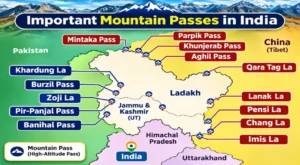
- Location: Union Territory of Ladakh, between Kargil and Leh.
- Mountain range: Situated in the Zanskar Range of the Himalayas.
- Altitude: Approximately 3,700 metres above sea level.
- Meaning: Popularly called the Pillar of the Sky Pass.
- Highway: Lies along National Highway-1, connecting Srinagar with Leh.
- Nearby region: Located along the route towards Mulbekh Valley.
Important Geographical Features
- Namika La and Fotu La are two major mountain passes between Kargil and Leh.
- Fotu La: Higher than Namika La, at approximately 4,108 metres.
- The region experiences freezing temperatures, snowfall and difficult mountain-road conditions.
- Its rugged terrain increases risks from landslides and road accidents.
Strategic and Economic Significance
- Defence: Supports military movement and supplies towards Ladakh.
- Connectivity: Links remote Himalayan settlements with major towns.
- Tourism: Provides access to mountain landscapes and Buddhist heritage.
- Trade: Facilitates regional transport and economic activities.
Cultural Importance
- Nearby Mulbekh is known for its rock-carved Maitreya Buddha image.
- Buddhist monasteries, locally called gompas, reflect Ladakh’s religious heritage.
Conclusion
Namika La Pass represents Ladakh’s strategic lifeline, where safer mountain infrastructure is essential for national security, regional development and human lives.
SELF-RELIANT INDIA FUND
TOPIC: (GS3) ECONOMY: THE HINDU
The Ministry of MSME organised an awareness workshop on the Self-Reliant India (SRI) Fund, focusing on women-led enterprises.
About the SRI Fund
- Launched: 2021, under the Atmanirbhar Bharat initiative.
- Objective: Provide growth capital to financially viable MSMEs with expansion potential.
- Total proposed corpus: ₹50,000 crore.
- Funding structure: ₹10,000 crore government contribution and ₹40,000 crore proposed private investment.
Implementation Mechanism
- Nodal Ministry: Ministry of Micro, Small and Medium Enterprises.
- Implementing agency: NSIC Venture Capital Fund Limited (NVCFL).
- Regulation: Category II Alternative Investment Fund registered with SEBI.
- Structure: Mother Fund–Daughter Fund model.
- Investment: Equity and quasi-equity, rather than conventional loans.
Major Objectives
- Improve access to long-term capital for growing MSMEs.
- Encourage MSME listing on stock exchanges.
- Promote technological innovation and domestic manufacturing.
- Help promising enterprises become national and global competitors.
- Generate employment and strengthen supply chains.
Significance
- Women empowerment: Supports women entrepreneurs facing financing barriers.
- Economic growth: Encourages investment, productivity and business expansion.
- Financial inclusion: Reduces dependence on traditional bank lending.
- Self-reliance: Strengthens domestic production and competitiveness.
Conclusion
The SRI Fund can transform promising MSMEs into competitive enterprises by combining patient capital, innovation and inclusive entrepreneurship.
TRANSFORMING AGRICULTURAL EXTENSION AND APPROACH FOR VIKSIT BHARAT 2047
TOPIC: (GS3) ECONOMY: THE HINDU
Achieving Viksit Bharat 2047 requires sustained agricultural growth of around 4% annually, highlighting the need to modernise India’s agricultural extension system.
What Is Agricultural Extension?
- Meaning: Providing farmers with scientific knowledge, technical guidance, skills and support to improve agricultural productivity and income.
- Objective: Connect agricultural research institutions with farmers for effective adoption of modern practices.
- Traditional model: Information flows from scientists to extension workers and finally to farmers.
Why Are Reforms Necessary?
- Climate change: Irregular rainfall, rising temperatures and extreme weather threaten crop production.
- Resource scarcity: Declining soil fertility and groundwater depletion require location-specific solutions.
- Technology barriers: Small farmers face high investment costs, limited credit and uncertainty.
- Market challenges: Farmers increasingly need information on prices, quality standards, certification and exports.
- Regional diversity: Uniform agricultural recommendations often ignore local farming conditions.
Agricultural Opportunity System
- New approach: Transform extension workers from information providers into facilitators of agricultural opportunities.
- Farmer participation: Identify farmers’ needs, financial capacity and local challenges before recommending technologies.
- Integrated support: Connect farmers with credit, insurance, irrigation, machinery and markets.
Four Pillars of Transformation
- Systems approach: Develop solutions suited to local soil, climate, water availability and market demand.
- AI-enabled advisories: Use satellites, weather stations and pest-monitoring systems for timely recommendations.
- Scaling innovations: Evaluate successful pilot projects before expanding them across regions.
- Institutional coordination: Promote collaboration among government agencies, Farmer Producer Organisations (FPOs), start-ups and research institutions.
Existing Government Initiatives
- Krishi Vigyan Kendras (KVKs): ICAR institutions providing farmer training, demonstrations and technology testing.
- ATMA: Encourages decentralised agricultural extension at district level.
- Kisan Sarathi: Provides digital agricultural information and advisory services.
- Kisan e-Mitra: AI-based assistant offering information about agricultural schemes.
- Digital Agriculture Mission: Supports digital infrastructure and data-driven agricultural services.
Way Forward
- Digital divide: Improve internet access and digital literacy among rural farmers.
- Institutional gaps: Strengthen coordination between agricultural departments and research organisations.
- Capacity building: Train extension workers in AI tools, climate-smart farming and market advisory services.
- Inclusive outreach: Prioritise smallholders, women farmers and remote communities.
- Accountability: Evaluate innovations using farm income, environmental sustainability and adoption rates.
Conclusion
India must transform agricultural extension from simply transferring technology to creating farmer-centred opportunities that ensure higher incomes, climate resilience and sustainable agricultural growth by 2047.