
Table of Contents
ToggleSarnath Nominated for UNESCO World Heritage Status
India has officially nominated the Ancient Buddhist Site of Sarnath for inclusion in the UNESCO World Heritage List under the 2025–26 nomination cycle. Sarnath has been on UNESCO’s tentative list since 1998 and is now under consideration for full inscription.
About Sarnath
Sarnath, located near Varanasi, Uttar Pradesh, is one of Buddhism’s most revered sites, marking the place where Gautama Buddha delivered his first sermon (Dhammachakkappavattana) after attaining enlightenment. Historically, it has been known as Rishipatana, Mrigadava, and Mrigadaya, while the modern name likely comes from Saranganatha, meaning “Lord of the Deer.”
It is recognized as one of the four major pilgrimage centers in Buddhism, alongside Lumbini, Bodh Gaya, and Kushinagar, commemorating the birth, enlightenment, first sermon, and passing of the Buddha, respectively.
Architectural and Historical Significance
Sarnath’s monuments reflect the architectural evolution from the Mauryan era to the Kushan, Gupta, and Gahadavala periods. The site is broadly divided into two main groups of monuments:
Group A:
Chaukhandi Stupa: Built around the 5th century CE, with an octagonal tower added in 1588 by Govardhan, commemorating Emperor Humayun’s visit.
Group B:
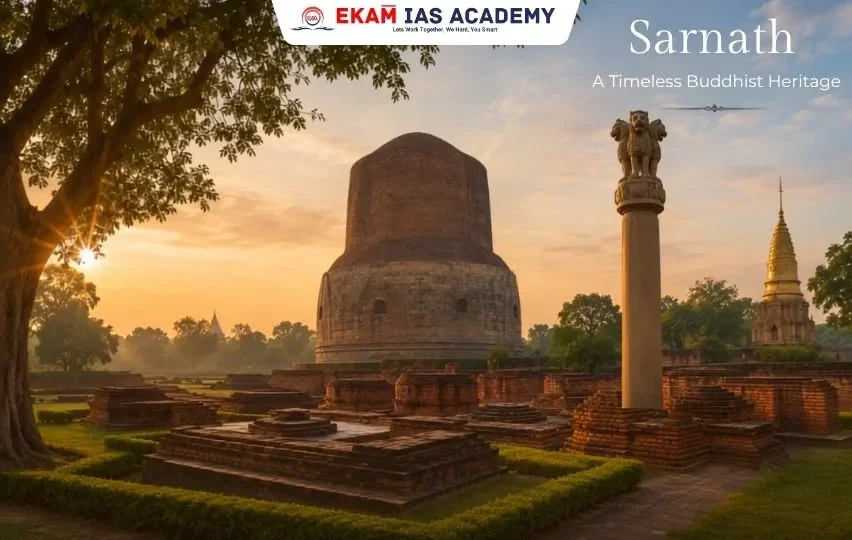
- Dhamek Stupa: Constructed circa 500 CE, marking the exact location of Buddha’s first sermon.
- Dharmarajika Stupa: Built by Emperor Ashoka in the 3rd century BCE to enshrine Buddha’s relics.
- Ashokan Pillar: Bears inscriptions of Ashoka’s edicts; the Lion Capital atop the pillar is now India’s National Emblem.
Other features include ancient monasteries, temples, and votive stupas spanning 3rd century BCE to 12th century CE. The site was restored and developed by various rulers, including the Guptas and Pala dynasty, despite invasions such as Mahmud of Ghazni’s raids.
Excavations and Museums
- The first scientific excavation was conducted by Sir Alexander Cunningham (1834–36).
- The Ashokan Lion Capital and pillar base were unearthed by Friedrich Oscar Oertel (1904–05).
- The Sarnath Archaeological Museum houses the original Lion Capital and other significant artefacts.
- Mulagandha Kuti Vihar, built by the Mahabodhi Society, features vivid frescoes narrating Buddha’s life.
UNESCO World Heritage Sites in India
UNESCO World Heritage Sites are locations of outstanding cultural or natural significance recognized under the 1972 World Heritage Convention. India ratified the Convention in 1977 and currently ranks 6th globally with 62 sites on its tentative list.
The Archaeological Survey of India (ASI) is the nodal agency responsible for managing India’s World Heritage nominations and ensuring compliance with UNESCO guidelines. Each country can nominate one site per year, making Sarnath’s nomination a significant step in promoting India’s Buddhist heritage globally.



Sarnath UNESCO Nomination FAQs
What is Sarnath known for?
Sarnath is the site where Gautama Buddha delivered his first sermon after enlightenment, making it a major Buddhist pilgrimage center.
When was Sarnath nominated for UNESCO World Heritage status?
India officially nominated Sarnath for UNESCO’s 2025–26 nomination cycle; it has been on the tentative list since 1998.
Which monuments are significant at Sarnath?
Key monuments include Dhamek Stupa, Dharmarajika Stupa, Chaukhandi Stupa, Ashokan Pillar, Mulagandha Kuti Vihar, and ancient monasteries.
Which agency manages India’s World Heritage nominations?
The Archaeological Survey of India (ASI) manages nominations and ensures compliance with UNESCO guidelines.
Why is Sarnath important globally?
Sarnath represents outstanding cultural heritage, reflecting India’s Buddhist history and architecture from Mauryan to Gupta periods.