
Table of Contents
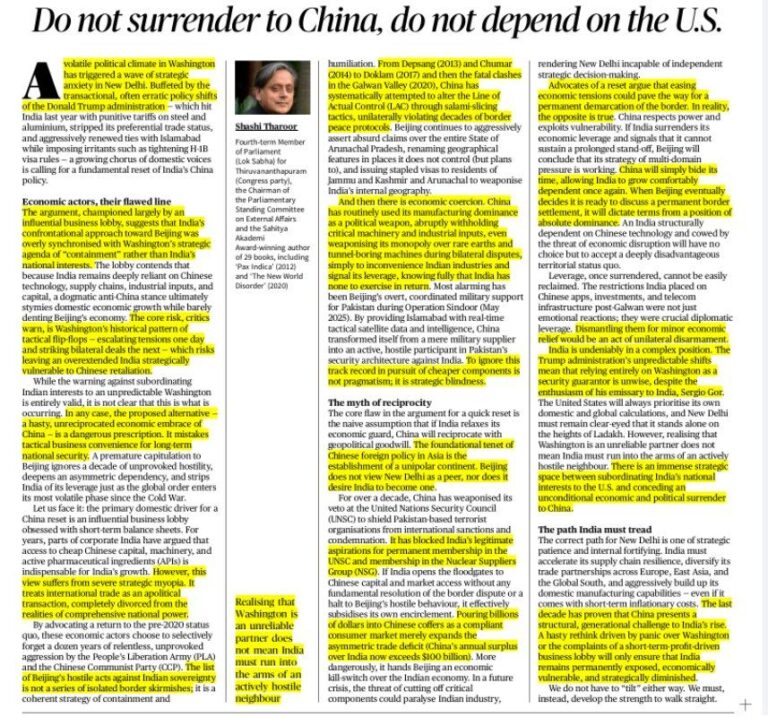
ToggleDo Not Surrender to China, Do Not Depend on the U.S.
The article examines India’s strategic position amid rising tensions between the U.S. and China. While Washington’s inconsistent foreign policy creates uncertainty, India faces the critical task of safeguarding its national interests independently. Reliance on the U.S. or a passive stance toward China could compromise India’s economic, territorial, and political security.
Geopolitical Challenges
U.S.–China Strategic Rivalry
The article notes that erratic U.S. policies, combined with China’s assertive foreign strategy, create complex geopolitical risks for India. India’s economic interests are tied to Chinese markets, technology, and critical components, making strategic autonomy crucial.
China’s Economic and Military Leverage
China uses industrial dominance, critical inputs, and infrastructure capabilities to exert regional influence. India must navigate this without over-relying on U.S. support, balancing trade, technology, and defence considerations.
India’s Strategic Response
Independent Decision-Making
India needs a proactive, self-reliant strategy:
- Strengthen domestic manufacturing and supply chains
- Avoid unilateral dependence on the U.S. for security
- Build resilient energy and defence capabilities
- Prepare for contingencies along borders and trade routes
Leverage Without Surrender
The article emphasizes that India should use strategic leverage to protect its interests rather than capitulate or rely entirely on external powers. India must actively manage its territorial, economic, and technological sovereignty.
Policy Recommendations
- Strengthen domestic industrial and defence base to reduce dependency on imports.
- Engage strategically with multiple partners—Europe, East Asia—without ceding autonomy.
- Prioritize national security along critical borders and trade chokepoints.
- Invest in emerging technologies (AI, semiconductors, defence systems) for long-term resilience.
Conclusion
India must not surrender its strategic independence to China or rely solely on the U.S. Maintaining autonomous decision-making, resilient industries, and diversified international partnerships is key to protecting national interests in a rapidly changing geopolitical environment.
Vocabulary
1. Strategic Autonomy – Independent policy choices
2. Economic Coercion – Using trade as pressure
3. Asymmetric Dependence – Unequal reliance
4. Supply Resilience – Ability to withstand disruptions
5. Reciprocity – Mutual exchange of benefits
Frequently Asked Questions (FAQs)
What is the main focus of the article?
The article discusses India’s strategic autonomy in the context of rising U.S.–China tensions and the need to protect national interests independently.
Why should India not depend solely on the U.S.?
Reliance on the U.S. could compromise India’s territorial, economic, and technological sovereignty and limit independent decision-making.
What are China’s key leverage points over India?
China exerts influence through industrial dominance, critical minerals, technology, and infrastructure capabilities, affecting India’s trade and security.
How can India strengthen its strategic position?
India can strengthen its position by boosting domestic manufacturing, defence capabilities, emerging technologies, and diversified international partnerships.
Why is this topic important for UPSC?
It is relevant under International Relations, Defence Policy, Strategic Autonomy, West Asia and East Asia geopolitics, and India’s foreign policy strategy (GS Paper 2 & GS Paper 3).
Source From : The Hindu
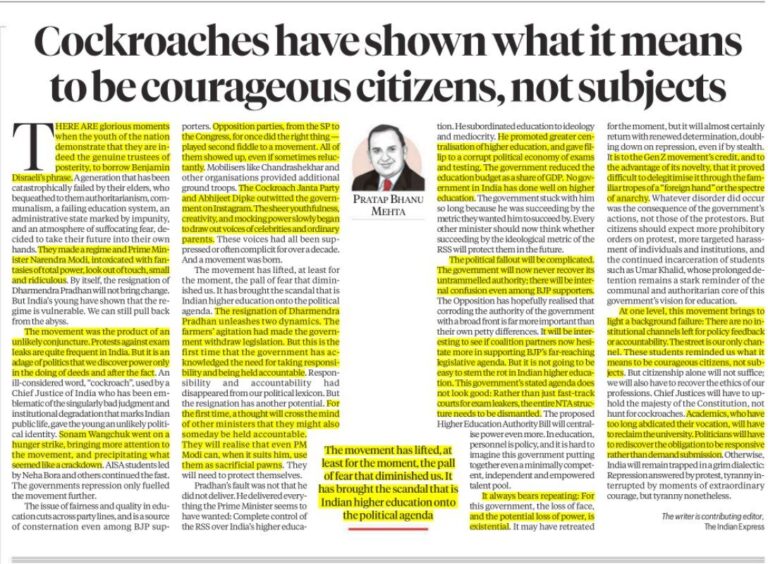
Cockroaches Have Shown What It Means to Be Courageous Citizens, Not Subjects
The article examines how youth-led protests in India have challenged systemic issues in education, governance, and political accountability. It highlights movements such as Sonam Wangchuk’s hunger strike and student activism that exposed flaws in the examination and higher education system. These actions demonstrate the power of citizens to influence policy and demand accountability.
Youth Mobilisation and Civic Engagement
Organic and Self-Organised Movements
The protest movements were largely self-mobilised, coordinated through social media and networks, rather than traditional party structures. Participants included students, educators, and activists, reflecting broad engagement across demographics.
Notable Cases
- Sonam Wangchuk’s hunger strike: Focused attention on education reforms and highlighted systemic failures.
- Examination scandals and university protests: Showed how students can influence policy despite administrative inertia.
Political and Institutional Implications
Challenging Authority
These movements compelled the government to acknowledge mistakes, resignations, and policy review, illustrating that organized citizen pressure can drive accountability, even against powerful institutions.
Limits of Government Response
The article notes that the political fallout is complex, and authorities may attempt to bypass accountability. Yet, sustained citizen action has kept education and governance reforms on the agenda.
Lessons for Democracy
- Civic activism demonstrates that youth are not passive subjects, but active stakeholders in governance.
- Transparency, public pressure, and media amplification are critical for driving institutional change.
- Moral courage and organized protests can expose systemic flaws and force policy attention.
Conclusion
Youth-led movements in India highlight the importance of citizen agency, moral courage, and accountability in a democratic system. They show that even in bureaucratic and political complexity, well-coordinated civic action can influence governance, policy, and institutional responsiveness. For UPSC aspirants, this topic is relevant under governance, civil society, democratic accountability, public policy, and ethics.
Vocabulary
1. Citizenship – Active democratic participation
2. Accountability – Responsibility for actions
3. Dissent – Expression of disagreement
4. Mobilisation – Organising collective action
5. Institutional Reform – Improving governance structures
Frequently Asked Questions (FAQs)
What is the main focus of the article?
The article highlights youth-led protests in India that challenged systemic issues in education, governance, and political accountability.
Who were key participants in these movements?
Key participants included students, educators, and activists, such as Sonam Wangchuk and other young citizens advocating for educational and policy reforms.
How did these movements influence government action?
The movements compelled the government to acknowledge mistakes, review policies, and prompt resignations, demonstrating the impact of organized citizen pressure.
What lessons does the article highlight for democracy?
It emphasizes that citizens, especially youth, are active stakeholders, and civic engagement, moral courage, and media amplification can drive accountability and reform.
Why is this topic important for UPSC?
It is relevant under governance, civil society, democratic accountability, public policy, and ethics, helping aspirants understand citizen participation in a democratic setup.