Table of Contents
ToggleStrategy for Environmental-Economic Accounts 2026–2030
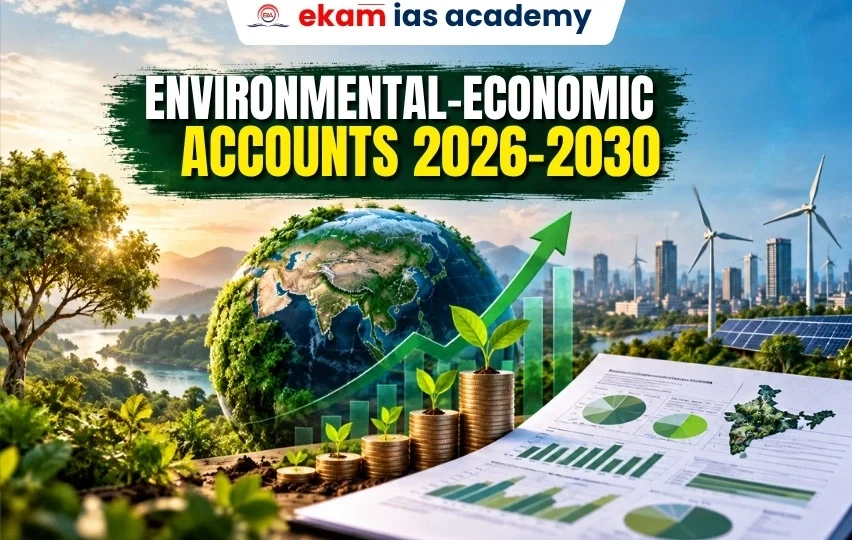
The Ministry of Statistics and Programme Implementation (MoSPI) released the Strategy for Environmental-Economic Accounts in India 2026–2030 in October 2026. The Strategy for Environmental-Economic Accounts 2026–2030 seeks to strengthen India’s environmental accounting system by improving data availability, expanding coverage of natural resources and integrating environmental information into economic policymaking. The Environmental Economic Accounts 2026 strategy also supports the broader goals of sustainable development and evidence-based resource management.
What is Environmental-Economic Accounting?
Environmental-economic accounting brings together economic and environmental information to show how natural resources are used and how environmental conditions change over time.
While indicators such as GDP measure economic production, they do not fully capture the depletion of natural resources or the benefits provided by ecosystems. Environmental Accounting in India helps address this gap by linking environmental conditions with economic activity and strengthening Natural Capital Accounting.
Key Components of Environmental-Economic Accounting
The framework covers several areas, including:
- Natural resources: Forests, minerals, land, soil and water, supporting Natural Resource Accounting India.
- Resource use: Consumption of natural resources by households and industries.
- Ecosystem services: Benefits such as carbon storage, pollination and water regulation.
- Environmental changes: Changes in the quantity and condition of natural assets.
- Economic linkages: Integration of environmental information with economic statistics, contributing to Environmental Statistics and Economic Growth analysis.
Major Focus Areas Under the Strategy
The 2026–2030 strategy proposes greater attention to forest, mineral, soil, land and water accounts. It also seeks improved measurement of carbon stocks, biodiversity and environment-related economic activities.
These accounts can provide policymakers with better information about resource availability, environmental conditions and the economic importance of ecosystems. Such information can contribute to Green GDP in India, Sustainable Development Accounting and improved assessment of natural capital.
What is the System of Environmental-Economic Accounting?
The System of Environmental-Economic Accounting (SEEA) is an internationally accepted framework endorsed by the UN Statistical Commission. The SEEA Framework provides common principles for connecting environmental data with national economic statistics.
India has been developing environmental accounts under the SEEA framework through MoSPI since 2018. The SEEA Central Framework covers environmental assets, natural-resource flows and environment-related economic activities. It provides an important foundation for UN Environmental Economic Accounting and comparable environmental statistics.
Previous Strategy 2022–2026
The earlier strategy expanded India’s environmental accounting into areas such as Material Flow Accounts, Ocean Accounts and Energy Accounts, along with thematic work on biodiversity and urban ecosystems.
The new strategy builds on these developments while placing greater emphasis on data gaps, expanded coverage and future priorities in Environmental Economic Accounting.
Importance for India
Environmental-economic accounts can support sustainable resource management, climate assessment, natural-capital measurement and evidence-based policymaking. They can also help States and Union Territories incorporate environmental considerations into regional development planning. This makes Green Economy and Sustainable Development an important dimension of environmental-economic accounting.
Challenges in Environmental-Economic Accounting
Major challenges include data shortages, complex measurement requirements, inconsistent methodologies, valuation difficulties and limited technical capacity. Measuring biodiversity and ecosystem services in particular can be challenging.
Way Forward
India needs stronger environmental surveys, standardised methodologies and better coordination among government agencies. Remote sensing and GIS technologies can improve monitoring, while regular reviews can identify gaps and strengthen implementation.
Conclusion
The Strategy for Environmental-Economic Accounts 2026–2030 represents an important step towards integrating environmental realities with economic decision-making. By improving natural-capital data and resource accounting, India can move towards development planning that better balances economic growth, resource security and environmental sustainability. The topic is also important for Environmental Economic Accounts UPSC and Environment and Economy UPSC, particularly for understanding the relationship between natural capital, economic statistics and sustainable development.


Environmental-Economic Accounts 2026–2030-FAQs Answered
What is the Strategy for Environmental-Economic Accounts 2026–2030?
It is a roadmap released by MoSPI to strengthen India’s environmental accounting by improving data availability, expanding natural-resource coverage and integrating environmental information into economic policymaking.
What is Environmental-Economic Accounting?
Environmental-economic accounting combines economic and environmental data to measure natural-resource use, environmental changes, ecosystem services and their relationship with economic activity.
What is the SEEA Framework?
The System of Environmental-Economic Accounting (SEEA) is an internationally accepted framework endorsed by the UN Statistical Commission for integrating environmental information with national economic statistics.
Why is Environmental-Economic Accounting important for India?
It supports sustainable resource management, natural-capital measurement, climate assessment and evidence-based policymaking, helping balance economic growth with environmental sustainability.
What are the major challenges in Environmental-Economic Accounting?
Key challenges include data shortages, complex measurement requirements, inconsistent methodologies, valuation difficulties and limited technical capacity, particularly for biodiversity and ecosystem services.