
Table of Contents
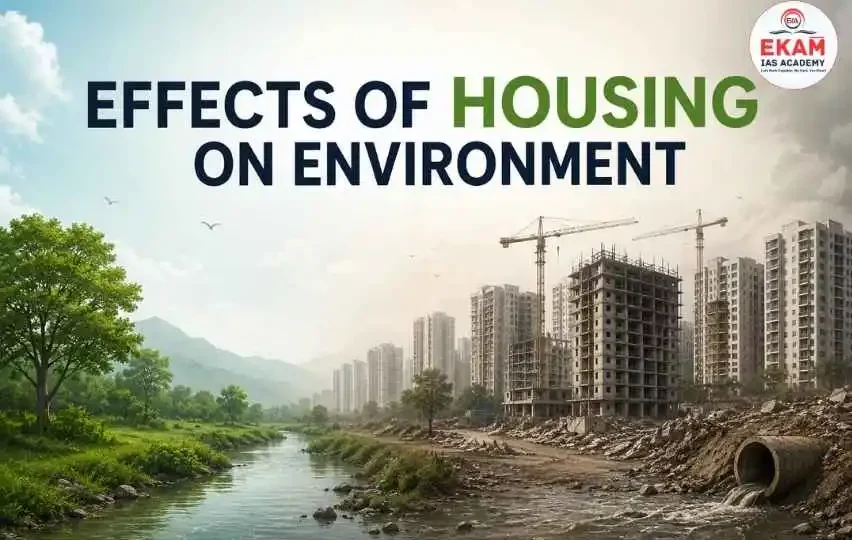
ToggleShelter is a fundamental human need, but the global surge in population and rapid economic shifts have turned construction into a major driver of ecological disruption. As cities expand to accommodate billions of residents, the housing sector has transitioned from a localized infrastructure activity into a major driver of global environmental degradation.
Growth of Housing, Urban Expansion, and the Environment
The demographic shift toward cities has triggered unprecedented horizontal and vertical construction. Urbanization and environment UPSC modules emphasize that the unchecked footprint of modern residential zones disrupts the natural layout of land.
Driving Forces of Degradation:
- The Concrete Jungle Effect: Replacing natural topsoil, wetlands, and forests with impermeable concrete and asphalt surfaces severely alters local hydrology. This shift reduces groundwater recharge and significantly increases the risk of urban flash floods.
- The Urban Heat Island (UHI) Phenomenon: Dense clusters of brick and concrete residential structures absorb and trap solar radiation during the day, causing urban centers to experience microclimates that are notably warmer than surrounding rural landscapes.
Major Effects of Housing on the Environment
The lifecycle of a housing development—from extracting raw materials to daily residential operations—exerts continuous pressure on Earth systems:
Resource Depletion: Building modern housing requires vast quantities of non-renewable resources, including river sand, limestone, timber, and fossil-fuel-intensive steel and cement. Unregulated river sand mining alters riverbed morphology, accelerating bank erosion and ruining aquatic habitats.
Pollution Footprint: Construction and Demolition (C&D) waste chokes city landfills, generating immense particulate matter ($PM_{2.5}$ and $PM_{10}$) that degrades ambient air quality. Furthermore, untreated domestic sewage from mega-housing complexes regularly pollutes freshwater bodies.
Impact on Biodiversity and Climate Change
- Habitat Fragmentation: Residential expansion directly causes deforestation and drives the clearance of fragile ecosystems like grasslands and mangroves. This process breaks up contiguous wildlife corridors, isolating gene pools and causing a sharp rise in human-wildlife conflict.
- Driving Global Warming: The housing sector is a massive contributor to global carbon emissions. This footprint is split into embodied carbon (emissions from manufacturing and transporting materials like cement and bricks) and operational carbon (emissions from daily heating, cooling, and lighting). The heavy use of energy-intensive Air Conditioning (HVAC) systems releases hydrofluorocarbons (HFCs), creating a feedback loop that accelerates climate change.
Housing and Environmental Issues in India
India faces distinct socio-ecological challenges within the housing and environmental degradation UPSC paradigm:
- The Topsoil Crisis: Traditional brick kilns operating on the fringes of Indian cities strip away fertile agricultural topsoil to bake red clay bricks, threatening long-term food security and accelerating land degradation.
- Wetland Encroachment: In major metros, rapid residential construction has filled in natural floodplains, peri-urban lakes, and marshes. This destruction of natural drainage networks has caused severe seasonal urban flooding.
- Groundwater Depletion: Due to inadequate municipal water pipelines, massive high-rise housing societies rely heavily on deep borewells, rapidly depleting deep aquifers.
Sustainable Housing Solutions and Government Initiatives
Mitigating the environmental impacts of the housing sector requires a structural transition toward green building philosophies and eco-sensitive urban planning.
A. Core Sustainable Solutions
- Passive Architectural Design: Planning buildings to maximize natural ventilation and daylighting, which sharply cuts down the need for artificial lighting and mechanical cooling.
- Eco-friendly Building Materials: Swapping out traditional cement and clay bricks for sustainable alternatives, such as fly-ash bricks, compressed earth blocks, bamboo composites, and low-carbon blended cement.
- Circular Resource Management: Mandatory integration of decentralized sewage treatment plants (STPs), rooftop rainwater harvesting systems, and solar water heaters in all multi-story residential designs.
B. Key Government Initiatives in India
- GRIHA (Green Rating for Integrated Habitat Assessment): India’s national rating tool that evaluates the environmental performance of a building throughout its entire lifecycle.
- Energy Conservation Building Code – Residential (Eco-Niwas Samhita): Introduced by the Bureau of Energy Efficiency (BEE), this code sets strict thermal comfort and energy efficiency standards for residential building designs.
- Pradhan Mantri Awas Yojana (PMAY) – Green Housing Focus: Incorporates eco-friendly, sustainable, and disaster-resilient construction technologies via the Technology Sub-Mission.
Social, Economic Implications, and Conclusion
The ecological damage caused by unsustainable housing does not affect everyone equally; it disproportionately impacts vulnerable, low-income communities. Informal settlements and slums are frequently located in high-risk zones, such as low-lying floodplains or toxic industrial fringes, leaving them highly exposed to the worst impacts of environmental degradation.
In conclusion, addressing the effects of housing on environment systems requires moving away from resource-heavy, unplanned urban sprawl toward a circular construction economy. By strictly enforcing green building codes, prioritizing vertical density over horizontal sprawl, and utilizing eco-friendly materials, India can successfully bridge its housing deficit without compromising its climate commitments or harming its rich biodiversity.
UPSC Prelims: PYQs & Practice Questions
Previous Year Questions (Prelims)
UPSC CSE Prelims 2022
Q: “Greenwashing” is best described as:
(a) Conveying a false impression that a company's products are environmentally sound and green.
(b) Non-inclusion of ecological costs in the Annual Financial Statements of a country.
(c) Ignoring the disastrous ecological consequences while undertaking infrastructure development.
(d) Making mandatory provisions for environmental costs in a government project.
Answer: (a) Conveying a false impression that a company's products are environmentally sound and green.
Explanation:
Greenwashing refers to the practice of presenting a product, project, company, or policy as more environmentally friendly than it actually is.
In the housing and construction sector, many real estate developers market luxury apartments as “eco-friendly townships” or “green heavens” based on superficial features like lawns or decorative plantations. However, such projects may still involve massive concrete footprints, high embodied carbon, groundwater depletion, and ecological disruption.
Thus, the term highlights the gap between real sustainability and marketing-based environmental claims.
UPSC CSE Prelims 2011
Q: Minor modifications in the ambient temperature of large urban settlements compared to their rural peripheries are primarily studied under which ecological concept?
(a) Thermal Inversion
(b) Urban Heat Island
(c) Greenhouse Effect
(d) Isothermal Stratification
Answer: (b) Urban Heat Island
Explanation:
The Urban Heat Island (UHI) effect occurs when urban areas become significantly warmer than their surrounding rural regions due to human-made surfaces and reduced vegetation.
Concrete buildings, asphalt roads, parking spaces, and dense residential blocks absorb and store large amounts of solar heat during the day. They release this heat slowly at night, keeping urban centres warmer than rural peripheries.
This is a major example of how housing expansion, urbanization, and the loss of natural vegetation alter local microclimates.
Practice Questions
Q: In the context of urbanization and environment, consider the following statements regarding the Eco-Niwas Samhita introduced in India:
1. It functions as the Energy Conservation Building Code for Residential Buildings (ECBC-R), launched to optimize energy efficiency in the housing sector.
2. It sets mandatory structural metrics to limit heat gain through building envelopes, thereby reducing dependency on high-power mechanical cooling systems.
Which of the statements given above is/are correct?
(a) 1 only
(b) 2 only
(c) Both 1 and 2
(d) Neither 1 nor 2
Answer: (c) Both 1 and 2
Explanation:
Both statements are correct. The
Eco-Niwas Samhita was formulated by the
Bureau of Energy Efficiency (BEE) to address the rising electricity demand of India’s expanding residential housing sector.
It acts as the Energy Conservation Building Code for Residential Buildings. Part I focuses on the thermal performance of the building envelope, including walls, roofs, and windows. By limiting heat gain, it reduces dependence on air conditioners and improves energy efficiency in urban housing.
Q: The construction of modern high-rise housing units impacts the environment even before the building is occupied due to “Embodied Carbon”. What does this term mean?
(a) The amount of carbon dioxide absorbed by indoor ornamental plants over a decade.
(b) The greenhouse gas emissions generated during the mining, manufacturing, and transportation of building materials like cement and steel.
(c) The methane gas released from domestic sewage lines during daily household operations.
(d) The carbon offset credits purchased by builders from international carbon stock markets.
Answer: (b) The greenhouse gas emissions generated during the mining, manufacturing, and transportation of building materials like cement and steel.
Explanation:
Embodied carbon refers to the hidden carbon footprint of construction. It includes greenhouse gas emissions released before the building becomes operational.
These emissions arise from raw material extraction, factory processing, manufacturing, and long-distance transport of construction materials such as cement, steel, baked bricks, glass, and aggregates. Therefore, even before a housing unit is occupied, it may already carry a significant environmental cost.
UPSC Mains – Previous Year & Practice Questions
Mains Previous Year Questions
Mains 2023
Question: Identify the main causes of the loss of
biodiversity in India.
(Requires detailing how expanding residential suburbs clear out peripheral wetlands and forests.)
Mains 2020
Question: How does the draft
Environment Impact Assessment (EIA) Notification differ from the existing
EIA Notification, 2006?
(Tests how construction project sizing dictates the level of statutory ecological scrutiny required.)
Mains 2014
Question: Enumerate the
indirect services provided by an ecosystem.
How do wetlands act as “Earth’s Kidneys”?
(Can contrast this with how real-estate encroachment chokes natural water purification services.)
Mains 2021
Question: Bring out the
socio-economic effects of the introduction of
development projects in the tribal areas of India.
(Can be connected with displacement, land-use change, and ecological pressure caused by housing and infrastructure expansion.)
Mains 2016
Question: Major cities of India are becoming vulnerable to
flood conditions. Discuss.
(Directly highlights how concrete housing surfaces block natural drainage, causing severe urban flash floods.)
Mains Practice Questions
[10 Marks | 150 Words]
Question: Examine how rapid vertical and horizontal real-estate expansion contributes to the Urban Heat Island phenomenon. Suggest sustainable architectural remedies to mitigate this problem.
[15 Marks | 250 Words]
Question: The lifecycle of the conventional housing industry is deeply tied to housing and environmental degradation. Analyze the ecological impacts of both embodied carbon and operational carbon within India’s residential building sector.
[15 Marks | 250 Words]
Question: Evaluate the institutional mechanism of GRIHA or Green Rating for Integrated Habitat Assessment in driving eco-sensitive construction in India. What structural bottlenecks limit its widespread adoption across private housing markets?



Effects of Housing on Environment-FAQs
How does urban housing cause seasonal flooding?
Urban housing replaces soil and vegetation with concrete and asphalt, reducing water absorption. During heavy rains, runoff increases and blocked drains cause flash floods.
Environmental problems of red clay brick kilns?
Brick kilns remove fertile topsoil, causing land degradation. They also burn coal and low-grade fuels, releasing black carbon, SO₂, and PM2.5.
Difference between passive and active green building technologies?
Passive design uses natural methods like ventilation, sunlight, shade, and insulation. Active design uses technology like solar panels, LED sensors, HVAC systems, and water recycling.
Why is river sand mining dangerous?
Excessive sand mining damages riverbeds, causes bank erosion, lowers groundwater, and destroys aquatic habitats. It also threatens species like fish and gharials.
What is GRIHA certification?
GRIHA is India’s green building rating system developed by TERI and adopted by MNRE. It rates buildings on energy, water, waste, materials, and environmental performance.