
Table of Contents
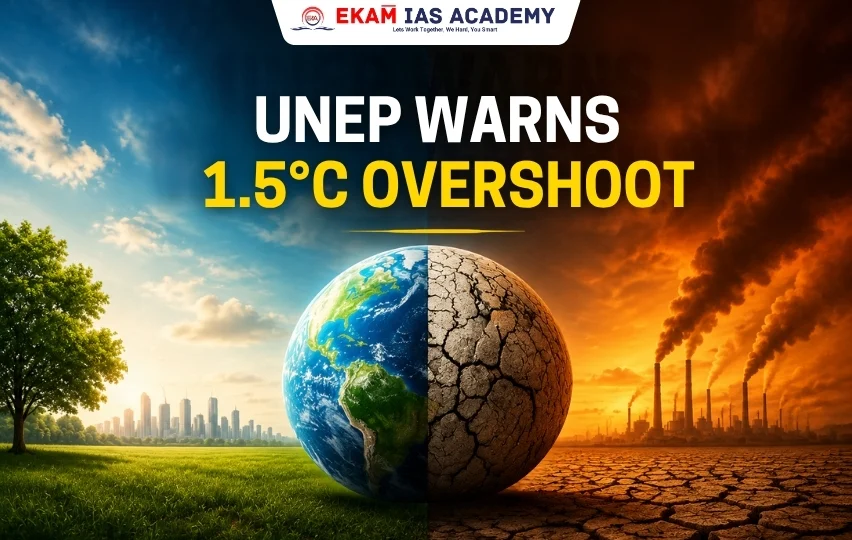
ToggleThe United Nations Environment Programme (UNEP) has released a new report stating that the world is likely to exceed the 1.5°C global warming limit within the next few years. For the first time, UNEP has proposed an “Overshoot, Peak and Decline” pathway, recognising that breaching the target is now highly likely and emphasizing the need to minimise both the extent and duration of the overshoot.
The 1.5°C Climate Goal
The Paris Agreement (2015) committed countries to keep the rise in global average temperature well below 2°C, while striving to limit warming to 1.5°C above pre-industrial levels.
Scientists consider the 1.5°C threshold critical because crossing it significantly increases the risks of extreme heatwaves, sea-level rise, glacier melt, coral reef destruction, food insecurity and irreversible ecosystem damage.
The possibility of temporarily exceeding this limit gained international recognition during COP30 in Belém, Brazil (2025), where countries acknowledged that a short-term overshoot may now be unavoidable.
Key Findings of the UNEP Report
According to UNEP’s report “Limiting Overshoot”, global temperatures are expected to rise beyond 1.5°C in the coming years.
Even if every country fully implements its current climate commitments and achieves announced net-zero targets, global temperatures could still peak at around 1.8°C.
Under existing policies, however, warming is projected to reach approximately 2.6°C by 2100, with possible outcomes ranging from 1.9°C to 3.6°C.
What is the Overshoot Pathway?
The new climate pathway accepts that exceeding 1.5°C is likely and focuses on limiting its long-term consequences.
The strategy aims to:
- Keep peak warming as low as possible after crossing 1.5°C.
- Reduce global temperatures below 1.5°C before the end of the century.
- Accelerate emission reductions while expanding carbon removal efforts.
This marks a shift from preventing the breach to reducing its severity and duration.
Major Risks of Exceeding 1.5°C
UNEP warns that remaining above the temperature threshold, even temporarily, could cause serious environmental and economic damage.
Some major consequences include:
- Faster sea-level rise.
- Widespread coral reef loss.
- Significant glacier melting.
- Declining agricultural productivity.
- Greater risk of crossing irreversible climate tipping points.
Critical tipping systems include the Greenland and West Antarctic Ice Sheets, the Atlantic Meridional Overturning Circulation (AMOC) and the Amazon rainforest, where permanent changes may become unavoidable.
Why Delaying Climate Action is Costly
The report highlights that postponing emission reductions makes future climate action much more difficult.
Every additional five years of high greenhouse gas emissions could increase peak global warming by around 0.1°C.
Reversing that increase later would require removing nearly 220 billion tonnes of carbon dioxide from the atmosphere, making delayed action far more expensive and technically challenging.
Methane Reduction Gets Greater Importance
For the first time, UNEP places major emphasis on reducing methane emissions.
Methane is a powerful greenhouse gas responsible for nearly 0.5°C of current global warming, but it remains in the atmosphere for a much shorter period than carbon dioxide.
Rapid methane reductions can quickly slow the rate of warming, helping to reduce the peak temperature during the overshoot period.
Growing Need for Carbon Removal
The report stresses that cutting emissions alone will no longer be enough.
To bring global temperatures back below 1.5°C, countries will need large-scale carbon removal through methods such as:
- Afforestation and reforestation.
- Ecosystem restoration.
- Advanced carbon capture technologies.
However, achieving removal on the required scale presents major challenges involving land availability, financing, technology and long-term monitoring.
Implications for Global Climate Policy
The UNEP report signals an important shift in international climate strategy.
Future climate policy is likely to focus on:
- Limiting the damage caused by temporary overshoot.
- Prioritising rapid methane reduction for immediate benefits.
- Expanding carbon removal as a central element of climate action.
This approach reflects the growing urgency of balancing emission reductions with adaptation and restoration efforts.
Conclusion
UNEP’s latest assessment marks a significant turning point in global climate discussions. Rather than assuming the 1.5°C target can still be fully avoided, it calls for minimising the extent of the overshoot while accelerating emission cuts, methane mitigation and carbon removal. The report underscores that immediate action remains essential to reduce long-term climate risks and support a more resilient global future.


FAQs: UNEP Warns 1.5°C Overshoot
What is the 1.5°C climate goal under the Paris Agreement?
The Paris Agreement (2015) aims to limit the rise in global average temperature to well below 2°C above pre-industrial levels while pursuing efforts to restrict warming to 1.5°C.
What does the “Overshoot, Peak and Decline” pathway mean?
It refers to a climate strategy where global temperatures may temporarily exceed 1.5°C, but countries focus on limiting the peak warming, reducing emissions and bringing temperatures back down over time.
Why is crossing the 1.5°C limit considered dangerous?
Exceeding 1.5°C increases risks such as extreme heatwaves, sea-level rise, glacier melting, coral reef loss, food insecurity and possible climate tipping points.
Why does UNEP emphasise methane reduction?
Methane is a powerful greenhouse gas responsible for a significant share of current warming. Reducing methane emissions can provide faster climate benefits because methane remains in the atmosphere for a shorter period than carbon dioxide.
Why is carbon removal important for achieving climate goals?
Carbon removal helps reduce atmospheric carbon dioxide through methods such as afforestation, ecosystem restoration and carbon capture technologies. It may become necessary to bring global temperatures back below 1.5°C after a temporary overshoot.