Table of Contents
ToggleInter-State Border Disputes in India
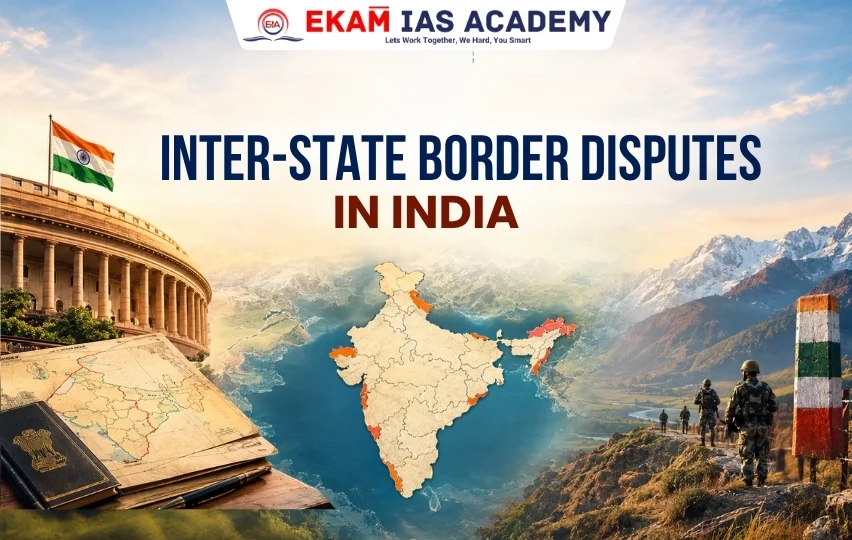
The structural framework of Inter-State Border Disputes in India represents an active challenge to Indian federalism and territorial integration. While the Constitution provides a resilient structure for regional autonomy, unresolved border friction frequently triggers political standoffs, law and order crises, and socio-economic blockades. Understanding Inter-State Border Disputes UPSC concepts requires examining historical reorganisation, constitutional provisions, administrative mechanics, and judicial pathways.
What are Inter-State Border Disputes
- Territorial Friction: Delimitation and administrative jurisdiction conflicts between two or more federating units over shared geographical boundaries.
- Administrative Ambiguity: Overlapping claims arising from imprecise colonial demarcations, river course changes, or unratified notification maps.
- Resource Access: Disputes driven by sovereign control over strategic land, forests, rivers, and natural mineral assets across state borders.
- Socio-Political Dimension: Multi-layered conflicts involving identity, ethnic affiliations, and language demographics along border belts.
Constitutional Provisions Related to State Boundaries
- Article 2: Grants Parliament the authority to admit or establish new States into the Union on terms it deems fit.
- Article 3: Empowers Parliament to alter state areas, alter boundaries, change state names, or form new States without mandatory state concurrence.
- Article 4: Mandates that laws enacted under Articles 2 and 3 are not considered constitutional amendments under Article 368.
- Seventh Schedule: Categorizes Foreign Affairs and Inter-State River Waters under the Union List, leaving public order within state domain.
Why Do Inter-State Border Disputes Arise?
- Colonial Legacy: Arbitrary administrative lines drawn by the British for revenue collection rather than geographical or cultural cohesion.
- Linguistic Reorganisation Gaps: Incomplete alignment between linguistic distributions and official administrative boundaries during post-independence restructuring.
- Topographical Shifts: Dynamic natural boundaries, such as shifting river courses (e.g., Brahmaputra tributaries), causing jurisdictional ambiguity.
- Political Mobilization: Sub-nationalism and electoral incentives driving state leaders to assert rigid territorial claims.
Major Inter-State Border Disputes in India
- Karnataka – Maharashtra Dispute: Contestation over the Belagavi (Belgaum), Karwar, and Nipani regions based on Marathi vs. Kannada demographics.
- Assam – Mizoram Dispute: Conflict originating from differing interpretations of the 1875 Inner Line Reserve Forest and 1933 administrative notifications.
- Assam – Arunachal Pradesh Dispute: Claims over boundary tracts defined by the 1951 Gopinath Bordoloi Committee report.
- Odisha – Andhra Pradesh Dispute: Multi-village jurisdictional dispute in the Kotia panchayat cluster dating back to 1936.
Assam – A Major Centre of Inter-State Border Disputes
- Mother State Dynamics: Assam shares boundaries with all Northeastern states, many of which were carved out of its original territorial expanse.
- Assam – Meghalaya Dispute: Friction across 12 sectors; landmark MoUs signed in 2022 resolved 6 sectors, while others remain under negotiation.
- Assam – Nagaland Dispute: Protracted border tensions along the Merapani and Golaghat belts dating back to the creation of Nagaland in 1963.
- Assam – Mizoram Border Dispute: Tensions along Cachar-Kolasib borders that periodically disrupt highway commerce and public safety.
Role of Linguistic Reorganisation
- States Reorganisation Act (1956): Redrew state lines primarily on linguistic criteria, creating linguistic minority pockets along border belts.
- Border Minorities: Created administrative friction for linguistic groups residing on the “wrong side” of newly drawn state lines.
- Identity Assertions: Heightened linguistic identity consciousness, making territorial concessions politically difficult for state governments.
- Unresolved Claims: Caused long-term legal and political challenges like the Karnataka Maharashtra Border Dispute.
Role of the Union Government
- Facilitator & Mediator: Intervenes through the Ministry of Home Affairs (MHA) to broker bilateral consensus and peace accords.
- Deployment of Neutral Forces: Deploys Central Armed Police Forces (CAPF) along volatile border sectors to maintain law and order.
- Boundary Commissions: Appoints independent commissions (e.g., Mahajan Commission) to assess claims and suggest equitable solutions.
- Administrative Coordination: Uses structured channels to maintain dialogue between state chief ministers and chief secretaries.
Role of the Supreme Court
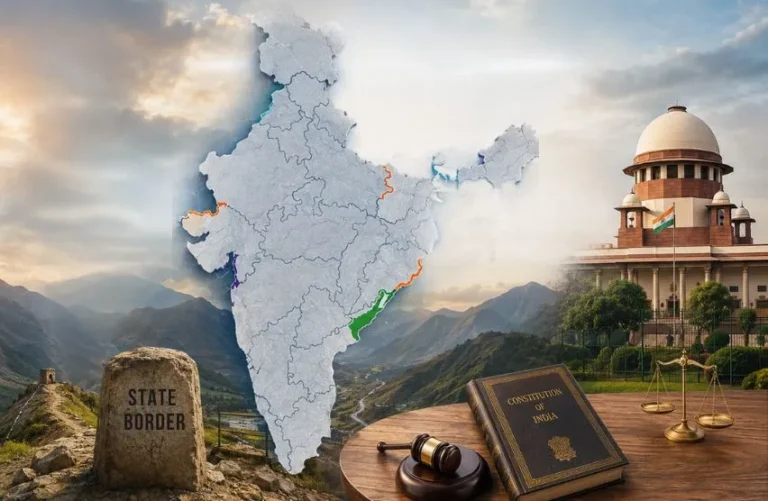
- Article 131 Jurisdiction: Possesses original and exclusive jurisdiction over legal disputes between the Union and States or between States.
- Article 131 Supreme Court Role: Adjudicates long-standing suits regarding the constitutionality of boundary reorganisations.
- Fact-Finding Committees: Appoints judicial commissions to survey disputed boundary stretches and gather local evidence.
- Judicial Limits: Legal decrees often face political delays in enforcement without underlying inter-state political consensus.
Inter-State Border Disputes and Federalism
- Cooperative vs. Friction Federalism: Test the resilience of Centre State Relations and Border Disputes management frameworks.
- Erosion of Trust: Boundary clashes erode institutional trust between state executives and administrative bodies.
- Bargaining Federalism: States leverage territorial claims to gain economic packages, political leverage, or resource allocations.
- National Integration: Highlights the need to transition from competitive state claims to collaborative federal governance.
Impact of Inter-State Border Disputes
- Law and Order Crises: Armed police clashes, civilian blockades, and loss of life along volatile borders.
- Economic Disruption: Blockades of national highways stall interstate commerce, leading to supply chain shortages.
- Development Deficit: Disputed areas often lack basic infrastructure, healthcare, and educational facilities due to jurisdictional confusion.
- Humanitarian Impact: Local residents face displacement, loss of agricultural access, and dual-taxation burdens.
Inter-State Border Disputes and Tribal Communities
- Customary Land Rights: Disregard for traditional tribal land ownership patterns during administrative demarcation.
- Community Fragmentation: Split ethnic and tribal groups across distinct administrative states, undermining social cohesion.
- Autonomous Councils: Friction between state governments and Sixth Schedule Autonomous District Councils over land regulation.
- Cultural Disconnect: Lack of native language support in state schooling and administrative services along border regions.
Institutional Mechanisms for Resolving Border Disputes
- Inter-State Council (Article 263): Constitutional forum designed to investigate, discuss, and advise on inter-state disputes.
- Zonal Councils: Statutory bodies under the States Reorganisation Act (1956) fostering regional coordination on common border issues.
- Joint Security Committees: Bilateral committees formed by adjacent states to manage local policing and prevent escalation.
- Tripartite Agreements: Structured peace accords involving the Centre, concerned State Governments, and local community bodies.
Challenges in Resolving Border Disputes
- Lack of Political Will: Compromise is often viewed as political surrender by domestic voter bases.
- Historical Antagonism: Deep-seated ethnic, linguistic, and historical grievances complicate consensus-building.
- Non-Enforceability: Absence of mandatory enforcement mechanisms for advisory commission recommendations.
- Demographic Shifts: Rapid population movements alter border demographics, generating fresh claims and counter-claims.
Role of Technology in Boundary Demarcation
- GIS and Satellite Imagery: Utilizes High-Resolution Satellite Imagery (HRSI) for precise physical boundary mapping.
- Drone Surveys: Deploys Unmanned Aerial Vehicles (UAVs) under the SVAMITVA framework for accurate plot-level demarcation.
- Digital Spatial Databases: Creates immutable georeferenced databases to prevent boundary pillar tampering.
- Inter-State Mapping: Facilitates objective, data-backed negotiations using scientific cartographic evidence.
Important Commissions and Committees
- Dhar Commission (1948): Recommended state reorganisation based on administrative convenience rather than linguistic lines.
- JVP Committee (1949): Re-examined linguistic reorganisation, urging caution regarding communal and territorial harmony.
- Fazl Ali Commission (1953): Formed the basis of the States Reorganisation Act, balancing language, security, and financial viability.
- Mahajan Commission (1966): Appointed to resolve the Karnataka-Maharashtra-Kerala border dispute; its recommendations remain unexecuted due to disagreement.
Inter-State Border Disputes and Internal Security
- Vulnerability to Insurgency: Border friction creates ungoverned spaces exploited by insurgent groups and smuggling networks.
- Inter-State Police Friction: Unprecedented clashes between state police forces damage national security cohesion.
- Strategic Vulnerability: Internal blockades along critical corridors (e.g., Siliguri Corridor, G.S. Road) threaten national supply lines.
- Misinformation & Polarization: Social media rumors escalate local clashes into wider communal and regional conflicts.
Way Forward
- Revitalize Constitutional Forums: Activate the Inter-State Council as a regular dispute-resolution body.
- Time-Bound Commissions: Establish statutory, independent boundary commissions with binding arbitration mandates.
- Joint Administrative Zones: Create shared economic and security zones in disputed sectors to maintain local development.
- Technology-Driven Consensus: Use ISRO satellite mapping to establish universally accepted cartographic borders.
Conclusion
- Preserving Federal Integrity: Resolving State Border Disputes in India is essential for national security and economic integration.
- Balanced Governance: Requires blending constitutional adherence, judicial clarity under Article 131, and collaborative political dialogue.
- Sustainable Resolution: Leveraging technology and institutional goodwill ensures border regions become zones of shared development rather than friction.
UPSC Prelims: PYQs & Practice Questions
Previous Year Questions
Q: The power of the Supreme Court of India to decide disputes between the Centre and the States falls under its:
(a) Advisory jurisdiction
(b) Appellate jurisdiction
(c) Original jurisdiction
(d) Writ jurisdiction
Answer: (c) Original jurisdiction
Explanation:
Under Article 131 of the Constitution, the Supreme Court has
original jurisdiction
in certain disputes involving the
Government of India and one or more States,
or disputes between two or more States.
The jurisdiction is called
original
because such disputes can be brought directly before the Supreme Court rather than through an appeal from a lower court.
Article 131 applies where the dispute involves a
question of law or fact on which the existence or extent of a legal right depends.
Therefore, option (c) Original jurisdiction is correct.
Q: Which body/authority can establish an Inter-State Council under Article 263 of the Constitution to investigate and discuss inter-State disputes?
(a) The Parliament
(b) The President of India
(c) The Prime Minister
(d) The Supreme Court of India
Answer: (b) The President of India
Explanation:
Under Article 263, the
President of India
may establish an
Inter-State Council
if it appears that public interest would be served by doing so.
The Council may be assigned duties such as
inquiring into and advising upon disputes between States,
discussing subjects of common interest between the Union and States or among States, and
making recommendations for better coordination of policy and action.
The Inter-State Council is therefore primarily an
advisory and coordinating body,
rather than a judicial authority.
Therefore, option (b) The President of India is correct.
Practice Questions
Q: With reference to the constitutional mechanisms for resolving Inter-State Border Disputes in India, consider the following statements:
1. Under Article 3 of the Indian Constitution, Parliament can alter the boundary of any State only after receiving the mandatory concurrence of the concerned State Legislature.
2. The jurisdiction of the Supreme Court under Article 131 to resolve legal boundary controversies between States is advisory and non-binding.
3. Zonal Councils are statutory bodies established under the States Reorganisation Act, 1956 to foster regional cooperation and address inter-State border issues.
How many of the statements given above are correct?
(a) Only one
(b) Only two
(c) All three
(d) None
Answer: (a) Only one
Explanation:
Statement 1 is incorrect.
Under Article 3, a Bill affecting the area, boundary or name of a State must be referred by the President to the concerned
State Legislature for expressing its views.
However, Parliament is not bound by the views of the State Legislature and its concurrence is not constitutionally mandatory.
Statement 2 is incorrect.
Under Article 131, the Supreme Court exercises
original jurisdiction in specified legal disputes between the Union and States or between States.
Its judicial decisions are
binding, unlike the advisory role of institutions such as the Inter-State Council.
Statement 3 is correct.
Zonal Councils are statutory bodies created under the
States Reorganisation Act, 1956.
They provide a forum for discussing matters of common interest such as
inter-State disputes, border issues, transport, security and economic coordination.
Therefore, only Statement 3 is correct.
Q: Consider the following pairs of Inter-State Border Disputes and the States involved:
1. Belagavi (Belgaum) Dispute — Maharashtra and Karnataka
2. Kotia Panchayat Dispute — Odisha and Andhra Pradesh
3. Langpih Border Dispute — Assam and Meghalaya
Which of the pairs given above is/are correctly matched?
(a) 1 only
(b) 1 and 2 only
(c) 2 and 3 only
(d) 1, 2 and 3
Answer: (d) 1, 2 and 3
Explanation:
Pair 1 is correctly matched.
The Belagavi dispute is a long-standing territorial dispute between
Maharashtra and Karnataka.
Pair 2 is correctly matched.
The Kotia group of villages is disputed between
Odisha and Andhra Pradesh.
Pair 3 is correctly matched.
Langpih is one of the disputed sectors along the
Assam-Meghalaya inter-State boundary.
Therefore, option (d) 1, 2 and 3 is correct.
UPSC Mains – Previous Year & Practice Questions
Mains Previous Year Questions
[15 Marks]
Question: “ Inter-State Border Disputes in India are a complex blend of colonial legacy, linguistic reorganisation and ethnic identity.” Analyse in the light of recent border clashes in the North-Eastern region. (UPSC GS Paper II – 2021)
[10 Marks]
Question: Examine the scope of Article 131 of the Constitution in resolving federal disputes. Does the Supreme Court offer an effective remedy for resolving long-pending State border disputes? (UPSC GS Paper II – 2019)
[15 Marks]
Question: Discuss the role of the Inter-State Council and Zonal Councils in promoting Cooperative Federalism and resolving territorial frictions between States. (UPSC GS Paper II – 2020)
[12.5 Marks]
Question: “ Reorganisation of States on linguistic lines was intended to foster national integration, but it has left behind unresolved border pockets.” Critically evaluate with relevant examples. (UPSC GS Paper II – 2016)
[15 Marks]
Question: How do unresolved Inter-State boundary disputes impact internal security and law enforcement in border areas? Suggest measures for better inter-State security coordination. (UPSC GS Paper III – 2022)
Mains Practice Questions
[15 Marks | 250 Words]
Question: “ Unilateral legislative assertions and judicial litigation have failed to conclusively resolve Inter-State Boundary Disputes in India.” Critically examine the need for political arbitration and technology-based boundary demarcation as complementary mechanisms for dispute resolution.
[10 Marks | 150 Words]
Question: Analyse how Inter-State Border Disputes can escalate into internal security challenges, with specific reference to the deployment of Central Armed Police Forces (CAPFs) along disputed State boundaries.
[15 Marks | 250 Words]
Question: “ Subnationalism and local electoral politics often undermine institutional mechanisms for boundary dispute resolution.” Discuss with reference to recent Memoranda of Understanding (MoUs) between Northeastern States aimed at resolving long-standing Inter-State Boundary Disputes.
Inter-State Border Disputes in India-FAQs
What are Inter-State Border Disputes in India?
They are territorial, administrative or resource-related conflicts between two or more states over boundary demarcation and jurisdiction.
Which constitutional provisions are important for state boundaries?
Articles 2, 3 and 4 are important for state creation and boundary alteration, while Article 131 provides Supreme Court jurisdiction over inter-state legal disputes.
Why do inter-state border disputes arise?
They arise due to colonial boundaries, linguistic reorganisation gaps, shifting natural boundaries, identity politics, resource control and administrative ambiguity.
Why is Assam central to many border disputes?
Assam shares borders with several Northeastern states that were carved out of its earlier territory, creating overlapping historical and administrative claims.
Why are Inter-State Border Disputes important for UPSC?
They are important because they connect federalism, Centre-State relations, internal security, Article 3, Article 131, regional identity and cooperative governance.