Table of Contents
TogglePhosphorus is a key element in all living organisms, forming the backbone of DNA, RNA, and ATP (energy currency of the cell). In the environment ecology notes UPSC curriculum, the phosphorus cycle is noted for its relative slowness and the absence of a significant gaseous phase. It is a “closed” system on a biological timescale but open on a geological one.
Definition of the Phosphorus Cycle
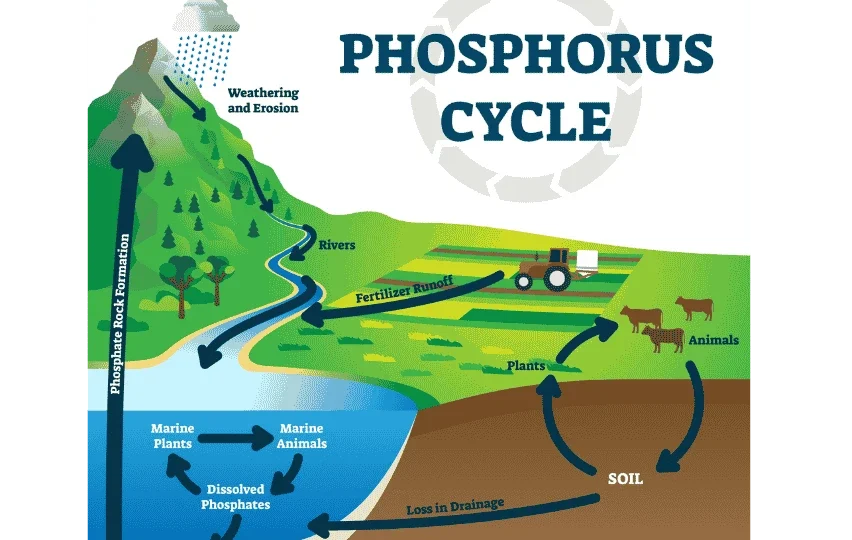
The phosphorus cycle process is the biogeochemical cycle that describes the movement of phosphorus through the lithosphere (rocks), hydrosphere (water), and biosphere (living organisms). It involves the slow release of phosphorus from rocks via weathering, its uptake by plants, and its eventual return to the soil or ocean sediments.
Major Components of the Phosphorus Cycle
- The Lithosphere (Reservoir): The primary source of phosphorus is phosphate rocks (like apatite) and volcanic deposits.
- The Soil (Exchange Pool): Phosphorus exists in the soil as orthophosphate, which is the only form plants can absorb.
- The Biosphere: Phosphorus moves through the food chain as herbivores eat plants and carnivores eat herbivores.
- The Hydrosphere: Dissolved phosphates in water bodies support aquatic life but can lead to ecological imbalances if present in excess.
Key Processes Involved
- Weathering: Rainfall and wind break down phosphate-rich rocks, releasing inorganic phosphorus into the soil and water.
- Absorption (Uptake): Plants absorb dissolved phosphorus from the soil. Because phosphorus is often “fixed” or stuck to soil particles, it is frequently the limiting nutrient in terrestrial ecosystems.
- Decomposition: When organisms die, decomposer microbes convert organic phosphorus back into inorganic phosphate, making it available for the next generation.
- Sedimentation and Lithification: Some phosphorus washes into the ocean, where it settles at the bottom. Over millions of years, these sediments are compressed into new rock, which may eventually be pushed to the surface by tectonic uplift.
Importance of the Phosphorus Cycle
- Soil Fertility: Phosphorus is critical for soil fertility phosphorus management. It promotes root development, flowering, and seed formation in crops.
- Biological Energy: Without phosphorus, organisms could not store or transfer energy via ATP.
- Skeletal Structure: It is a major component of bones, teeth, and shells in various animals.
Human Impacts on the Phosphorus Cycle
Human intervention has accelerated the phosphorus cycle, often with negative consequences:
- Agricultural Runoff: Excessive use of phosphate fertilizers leads to nutrient-rich runoff entering rivers and lakes.
- Eutrophication UPSC: This is a critical exam topic. Excess phosphorus triggers massive algal blooms. As these algae die and decompose, they consume all available oxygen, leading to “dead zones” and the death of fish.
- Mining: Industrial mining of phosphate rock for fertilizers is depleting a finite natural resource that takes millions of years to replenish.
Conclusion
The phosphorus cycle serves as a reminder of the Earth’s geological pace. For sustainable agriculture India UPSC, the challenge lies in managing phosphorus use to ensure food security without triggering eutrophication. As part of your environment ecology notes UPSC, remember that managing this cycle is key to maintaining both terrestrial productivity and aquatic health.
UPSC Prelims: PYQs & Practice Questions
Previous Year Questions (Prelims)
Q: Which of the following cycles does not have a gaseous phase in its natural state? (UPSC CSE Prelims 2011)
(a) Carbon Cycle
(b) Nitrogen Cycle
(c) Phosphorus Cycle
(d) Sulphur Cycle
Answer: (c) Phosphorus Cycle
Explanation:
The Phosphorus Cycle is a classic sedimentary biogeochemical cycle with no significant gaseous phase. Phosphorus exists mainly in phosphate rocks, unlike Carbon (CO₂) and Nitrogen (N₂), which have atmospheric components.
Q: With reference to the 'Sulphur Cycle', consider the following statements: (UPSC CSE Prelims 2014)
1. Sulphur is released into the atmosphere by the weathering of rocks.
2. Sulphur is released into the atmosphere by volcanic eruptions.
Which of the statements given above is/are correct?
(a) 1 only
(b) 2 only
(c) Both 1 and 2
(d) Neither 1 nor 2
Answer: (c) Both 1 and 2
Explanation:
The Sulphur Cycle is primarily sedimentary but has a significant gaseous component. Sulphur is released through weathering of rocks and volcanic eruptions. This distinguishes it from the Phosphorus Cycle, which lacks a gaseous phase.
Practice Questions
Q: Which of the following is the primary "limiting nutrient" in many freshwater lake ecosystems?
(a) Carbon
(b) Nitrogen
(c) Phosphorus
(d) Oxygen
Answer: (c) Phosphorus
Explanation:
In freshwater ecosystems, phosphorus is usually in limited supply. Excess addition (e.g., from fertilizers) leads to eutrophication—rapid algal growth that depletes dissolved oxygen and harms aquatic life.
Q: The process by which phosphorus is moved from deep ocean sediments back to terrestrial ecosystems over geological time is:
(a) Decomposition
(b) Weathering
(c) Tectonic uplift
(d) Leaching
Answer: (c) Tectonic uplift
Explanation:
Phosphorus deposited in ocean sediments remains locked for long periods. Through tectonic uplift (mountain building), these sediments are brought back to land, where weathering releases phosphorus and restarts the cycle.
UPSC Mains – Previous Year & Practice Questions
Mains Previous Year Questions
Question: Each year a large amount of plant material is produced by photosynthesis. Explain the mechanism of their decomposition. (Mains 2022)
(Relates to ammonification in the nitrogen cycle)
Question: What is an ecosystem? Describe the various services provided by an ecosystem. (Mains 2017)
(Nutrient cycling is a key ecosystem service)
Question: What do you understand by 'Environmental Ethics'? (Mains 2013)
(Includes human disruption of natural cycles like nitrogen due to fertilizers)
Question: Coastal regions of India are vulnerable to various climate change impacts. Discuss. (Mains 2019)
(Relates to nitrogen-driven eutrophication in coastal ecosystems)
Question: The Sustainable Development Goals (SDGs) are a set of 17 goals aimed at global development. Discuss. (Mains 2016)
(SDG 2 and SDG 14 involve nitrogen management and ecosystem sustainability)
Mains Practice Questions
[10 Marks | 150 Words]
Question: Explain the phosphorus cycle and discuss why it is considered an 'imperfect cycle' compared to the nitrogen cycle.
[15 Marks | 250 Words]
Question: Identify the anthropogenic factors that accelerate the phosphorus cycle. How does this lead to eutrophication in Indian wetlands?
[15 Marks | 250 Words]
Question: Phosphorus is a non-renewable resource with no synthetic substitute. Discuss the implications of 'Peak Phosphorus' for India’s food security.



Phosphorus Cycle-FAQs
Why is phosphorus important for living organisms?
It is a structural component of DNA and RNA, a vital part of the energy molecule ATP, and a major constituent of bones and teeth.
How does phosphorus enter the food chain?
It enters when plants absorb dissolved inorganic phosphates from the soil. Animals then obtain it by eating those plants or other animals.
What is the biggest difference between the Phosphorus and Nitrogen cycles?
The Nitrogen cycle is gaseous with its main reservoir in the atmosphere. The Phosphorus cycle is sedimentary with its reservoir in rocks and has no gaseous phase.
What are 'Guano' deposits?
These are accumulations of seabird or bat droppings. They are extremely rich in phosphorus and provide a rare natural way for phosphorus to return from the marine environment to land.
How can we reduce phosphorus pollution?
By practicing precision farming to reduce fertilizer runoff, treating sewage to remove phosphates, and restoring riparian buffers (vegetation along riverbanks) to trap sediment.