
Table of Contents
ToggleCarbon is the “building block of life,” present in all organic molecules. The carbon cycle UPSC syllabus highlights how this element circulates in a continuous loop, maintaining a delicate balance that prevents the Earth from becoming too hot or too cold.
Defining the Carbon Cycle Clearly
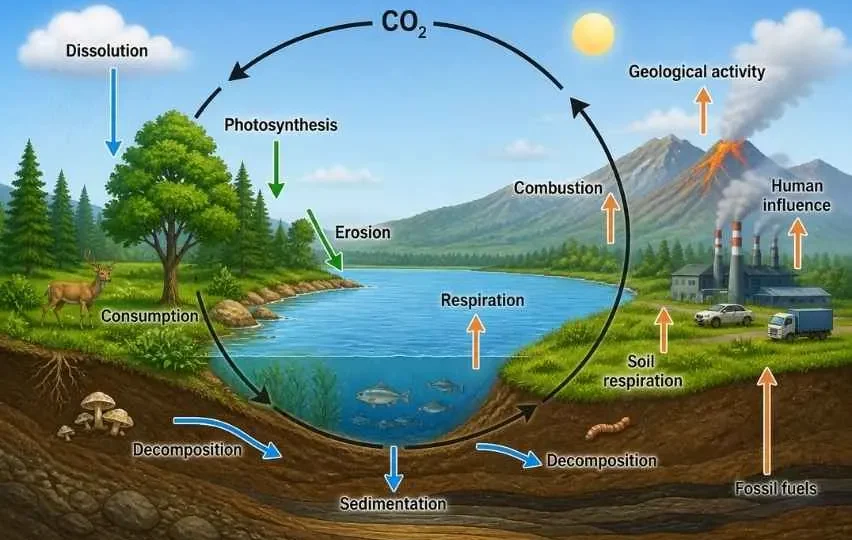
The carbon cycle process is the biogeochemical cycle by which carbon is exchanged among the biosphere, pedosphere, geosphere, hydrosphere, and atmosphere of the Earth. It represents a closed system where the total amount of carbon remains constant, but its distribution among various “reservoirs” changes over time.
Major Components: Sinks and Sources
Understanding the carbon cycle sink and source UPSC distinction is vital for exam precision:
1. Carbon Sources
A source is any process or entity that releases more carbon into the atmosphere than it absorbs.
- Respiration: Animals and plants release CO2 as a byproduct of energy production.
- Combustion: Burning of fossil fuels (coal, oil, gas) and biomass.
- Volcanic Activity: Natural release of carbon from the Earth’s interior.
- Decomposition: Microbes breaking down organic matter release carbon gases.
2. Carbon Sinks
A sink is a reservoir that absorbs more carbon than it releases.
- Oceans: The largest functional carbon sink, absorbing $CO_2$ through direct dissolution.
- Forests: Photosynthesis by plants fixes atmospheric carbon into biomass.
- Soil: Organic matter stored in the ground acts as a long-term reservoir.
Types of Carbon Cycles
The cycle operates on two different timescales:
Short-term (Biological) Cycle: Involves the rapid exchange of carbon through photosynthesis and respiration. This happens over days to years.
Long-term (Geological) Cycle: Involves the storage of carbon in rocks (like limestone), fossil fuels, and ocean sediments. This process takes millions of years.
Key Processes Involved
- Photosynthesis: Green plants convert solar energy and CO2 into glucose.
- Respiration: Organisms oxidize glucose to release energy, returning CO2 to the air.
- Weathering: Atmospheric carbon dissolved in rain (carbonic acid) reacts with rocks, eventually washing into oceans as bicarbonate ions.
- Sedimentation: Marine organisms use carbon to build shells; when they die, these settle on the ocean floor to form sedimentary rocks.
Importance of the Carbon Cycle
- Photosynthesis: Green plants convert solar energy and CO2 into glucose.
- Respiration: Organisms oxidize glucose to release energy, returning CO2 to the air.
- Weathering: Atmospheric carbon dissolved in rain (carbonic acid) reacts with rocks, eventually washing into oceans as bicarbonate ions.
- Sedimentation: Marine organisms use carbon to build shells; when they die, these settle on the ocean floor to form sedimentary rocks.
Human Impacts on the Carbon Cycle
Anthropogenic activities have significantly disrupted the natural equilibrium:
- Fossil Fuel Combustion: Rapidly transfers carbon from the geological “long-term” reservoir to the atmospheric “short-term” reservoir.
- Deforestation: Reduces the planet’s capacity to absorb CO2 (loss of sinks) and releases stored carbon through burning.
- Ocean Acidification: As oceans absorb excess CO2, they become more acidic, threatening marine life and reducing their efficiency as carbon sinks.
Conclusion
For environment ecology notes UPSC, the carbon cycle illustrates the interconnectedness of Earth’s systems. The shift from a balanced cycle to a carbon-heavy atmosphere is the primary driver of the current climate crisis. Protecting natural sinks like forests and peatlands is essential for restoring the ecological balance.
UPSC Prelims: PYQs & Practice Questions
Previous Year Questions (Prelims)
Q: Which of the following adds/add carbon dioxide to the carbon cycle on the planet Earth?
1. Volcanic action
2. Respiration
3. Photosynthesis
4. Decay of organic matter
Select the correct answer using the code given below:
(a) 1 and 3 only
(b) 2 only
(c) 1, 2 and 4 only
(d) 1, 2, 3 and 4
Answer: (c) 1, 2 and 4 only
Explanation:
Respiration, volcanic action, and decay of organic matter release CO2 into the atmosphere. Photosynthesis is a carbon sink process that removes CO2 from the atmosphere to create biomass.
Q: Regarding "carbon credits", which one of the following statements is not correct? (UPSC CSE Prelims 2011)
(a) The carbon credit system was ratified in conjunction with the Kyoto Protocol.
(b) Carbon credits are awarded to countries or groups that have reduced greenhouse gases below their emission quota.
(c) The goal of the carbon credit system is to limit the increase of carbon dioxide emission.
(d) Carbon credits are traded at a price fixed from time to time by the United Nations Environment Programme.
Answer: (d)
Explanation:
Carbon credits are traded on the open market, and their prices are determined by supply and demand. They are not fixed by the United Nations Environment Programme. This mechanism incentivizes the reduction of greenhouse gas emissions.
Practice Questions
Q: Consider the following regarding carbon cycle sinks and sources (UPSC):
1. Oceans act as a sink by dissolving CO₂ directly into the water.
2. The "Biological Pump" refers to the process where marine organisms fix carbon through photosynthesis and transport it to the deep ocean upon death.
Which of the statements given above is/are correct?
(a) 1 only
(b) 2 only
(c) Both 1 and 2
(d) Neither 1 nor 2
Answer: (c) Both 1 and 2
Explanation:
Both statements are correct. Oceans absorb carbon directly from the atmosphere, and the Biological Pump helps transfer carbon to deep ocean layers, making oceans the largest functional carbon sink.
Q: Which process in the carbon cycle takes the longest time to complete?
(a) Photosynthesis
(b) Respiration
(c) Sedimentation and Lithification
(d) Decomposition
Answer: (c) Sedimentation and Lithification
Explanation:
Biological processes like photosynthesis, respiration, and decomposition occur over short time scales. However, sedimentation and lithification take millions of years, forming part of the long-term geological carbon cycle.
UPSC Mains – Previous Year & Practice Questions
Mains Previous Year Questions
Question: Each year a large amount of plant material is produced by photosynthesis. Explain the mechanism of their decomposition. (Mains 2022)
Question: What is an ecosystem? Describe the various services provided by an ecosystem.
(Carbon sequestration is a critical regulating service). (Mains 2018)
Question: 'Climate Change' is a global problem. How will India be affected by climate change? How will Himalayan and coastal states of India be impacted? (Mains 2017)
Question: Explain the purpose of the 'Green Grid Initiative' announced at COP26. (Mains 2021)
Question: “The standard of living in a country can be raised only through sustainable development.” Discuss.
(Relates to balancing carbon emissions with economic growth). (Mains 2015)
Mains Practice Questions
[15 Marks | 250 Words]
Question: Explain the distinction between the short-term biological and long-term geological carbon cycles. How has the burning of fossil fuels bridged these two cycles with adverse effects?
[15 Marks | 250 Words]
Question: What is 'Blue Carbon'? Discuss the significance of conserving India’s mangroves and seagrasses in the context of the national goal for carbon neutrality.
[10 Marks | 150 Words]
Question: Ocean acidification is often called the 'evil twin' of global warming. Explain its relationship with the carbon cycle and its impact on marine biodiversity.



Carbon Cycle-FAQs
What is a Carbon Sink?
A sink is any natural or artificial reservoir that absorbs and stores more carbon from the atmosphere than it releases, such as forests and oceans.
How does deforestation affect the carbon cycle?
It removes a major carbon sink (trees) and often acts as a source when trees are burned or decay, releasing stored carbon back into the atmosphere.
Is the carbon cycle a 'perfect' cycle?
Yes, it is classified as a gaseous (perfect) cycle because its primary reservoir is the atmosphere, which allows it to respond relatively quickly to imbalances compared to sedimentary cycles.
What role does 'Weathering' play in the carbon cycle?
Rainwater reacts with atmospheric CO2 to form weak carbonic acid, which dissolves rocks. This process eventually carries carbon ions into the ocean, where they are used by organisms to make shells, eventually forming limestone.
Why is the carbon cycle important for UPSC?
It is the core mechanism behind the Greenhouse Effect and Global Warming. Understanding it is essential for discussing climate change mitigation, carbon credits, and India’s “Net Zero” commitments.