Table of Contents
ToggleOzone Layer Depletion: Causes, Health Impacts
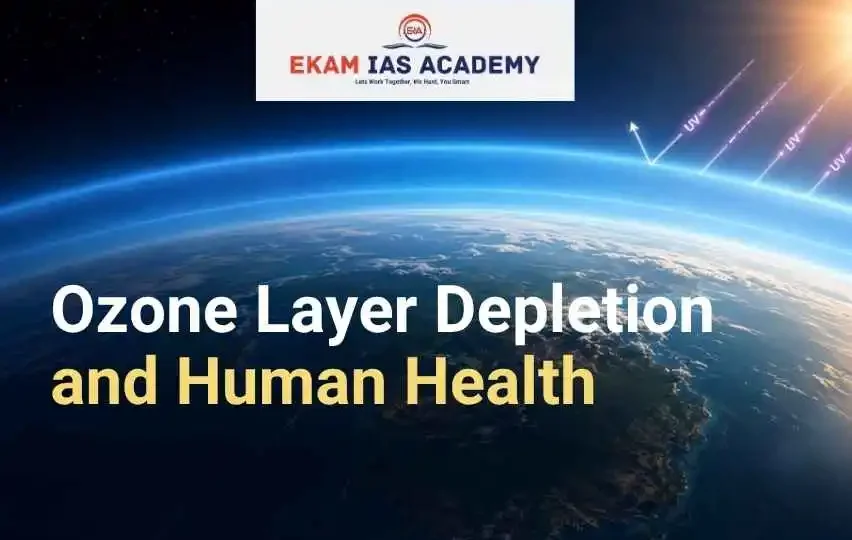
The study of Ozone Layer Depletion is not merely an assessment of environmental gases; it is a critical evaluation of a global ecological boundary that shields the biosphere from lethal cosmic rays.
This analytical framework breaks down the dynamics of Stratospheric Ozone, the health penalties of exposure, and global regulatory frameworks into high-yield.
Ozone Layer
The Ozone Layer is a diffuse layer of triatomic oxygen (O3) molecules concentrated primarily within the Stratospheric Ozone layer, roughly 15 to 30 kilometers above the Earth’s surface.
- The Atmospheric Shield: Unlike harmful tropospheric (ground-level) ozone, which acts as a toxic pollutant, stratospheric ozone serves as the Earth’s natural sunscreen.
- The Radiation Filter: Its primary ecological purpose is to absorb and neutralize high-energy solar Ultraviolet Radiation—specifically filtering out nearly 99% of lethal UV-C rays and the vast majority of harmful UV-B rays.
Ozone Layer Depletion
Ozone Layer Depletion refers to the steady thinning of this protective stratospheric shield due to the accumulation of anthropogenic industrial gases known as Ozone-Depleting Substances (ODS).
- The Chemical Drivers: Primary ODS include Chlorofluorocarbons (CFCs), Halons, Hydrochlorofluorocarbons (HCFCs), Carbon Tetrachloride, and Methyl Bromide.
- The Catalyst Action: When these stable compounds migrate to the stratosphere, intense solar UV radiation breaks them apart, releasing highly reactive chlorine and bromine atoms. A single free chlorine atom can trigger a devastating chain reaction, destroying up to 100,000 ozone molecules before being neutralized.
Stage Process ODS Release CFCs/Halons rise to the Stratosphere. UV Photolysis Solar UV splits ODS, releasing free Chlorine. Catalytic Cycle Single Chlorine atom destroys 100,000 O₃ molecules.
Direct Effects of Ozone Depletion on Human Health
The thinning of the stratospheric shield causes a rise in surface-level Ultraviolet Radiation, unleashing severe Ozone Depletion Health Impacts. The major UV Radiation Effects on the human body include:
A. Carcinogenesis (Skin Cancer)
Prolonged exposure to UV-B radiation alters human cellular DNA by inducing pyrimidine dimers, causing critical genetic errors during replication. This process directly leads to non-melanoma skin malignancies, such as basal and squamous cell carcinomas, as well as highly aggressive, fatal malignant melanomas.
B. Ocular Damage (Cataracts)
The human eye is exceptionally vulnerable to UV radiation. Increased UV-B exposure triggers oxidative damage to proteins within the ocular lens. This accelerates the development of cortical Cataracts, leading to clouding of the vision, macular degeneration, and potential blindness if left untreated.
C. Immune System Suppression
A critical, less visible consequence of ozone loss is systemic Immune System Suppression. UV radiation alters the cellular integrity and antigen-presenting capabilities of Langerhans cells in the skin. This dampens the body’s local immune response, reducing the efficacy of vaccinations and leaving individuals more vulnerable to viral and infectious diseases.
Environmental and Ecological Impacts
Beyond the direct links between Ozone Depletion and Human Health, increased UV radiation alters global ecosystems:
- Marine Food Webs: UV-B radiation penetrates deep into clear ocean waters, destroying phytoplankton populations. Because these micro-organisms form the baseline of aquatic food webs and act as a massive carbon sink, their decline threatens global fisheries and worsens climate change.
- Terrestrial Vegetation: High UV levels disrupt plant physiological processes, reducing chlorophyll content, shortening stem length, and lowering overall crop yields for agricultural staples like rice, wheat, and soybeans.
Global Regulatory Frameworks
- Vienna Convention (1985): The foundational, non-binding international framework created to promote cooperative scientific research on the ozone layer.
- Montreal Protocol (1987): Universally ratified and legally binding, this landmark treaty established strict phase-out schedules for nearly 100 industrial ODS.
- Kigali Amendment (2016): Expanded the Protocol’s mandate to phase down Hydrofluorocarbons (HFCs). While HFCs do not deplete stratospheric ozone, they are potent greenhouse gases with high global warming potential.
India's Domestic Actions
- Ozone Depleting Substances (Regulation and Control) Rules, 2000: Enacted under the Environment (Protection) Act, 1986, to legally restrict the production, trade, and industrial use of ODS.
- India Cooling Action Plan (ICAP): A multi-sectoral initiative designed to lower cooling demand, improve energy efficiency, and transition to eco-friendly, low-global-warming-potential alternatives by 2038.
Key Global Achievements
Thanks to the near-total phase-out of ODS, atmospheric concentrations of these harmful gases have dropped substantially. Current scientific models indicate that the Ozone Layer and Human Health safety baselines are recovering, with the layer on track to return to 1980 levels across most regions by 2045–2066.
Critical Operational Challenges
Despite historical successes, two major challenges remain for environmental governance:
- The Illegal Trade Nexus: Black-market trading of banned, low-cost ODS (such as CFC-11 and CFC-12) continues to plague customs enforcement in several developing regions.
- The Substitution Dilemma: Finding new, long-term replacements that do not deplete the ozone layer or contribute to global warming requires substantial capital and technology transfers to avoid burdening developing nations.
Conclusion
The global effort to repair the ozone layer demonstrates that international environmental governance can achieve meaningful results when backed by scientific consensus and legally binding mandates. Protecting the Ozone Layer and Human Health requires continued adherence to the Kigali Amendment, rigorous enforcement against illegal ODS manufacturing, and domestic investments in green cooling solutions like ICAP. Sustaining these efforts will safeguard global public health, secure agricultural outputs, and ensure long-term climate safety.
UPSC Prelims: PYQs & Practice Questions
Previous Year Questions (Prelims)
Q: Which one of the following gases is not an ozone-depleting substance? (UPSC CSE Prelims 2012)
(a) Chlorofluorocarbons
(b) Halons
(c) Methyl chloroform
(d) Methane
Answer: (d) Methane
Explanation:
Chlorofluorocarbons (CFCs), Halons, and Methyl Chloroform are classified under the Montreal Protocol as major Ozone-Depleting Substances (ODS) because they release reactive chlorine or bromine atoms that destroy stratospheric ozone. Methane (CH4), though a potent greenhouse gas, is not a direct ozone-depleting substance.
Q: The formation of the "Ozone Hole" in the Antarctic region has been a matter of global concern. What is the prominent reason for the formation of this hole? (UPSC CSE Prelims 1993 / Common Core Trend)
(a) Presence of prominent tropospheric turbulence and inflow of methane
(b) Presence of prominent polar front and stratospheric clouds; and inflow of chlorofluorocarbons
(c) Absence of polar fronts and presence of strong volcanic plumes
(d) Increased temperature at polar regions due to greenhouse effect
Answer: (b) Presence of prominent polar front and stratospheric clouds; and inflow of chlorofluorocarbons
Explanation:
The unique meteorological conditions over Antarctica accelerate Ozone Layer Depletion. During winter, the polar vortex isolates Antarctic air, causing extremely low temperatures and the formation of Polar Stratospheric Clouds (PSCs). These clouds provide a surface for converting stable chlorine compounds from CFCs into highly reactive chlorine radicals when sunlight returns in spring.
Practice Questions
Q: With reference to the effects of Ozone Depletion on human health and ecosystems, consider the following statements:
1. Increased solar Ultraviolet Radiation, specifically UV-B, alters human skin biology by inducing pyrimidine dimers, directly accelerating the risk of malignant melanomas and non-melanoma skin cancer.
2. Enhanced UV-B exposure acts as a system-wide catalyst for Immune System Suppression by lowering the antigen-presenting capacity of Langerhans cells, which may reduce immune response efficiency.
Which of the statements given above is/are correct?
(a) 1 only
(b) 2 only
(c) Both 1 and 2
(d) Neither 1 nor 2
Answer: (c) Both 1 and 2
Explanation:
Both statements are scientifically accurate. UV-B radiation can damage DNA by forming pyrimidine dimers, causing transcription errors that increase the risk of skin cancer. It can also affect human immunology by damaging dermal defense cells such as Langerhans cells, suppressing immune responses and increasing vulnerability to infectious pathogens.
Q: The Kigali Amendment, an active global milestone associated with the Montreal Protocol framework, aims to phase down which group of chemicals, and for what primary reason?
(a) Chlorofluorocarbons (CFCs) due to their direct toxicity to marine phytoplankton networks.
(b) Hydrofluorocarbons (HFCs) due to their exceptionally high Global Warming Potential (GWP), despite having zero impact on Ozone Layer Depletion.
(c) Methyl Bromide due to its adverse health impacts on agricultural soil health.
(d) Perfluorocarbons (PFCs) to lower urban ground-level smog concentrations.
Answer: (b) Hydrofluorocarbons (HFCs) due to their exceptionally high Global Warming Potential (GWP), despite having zero impact on Ozone Layer Depletion
Explanation:
The Kigali Amendment to the Montreal Protocol focuses on the phasedown of Hydrofluorocarbons (HFCs). HFCs do not directly deplete the ozone layer, but they have very high Global Warming Potential, making them significant contributors to climate change.
UPSC Mains – Previous Year & Practice Questions
Mains Previous Year Questions
Mains 2023
Question: Evaluate the success of the Montreal Protocol in comparison to the Kyoto Protocol regarding the mitigation of global atmospheric crises. Bring out the primary reasons behind its universal compliance.
Mains 2020
Question: Explain the physical and chemical mechanisms of Ozone Layer Depletion in the upper atmosphere. Highlight its major environmental and human health repercussions on the tropical biosphere.
Mains 2015
Question: Discuss the significance of the India Cooling Action Plan (ICAP) in balancing domestic economic development with international environmental mandates under the Montreal Protocol framework.
Mains 2014
Question: Give a comprehensive account of the atmospheric catalytic cycles driven by halogen radicals. How does the thinning of the Ozone Layer impact marine food security?
Zoology / Environment Core
Mains 2011
Question: What are Ozone-Depleting Substances (ODS)? Outline the institutional challenges India faces in phasing out Hydrochlorofluorocarbons (HCFCs) across its medium and small-scale refrigeration sectors.
Mains Practice Questions
[15 Marks | 250 Words]
Question: While the environmental impacts of Ozone Layer Depletion are well documented, its direct toll on human physiology, ranging from Cataracts to Immune System Suppression, presents a structural challenge to public healthcare infrastructure. Discuss.
[10 Marks | 150 Words]
Question: Analyze how increased surface-level exposure to Ultraviolet Radiation disrupts the primary productivity of marine ecosystems and alters terrestrial biogeochemical cycles.
[15 Marks | 250 Words]
Question: India’s enforcement of the Ozone Depleting Substances Rules highlights its dedication to global environmental commons. However, transitioning to green cooling alternatives creates economic and technical hurdles for small and medium enterprises. Suggest policy options to address this issue.



Ozone Layer Depletion and Human Health-FAQs
What is the ozone layer?
The ozone layer is a protective layer of ozone gas found mainly in the stratosphere, about 15 to 30 km above Earth’s surface. It absorbs harmful ultraviolet radiation from the Sun.
What causes ozone layer depletion?
Ozone layer depletion is mainly caused by ozone-depleting substances such as CFCs, halons, HCFCs, carbon tetrachloride and methyl bromide, which release chlorine and bromine in the stratosphere.
How does ozone depletion affect human health?
Ozone depletion increases UV-B radiation exposure, which can cause skin cancer, cataracts, eye damage, immune suppression and higher vulnerability to infections.
What are the environmental impacts of ozone depletion?
It can damage phytoplankton, disturb marine food chains, reduce crop yields, affect plant growth and weaken ecosystem productivity.
Why is ozone layer depletion important for UPSC?
It is important for UPSC because it connects with environment, climate governance, Montreal Protocol, Kigali Amendment, UV radiation, human health and sustainable development.