Table of Contents
ToggleHow Global Warming Affects Human Health – Risks, Vulnerable Groups, and India’s Response
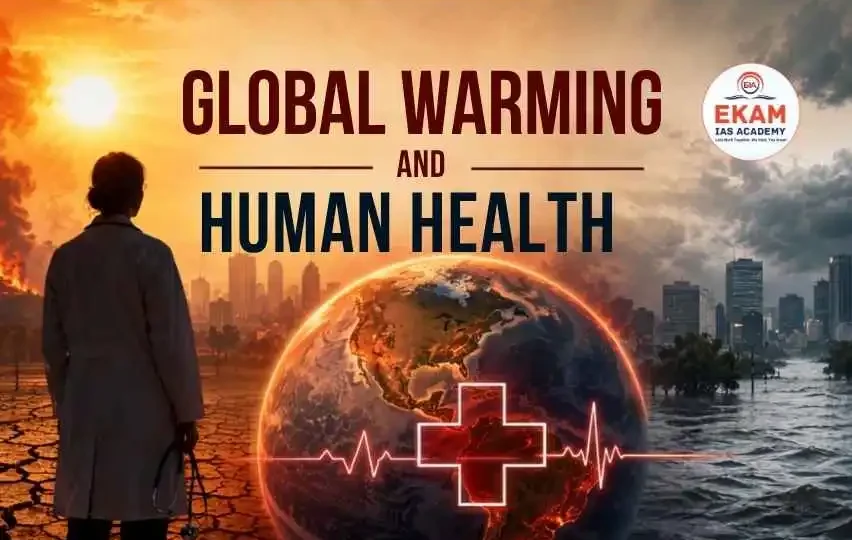
The World Health Organization (WHO) characterizes Climate Change and Health as a primary global emergency of the 21st century. It is no longer just an abstract planetary crisis; it acts as a severe threat multiplier that directly compromises medical infrastructures worldwide.
This comprehensive set of study notes explores how rising temperatures undermine the social determinants of health, shift epidemiology, and create unprecedented challenges for public health administration.
Global Warming and the Health Nexus
Global Warming and Human Health are deeply interconnected through atmospheric feedback loops.
- The Climate Driver: The continuous accumulation of long-lived greenhouse gases (GHGs) like CO2, CH4, and N2O traps solar radiation, altering historical weather baselines.
- The Exposure Pathway: The fundamental Global Warming Effects on Health manifest through both direct pathways (e.g., thermal shock from intense heat) and indirect pathways (e.g., ecosystem disruptions that alter infectious disease vectors or reduce nutritional yields).
How Global Warming Affects Human Health
The mechanisms through which Climate Change Health Impacts disrupt the human body can be categorized into three major environmental dimensions:
| Pathway | Impact |
|---|---|
| Direct Thermal Stress | Acute failures in organ systems via Heatstroke. |
| Biological Vectors | Expanding zones for Malaria and Dengue. |
| Systemic Deprivation | Widespread failures in Crop Yields & Clean Water. |
- Primary Pathways: Exposure to severe Extreme Weather Events such as cyclones, unseasonal floods, and prolonged droughts, which cause immediate physical trauma and mortality.
- Secondary Pathways: Ecosystem failures that trigger the rapid replication of pathogens, leading to contaminated water networks and agricultural yields with diminished micronutrient profiles.
- Tertiary Pathways: Forced socioeconomic displacement, resource conflict, and mental trauma caused by the loss of traditional, climate-dependent livelihoods.
Major Health Impacts of Global Warming
A. Extreme Heatwaves and Cardiovascular Strain
The surge in intense Heatwaves and Health complications presents an acute risk to public safety. Extended exposure to high wet-bulb temperatures impairs the human body’s natural thermoregulation. This places extreme stress on the cardiovascular and renal systems, leading to a rise in acute kidney injury, severe heat exhaustion, and fatal cases of heatstroke.
B. Proliferation of Vector-Borne Diseases
As sub-tropical climate zones expand northward and into higher altitudes, the transmission windows for dangerous Vector-Borne Diseases are widening. Higher ambient humidity and warmer winters accelerate the reproductive cycles and biting rates of Anopheles and Aedes mosquitoes, leading to an expansion of malaria, Zika virus, and dengue into areas previously free of these diseases.
C. Synergistic Effects of Air Pollution
The intersection of Air Pollution and Global Warming creates a hazardous atmospheric mix. Rising temperatures speed up the photochemical reactions that form ground-level ozone (O3) and increase the frequency of intense wildfires. This leads to high concentrations of fine particulate matter (PM2.5), which triggers widespread respiratory and cardiovascular illnesses, including chronic obstructive pulmonary disease (COPD) and severe asthma attacks.
D. Climate Change and Mental Health
A critical focus area in recent medical studies is the link between Climate Change and Mental Health. The psychological toll of surviving catastrophic weather events, combined with the chronic anxiety over systemic ecological decline (often termed “eco-anxiety”), has caused a measurable rise in post-traumatic stress disorder (PTSD), severe depression, and domestic stress within vulnerable communities.
Vulnerable Groups and the Global Health Burden
The Health Effects of Global Warming are not distributed equally across populations. The Global Health Burden falls disproportionately on groups with lower physiological resilience or limited economic safety nets:
- Pediatric and Geriatric Populations: Children face heightened risks of severe dehydration and malnutrition, while adults over 65 experience a sharp increase in heat-related mortality.
- Occupational Risk Groups: Outdoor laborers, such as agricultural and construction workers, face direct exposure to extreme heat and dangerous ambient air pollution.
- Socioeconomically Disadvantaged Communities: Marginalized populations often live in low-quality housing within urban heat islands, lacking access to clean drinking water, mechanical cooling, or adequate healthcare infrastructure.
Health Impacts of Global Warming in India
India is highly vulnerable to the intersection of Climate Change and Public Health challenges:
- The Monsoon Disruption: Erratic monsoon cycles trigger intense localized flooding that overwhelms urban sanitation systems, leading to regular outbreaks of water-borne pathogens like cholera and typhoid.
- The Lost Labor Capacity: Extreme heat stress reduces safe working hours for outdoor workers across the Indo-Gangetic plain, threatening rural livelihoods and reducing national labor productivity.
- Malnutrition Vulnerability: Rising temperatures and unpredictable rainfall drop major crop yields, directly worsening child stunting and wasting across vulnerable districts.
Institutional Initiatives
- National Action Plan on Climate Change (NAPCC): Includes the specialized Prime Minister’s Council on Climate Change to coordinate health adaptation and mitigation strategies.
- National Programme on Climate Change and Human Health (NPCCHH): Rolled out under the Ministry of Health and Family Welfare to build healthcare capacity, establish real-time bio-surveillance, and reduce the impact of climate-sensitive illnesses.
- Heat Action Plans (HAPs): Deployed across cities and states to provide early warning systems, adjust outdoor labor hours, and set up designated cooling centers during peak summer months.
Global Initiatives
- WHO Global Strategy on Health, Environment and Climate Change: A comprehensive roadmap designed to guide nations in building climate-resilient, low-carbon healthcare facilities.
- The COP Health Guiding Frameworks: Recent UNFCCC climate change summits have integrated dedicated “Health Days” to mobilize international climate finance toward protecting public health infrastructure.
Challenges
- The Financing Gap: Global climate funds remain heavily focused on mitigation projects (like renewable energy), leaving adaptation measures for public health underfunded.
- Data Fragmentation: Many developing countries lack integrated epidemiological data systems that connect real-time weather anomalies directly to hospital admission rates.
Conclusion
Addressing the Health Impacts of Global Warming requires a fundamental shift from reactive medical treatment to proactive, climate-resilient public health strategies. Mitigating carbon emissions delivers clear, immediate health co-benefits, particularly by reducing ambient air pollution and preventing premature deaths. For India, investing in robust, climate-informed early warning systems, upgrading rural healthcare centers, and implementing localized Heat Action Plans are essential steps to shield vulnerable communities from the growing health risks of a warming planet.
UPSC Prelims: PYQs & Practice Questions
Previous Year Questions (Prelims)
UPSC CSE Prelims 2022
Q: Consider the following statements:
1. High-intensity heatwaves in India are strongly correlated with the presence of ground-level ozone (O3) pollution.
2. Ground-level ozone is emitted directly into the atmosphere from the tailpipes of heavy transport vehicles.
Which of the statements given above is/are correct?
(a) 1 only
(b) 2 only
(c) Both 1 and 2
(d) Neither 1 nor 2
Answer: (a) 1 only
Explanation:
Statement 1 is correct. High ambient temperatures and strong solar radiation during heatwaves accelerate the photochemical reactions that form ground-level ozone, causing dangerous pollution spikes during extreme heat events. Statement 2 is incorrect because ground-level ozone is a secondary pollutant. It is not emitted directly from vehicle exhaust; rather, it forms when primary pollutants like Nitrogen Oxides (NOx) and Volatile Organic Compounds (VOCs) react in the presence of sunlight.
UPSC CSE Prelims 2013
Q: Government of India encourages the cultivation of Sea Buckthorn. What is the importance of this plant?
1. It helps in controlling soil erosion and in desertification control.
2. It is a rich source of biodiesel.
3. It has nutritional value and is well-adapted to live in cold deserts.
4. Its timber is of great commercial value.
Select the correct answer using the code given below:
(a) 1 and 3 only
(b) 2, 3 and 4 only
(c) 1, 3 and 4 only
(d) 1, 2, 3 and 4
Answer: (a) 1 and 3 only
Explanation:
Sea Buckthorn is a soil-binding plant that helps in soil erosion control and desertification control, especially in high-altitude cold desert regions like Ladakh. Its berries are rich in vitamins and nutrients, making it valuable for local nutrition. However, it is not a major source of commercial timber or high-yield biodiesel. Hence, the correct answer is (a).
Practice Questions
Q: With reference to the Health Impacts of Global Warming, consider the following statements regarding Wet-Bulb Temperature:
1. It is a combined metric of ambient dry-bulb temperature and relative humidity that measures the human body's capacity to cool itself via sweat evaporation.
2. A sustained wet-bulb temperature threshold of 35°C marks the absolute limit of human survivability, beyond which metabolic heat exhaustion turns fatal regardless of fitness levels.
Which of the statements given above is/are correct?
(a) 1 only
(b) 2 only
(c) Both 1 and 2
(d) Neither 1 nor 2
Answer: (c) Both 1 and 2
Explanation:
Both statements are correct. Wet-bulb temperature reflects the cooling limit achievable through evaporation. If the wet-bulb temperature reaches 35°C, air saturation prevents sweat from evaporating from human skin. This halts natural thermoregulation, causing metabolic heat storage, rapid core temperature rise, and possible systemic organ failure.
Q: The National Programme on Climate Change and Human Health (NPCCHH), which aims to reduce public health vulnerabilities of climate-sensitive disorders in India, is an administrative initiative managed by which Union Ministry?
(a) Ministry of Environment, Forest and Climate Change (MoEFCC)
(b) Ministry of Health and Family Welfare (MoHFW)
(c) Ministry of Science and Technology
(d) Ministry of Earth Sciences (MoES)
Answer: (b) Ministry of Health and Family Welfare (MoHFW)
Explanation:
While environmental parameters are monitored by the MoEFCC, the NPCCHH is a dedicated public health capacity-building framework executed by the Ministry of Health and Family Welfare. It prepares hospitals and healthcare workers to respond to climate-related health risks and epidemiological shifts.
UPSC Mains – Previous Year & Practice Questions
Mains Previous Year Questions
Mains 2024
Question: Analyze the socio-economic and public health consequences of severe heatwave conditions in the Indo-Gangetic plains, and suggest administrative mitigation strategies.
Mains 2022
Question: Discuss the ecological and health hazards associated with the depletion of urban wetlands and the subsequent amplification of urban heat island effects in tier-1 Indian cities.
Mains 2020
Question: Explain the synergistic relationship between rising ambient air pollution and increasing global temperatures. How does this double burden impact public health delivery in developing nations?
Mains 2017
Question: Climate change is a global problem. How will India be affected by climate change? Focus on the vulnerabilities of food security, agricultural yields, and nutritional deficiencies.
Mains 2014
Question: Environmental degradation cannot be halted without evaluating its direct toll on human health. Elucidate how the rights of vulnerable communities are violated by institutional apathy toward climate adaptation.
Mains Practice Questions
[15 Marks | 250 Words]
Question: Global warming operates as an environmental threat multiplier that alters the transmission windows and geographic boundaries of infectious vectors. Examine the challenges this poses to India's public health surveillance networks.
[10 Marks | 150 Words]
Question: Unplanned concrete urbanization has intensified the Urban Heat Island phenomenon across Indian metros. Evaluate the role of Heat Action Plans in reducing cardiovascular and renal mortality among outdoor daily wage laborers.
[15 Marks | 250 Words]
Question: The psychiatric consequences of Extreme Weather Events and chronic ecological degradation remain highly under-reported. Discuss the concept of eco-anxiety and highlight the need to integrate psychological resilience into national climate adaptation strategies.



Global Warming and Human Health-FAQs
How does global warming affect human health?
Global warming affects human health through extreme heatwaves, air pollution, vector-borne diseases, water-borne infections, food insecurity, mental stress and climate-related disasters.
What are the major health impacts of global warming?
The major health impacts include heatstroke, dehydration, cardiovascular stress, kidney injury, asthma, dengue, malaria, cholera, malnutrition, depression and post-traumatic stress disorder.
How do heatwaves affect health?
Heatwaves increase body temperature and stress the heart, kidneys and nervous system. They can cause heat exhaustion, heatstroke, dehydration and higher mortality among elderly people, children and outdoor workers.
How does global warming increase vector-borne diseases?
Rising temperatures and humidity expand the breeding zones of mosquitoes, increasing the spread of diseases such as dengue, malaria, chikungunya and Zika virus.
Why is global warming and health important for UPSC?
This topic is important for UPSC because it connects with climate change, public health, heat action plans, vector-borne diseases, air pollution, food security, disaster management and sustainable development.