
Table of Contents
ToggleTungabhadra Water Dispute
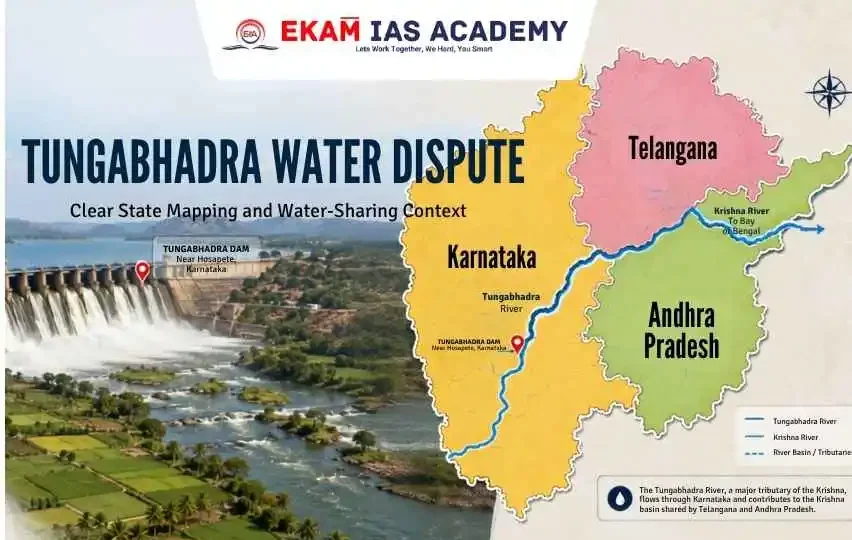
The Tungabhadra Water Dispute has emerged as a major issue in India’s inter-state river water management system. Recent discussions gained attention after the Union Government proposed a High-Level Committee following cooperation among Karnataka, Andhra Pradesh, and Telangana regarding the inauguration of 33 new spillway gates at the Tungabhadra Dam. The development highlights the importance of cooperative federalism, equitable water distribution, and sustainable river basin management.
Why is the Tungabhadra Water Dispute in News?
The dispute recently returned to the spotlight due to government efforts to resolve long-standing water-sharing disagreements among states in the Tungabhadra basin.
Major reasons include:
- Proposal for a High-Level Committee
- Consensus among Karnataka, Andhra Pradesh, and Telangana
- Installation of 33 new spillway gates
- Efforts toward an amicable and cooperative settlement
The issue reflects broader challenges associated with water security and river basin governance in India.
About the Tungabhadra River
The Tungabhadra River is a major perennial right-bank tributary of the Krishna River. It plays a significant role in irrigation, agriculture, and water supply across southern India.
Origin of Tungabhadra River
The river is formed through the confluence of:
- Tunga River
- Bhadra River
Both rivers originate in the Western Ghats near Varaha Parvatha and Gangamoola in Karnataka.
The rivers meet at Kudli, near Shivamogga, after which they continue as the Tungabhadra River.
Course of the River
Important features of its course include:
- Total river length: approximately 531 km
- Flows mainly through Karnataka
- Forms parts of Karnataka–Andhra Pradesh and Andhra Pradesh–Telangana borders
- Joins the Krishna River at Sangameswaram in Andhra Pradesh
- Combined Krishna waters finally drain into the Bay of Bengal at Hamsaladeevi
Tungabhadra Reservoir Project and Importance
The Tungabhadra Reservoir Project was commissioned in the 1950s near Hosapete in Karnataka’s Vijayanagara district.
Importance of the Project
The project plays an important role in:
- Irrigation support
- Agricultural development
- Drought management
- Inter-state water sharing
- Regional economic development
The project is crucial for farmers in drought-prone regions of southern India.
Water Sharing and Present Issues
The Krishna Water Disputes Tribunal-I, headed by Justice R.S. Bachawat, originally allocated Tungabhadra waters in a 65:35 ratio between Karnataka and undivided Andhra Pradesh.
After the bifurcation of Andhra Pradesh in 2014, Telangana received an entitlement of 15.9 TMC from the Tungabhadra system.
Major Challenges
Current issues include:
- Heavy siltation in reservoirs
- Reduction in original storage capacity of around 134 TMC
- Reduced water availability in downstream areas
- Growing demand for irrigation and drinking water
- Inter-state disagreements over water allocation
The Rajolibanda Diversion Scheme (RDS) also remains important as it diverts water through a 143-km canal to drought-prone areas.
Constitutional Framework Governing Inter-State River Disputes
India has established constitutional and legal mechanisms for handling river water conflicts.
Constitutional Provisions
Important provisions include:
- Entry 17 of State List – Water as a state subject
- Entry 56 of Union List – Regulation of inter-state rivers
- Article 262 – Parliament can adjudicate inter-state river disputes
- Inter-State River Water Disputes Act, 1956
The Cauvery Judgment (2018) also emphasized equitable sharing and recognized inter-state rivers as national assets.
Way Forward for Sustainable Resolution
A long-term solution requires a balanced and cooperative approach.
Suggested Measures
- Scientific assessment of water availability
- Dam modernization
- Desiltation and reservoir restoration
- Canal repair and efficiency improvement
- Fair and transparent water-sharing mechanisms
- Strengthening cooperative federalism
Conclusion
The Tungabhadra Water Dispute demonstrates the complexities of managing shared water resources in India. Sustainable river governance requires cooperation rather than confrontation. A combination of scientific planning, legal mechanisms, and cooperative approaches can ensure long-term water security for states dependent on the Krishna River basin.



Tungabhadra Water Dispute-FAQs Answered
What is the Tungabhadra Water Dispute?
The Tungabhadra Water Dispute is an inter-state water-sharing issue involving Karnataka, Andhra Pradesh and Telangana over the allocation and use of Tungabhadra River waters.
Why is the Tungabhadra Water Dispute in news?
It is in news because the Union Government proposed a High-Level Committee after Karnataka, Andhra Pradesh and Telangana showed cooperation during the inauguration of 33 new spillway gates at Tungabhadra Dam.
Which states are involved in the Tungabhadra Water Dispute?
The major states involved are Karnataka, Andhra Pradesh and Telangana, as the Tungabhadra River and reservoir system support irrigation and water needs across these regions.
What are the major challenges in the Tungabhadra basin?
Major challenges include reservoir siltation, reduced storage capacity, rising irrigation demand, downstream water shortage and disagreements over water allocation.
Why is the Tungabhadra Water Dispute important for UPSC?
It is important for UPSC because it connects with Article 262, inter-state river water disputes, cooperative federalism, Krishna basin, water governance, irrigation and sustainable river management.