
Table of Contents
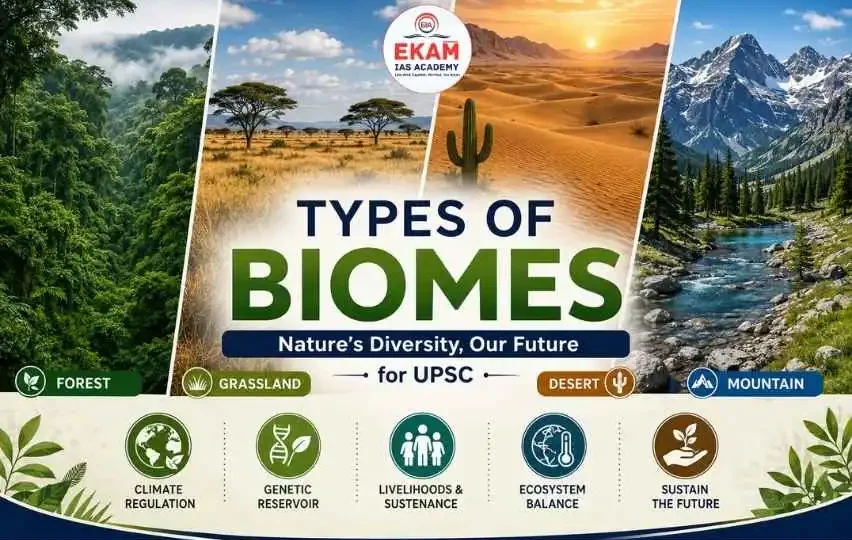
ToggleA biome is a large geographic area characterized by its climate, soil, and distinctive flora and fauna. For types of biomes UPSC preparation, it is crucial to recognize that temperature and precipitation are the primary drivers that differentiate one biome from another.
Definition of Biome
A biome is a major regional or global biotic community, such as a forest grassland desert mountain ecosystem. It is defined by the physiognomy of the dominant vegetation and the adaptations of organisms to that specific environment. Unlike an ecosystem, which can be small, a biome is a massive unit often spanning continents.
Types of Biomes
Forest Ecosystems
Forests are dominated by trees and cover roughly one-third of the Earth’s land.
- Tropical Rainforests: Characterized by high rainfall and multi-layered canopies. They possess the highest biodiversity.
- Temperate Deciduous Forests: Found in mid-latitudes, where trees shed leaves in winter.
- Coniferous (Taiga) Forests: Dominated by needle-leaved evergreen trees, adapted to cold, sub-arctic climates.
Grassland Ecosystem
Grasslands occur where rainfall is intermediate—not enough for forests but more than a desert.
- Tropical Grasslands (Savanna): Marked by scattered trees and distinct wet/dry seasons (e.g., African Savanna).
- Temperate Grasslands (Prairies/Steppes): Known for highly fertile soils, these are often the “breadbaskets” of the world. In India, these are found in the Terai region.
Desert Ecosystem
Deserts are characterized by extremely low precipitation (less than 25 cm annually).
- Adaptations: Plants (xerophytes) have thick cuticles and succulent stems. Animals are often nocturnal to avoid daytime heat.
- Hot vs. Cold: Includes hot deserts like the Thar and cold high-altitude deserts like Ladakh.
Mountain Ecosystem
Mountain biomes are unique because they exhibit altitudinal zonation.
- As altitude increases, the temperature drops, mimicking the transition from the equator to the poles within a single mountain range.
- Flora: Transitions from tropical/temperate forests at the base to alpine meadows and finally lichens/mosses at the peak.
Comparison of Major Biomes
| Biome | Temperature | Precipitation | Key Vegetation |
| Forest | Variable (High in Tropical) | High | Trees, Epiphytes |
| Grassland | Moderate to High | Seasonal/Low | Grasses, scattered shrubs |
| Desert | Extreme (Hot/Cold) | Very Low | Cacti, thorny bushes |
| Mountain | Decreases with height | Variable | Conifers, Alpine flora |
Importance of Biomes
- Climate Regulation: Forests act as massive carbon sinks, mitigating the greenhouse effect.
- Genetic Reservoir: Biomes like rainforests hold the genetic keys to future medicines and crops.
- Livelihoods: Millions of people depend on grasslands for pastoralism and mountains for freshwater (the “Water Towers” of the world).
Human Impacts on Biomes
- Deforestation: Agriculture and urbanization are shrinking forest biomes, leading to habitat fragmentation.
- Desertification: Overgrazing and poor irrigation are turning productive grasslands into deserts.
- Climate Change: Mountain biomes are most sensitive, with glacial retreat threatening downstream water security.
Conclusion
For biomes UPSC studies, the focus must remain on the delicate balance of climate and life. Protecting these biomes is not just about wildlife conservation; it is about maintaining the ecosystem services that sustain human civilization. As students of environment and ecology, recognizing the interconnectedness of these regions is vital for formulating global conservation strategies.
UPSC Prelims: PYQs & Practice Questions
Previous Year Questions (Prelims)
Q: Which of the following leaf modifications occur(s) in the desert ecosystem to inhibit water loss? (UPSC CSE Prelims 2018)
1. Hard and waxy leaves
2. Tiny leaves or no leaves
3. Thorns instead of leaves
Select the correct answer using the code given below:
(a) 2 and 3 only
(b) 2 only
(c) 3 only
(d) 1, 2 and 3
Answer: (d) 1, 2 and 3
Explanation:
Desert plants (xerophytes) adapt to conserve water. Waxy cuticles reduce transpiration, reduced leaf size limits surface area, and thorns minimize water loss while providing protection.
Q: Which one of the following is the characteristic climate of the Tropical Savannah Region (Grassland)? (UPSC CSE Prelims 2013)
(a) Rainfall throughout the year
(b) Rainfall in winter only
(c) An extremely short dry season
(d) A definite dry and wet season
Answer: (d) A definite dry and wet season
Explanation:
The Savannah ecosystem is defined by clear seasonality—a hot, wet season followed by a dry season. This prevents dense forest growth and supports grasses with scattered trees.
Practice Questions
Q: With reference to mountain ecosystems, the term "Altitudinal Zonation" refers to:
(a) The distribution of species based on the slope of the mountain
(b) The change in vegetation communities as one moves higher in elevation
(c) The movement of migratory birds across different mountain ranges
(d) The process of soil erosion at high altitudes
Answer: (b) The change in vegetation communities
Explanation:
As altitude increases, temperature and oxygen levels decrease, resulting in distinct vegetation zones (e.g., deciduous → coniferous → alpine tundra). This pattern mirrors latitudinal zonation.
Q: Which biome is often referred to as the "Breadbasket of the World" due to its highly fertile Chernozem soils?
(a) Tropical Rainforest
(b) Taiga (Coniferous Forest)
(c) Temperate Grassland
(d) Hot Desert
Answer: (c) Temperate Grassland
Explanation:
Temperate grasslands (e.g., Prairies, Steppes) have deep, nutrient-rich Chernozem soils, making them ideal for large-scale cereal cultivation and earning the title “breadbasket.”
UPSC Mains – Previous Year & Practice Questions
Mains Previous Year Questions
Question: Explain the causes and effects of desertification. How is it related to the loss of biodiversity? (Mains 2021)
Question: What is the economic significance of the mountain ecosystem? How does it affect the climate of India? (Mains 2019)
Question: Discuss the causes and consequences of deforestation. How does it contribute to climate change? (Mains 2017)
Question: Explain the role of grasslands in the conservation of the Great Indian Bustard. (Mains 2023)
Question: “The standard of living in a country can be raised only through sustainable development.” Discuss in the context of mountain and forest biomes. (Mains 2015)
Mains Practice Questions
[10 Marks | 150 Words]
Question: How does the 'Rain Shadow Effect' lead to the formation of desert ecosystems? Explain with examples from the Indian subcontinent.
[15 Marks | 250 Words]
Question: Analyze the ecological importance of Tropical Rainforests as carbon sinks. What are the global implications of reaching a 'tipping point' in the Amazon biome?
[15 Marks | 250 Words]
Question: Mountain biomes are often called the 'Water Towers of the World'. Discuss the impact of glacial retreat on the water security of downstream populations in the Himalayas.



Biomes-FAQs
What is the main factor that distinguishes a grassland from a forest?
Rainfall. Forests require high, consistent rainfall. Grasslands occur in regions where rainfall is sufficient to support grass but insufficient to support the growth of large, dense tree canopies.
What are 'Xerophytes' and where are they found?
Xerophytes are plants adapted to survive in environments with little liquid water, such as desert ecosystems. They often feature deep roots, succulent stems for water storage, and needle-like leaves.
Why do mountain ecosystems have so many different types of biomes in one place?
Due to Altitudinal Zonation. A 1,000-meter increase in height is roughly equivalent to traveling several hundred kilometers toward the poles in terms of temperature change.
What is 'Tundra' and how does it differ from a Desert?
Tundra is a “cold desert” found in the Arctic or high mountains. While both have very low precipitation, the Tundra is characterized by permafrost (permanently frozen subsoil) and extremely low temperatures.
How does a Savanna differ from a Prairie?
Savanna is a tropical grassland with scattered trees and a warm climate year-round. A Prairie is a temperate grassland with cold winters, hot summers, and almost no trees.
You May Also Read
Grassland Ecosysytem