Table of Contents
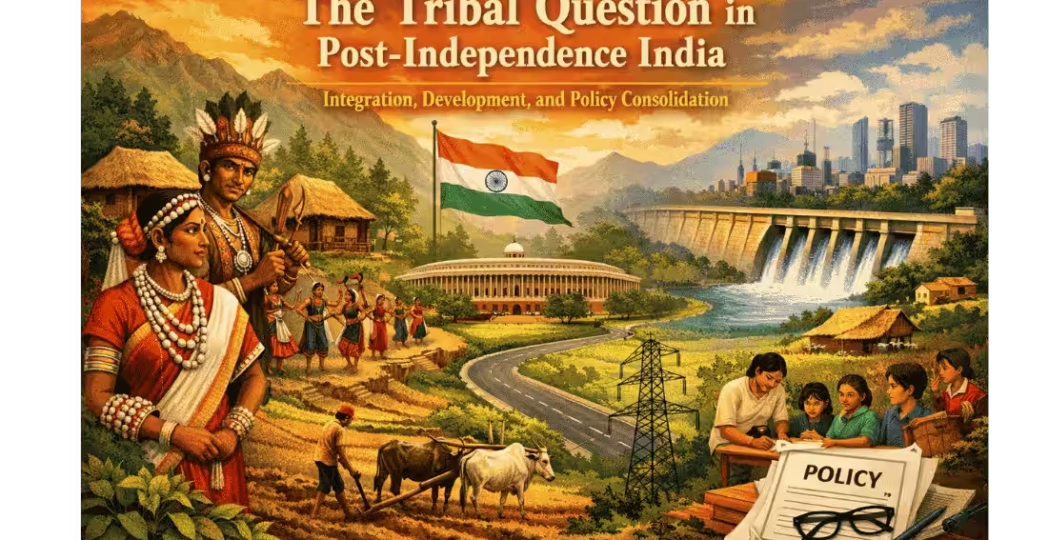
ToggleThe Tribal Question in Post-Independence India: Integration, Development, and Policy Consolidation
I. Introduction: The Legacy of Colonialism and the New Dawn
At the time of Independence in 1947, India inherited a complex tribal landscape. The British policy of “Isolation” had left tribal areas as “Excluded” or “Partially Excluded,” effectively cutting them off from the mainstream while allowing for economic exploitation by contractors and moneylenders. The task before the newly independent nation was to integrate these communities into the democratic fabric without destroying their unique cultural identity.
II. The Nehruvian Approach: Tribal Panchsheel
Jawaharlal Nehru, heavily influenced by the anthropologist Verrier Elwin, advocated for a middle path between total isolation and forced assimilation. This was codified as the Tribal Panchsheel (Five Principles), which served as the bedrock of India’s early tribal policy:
- Non-Imposition: People should develop along the lines of their own genius. We should avoid imposing anything on them.
- Respect for Land and Forest Rights: Tribal rights in land and forests should be respected.
- Encouraging Leadership: We should try to train and build up a team of their own people to do the work of administration and development.
- Avoid Over-Administration: We should not over-administer these areas or overwhelm them with a multiplicity of schemes.
- Quality of Human Character: We should judge results, not by statistics or the amount of money spent, but by the quality of human character that is evolved.
III. The Constitutional Framework: Protection and Empowerment
The Indian Constitution provided a robust legal structure to protect tribal interests:
1. The Fifth and Sixth Schedules
- Fifth Schedule: Applicable to “Scheduled Areas” in mainland India. It provides for the creation of Tribal Advisory Councils to advise the Governor on matters of welfare and advancement.
- Sixth Schedule: Applicable to North-Eastern states (Assam, Meghalaya, Tripura, and Mizoram). It allows for Autonomous District Councils (ADCs) with legislative and judicial powers, ensuring a high degree of self-governance.
2. Special Provisions
- Article 342: Defines who “Scheduled Tribes” are.
- Article 164: Provides for a Minister in charge of tribal welfare in states like Chhattisgarh, Jharkhand, Madhya Pradesh, and Odisha.
- Article 275: Grants-in-aid from the Union to the States for the promotion of the welfare of Scheduled Tribes.
IV. Major Tribal Movements and Issues Post-1947
1. The Northeast Insurgencies
The integration of the North-East was one of the greatest challenges for the Nehru government. Groups like the Nagas (led by A.Z. Phizo) demanded total independence, leading to a long-drawn-out conflict. The government responded with a mix of military action and political negotiation, eventually creating the state of Nagaland in 1963.
2. The Jharkhand Movement
Originally a movement for cultural and ethnic identity among the Santhals and Mundas, it eventually became a political demand for a separate state to escape exploitation by “outsiders” (Dikus). This culminated in the creation of Jharkhand in 2000.
3. Naxalism and Tribal Discontent
The failure of land reforms and the continued alienation of tribal lands for mining and industrial projects led to the rise of the Naxalite movement. Tribals in the “Red Corridor” (Chhattisgarh, Odisha, Jharkhand) became caught between the state and the insurgents, highlighting the “Development Deficit” in these regions.
V. Evolution of Tribal Policy: From Welfare to Rights
1. The Tribal Sub-Plan (TSP) – 1974
Introduced during the Fifth Five-Year Plan, the TSP ensured that a portion of the state and central budget was specifically earmarked for tribal development, proportionate to their population.
2. PESA Act (1996)
The Panchayats (Extension to Scheduled Areas) Act was a landmark legislation that extended the 73rd Amendment to tribal areas. It empowered Gram Sabhas to manage local resources, including minor forest produce and land alienation issues.
3. The Forest Rights Act (FRA) – 2006
The Scheduled Tribes and Other Traditional Forest Dwellers (Recognition of Forest Rights) Act aimed to undo “historical injustice” by granting legal titles to forest lands that tribes had occupied for generations.
VI. Contemporary Challenges: The Integration-Development Conflict
Despite decades of policy consolidation, several challenges remain:
- Land Alienation: Large-scale displacement due to dams (e.g., Narmada Bachao Andolan) and mining projects remains a flashpoint.
- Loss of Language and Culture: Modern education systems often fail to incorporate tribal languages, leading to a loss of indigenous knowledge.
Health and Nutrition: High rates of malnutrition and diseases like sickle cell anemia persist in tribal pockets.
VII. Conclusion: The Way Forward
The post-independence history of tribal policy shows a shift from “Paternalistic Welfare” to a “Rights-Based Approach.” The future lies in ensuring that the spirit of Nehru’s Panchsheel is combined with modern democratic decentralization (PESA and FRA) to allow India’s tribes to be partners in national growth without losing their soul.
UPSC Prelims: PYQs & Practice Questions
Previous Year Questions (PYQs)
Question 1 (UPSC Prelims 2019)
Q: Under which Schedule of the Constitution of India can the transfer of tribal land to private parties for mining be declared null and void?
Options:
(a) Third Schedule | (b) Fifth Schedule | (c) Ninth Schedule | (d) Twelfth Schedule
Answer: (b)
Explanation: The Fifth Schedule deals with the administration of Scheduled Areas. In the landmark Samatha vs. State of Andhra Pradesh case, the Supreme Court held that transfer of tribal land in Scheduled Areas to private parties for mining is unconstitutional and that the State acts as a custodian of tribal interests.
Practice Question 2 (UPSC Prelims – Contextual)
Q: The "Tribal Panchsheel" for tribal development was formulated by:
Options:
(a) Mahatma Gandhi | (b) B.R. Ambedkar | (c) Jawaharlal Nehru | (d) Verrier Elwin
Answer: (c)
Explanation: Jawaharlal Nehru, with inputs from anthropologist Verrier Elwin, articulated five guiding principles (Tribal Panchsheel) for tribal policy—stressing that tribes should develop according to their own genius, with minimal external imposition and protection of their rights, land, and culture.
Prelims Practice Questions
Question 1
Q: The PESA Act, 1996 extends the provisions of Panchayats to the Scheduled Areas under which Schedule of the Constitution?
Options:
(a) Fourth Schedule | (b) Fifth Schedule | (c) Sixth Schedule | (d) Seventh Schedule
Answer: (b) Fifth Schedule
Explanation: The Panchayats (Extension to the Scheduled Areas) Act, 1996 (PESA) applies to Scheduled Areas under the Fifth Schedule (not the Sixth Schedule). It strengthens Gram Sabha-based self-governance and community control over local resources in eligible states.
Question 2
Q: Which Constitutional Article empowers the President to specify the castes, races, or tribes that shall be deemed to be Scheduled Tribes?
Options:
(a) Article 330 | (b) Article 332 | (c) Article 342 | (d) Article 356
Answer: (c) Article 342
Explanation: Under Article 342, the President notifies Scheduled Tribes for a State/UT in consultation with the Governor. Any subsequent inclusion/exclusion is done only by Parliament through law.
Mains Previous Year Questions (Post-Independence)
Tribal Panchsheel: Vision vs Implementation
Question: "The Tribal Panchsheel was a visionary document, yet its implementation faced several hurdles in post-independence India." Discuss. (GS Paper I)
Industrialisation & Mining: Displacement in Red Corridor
Question: Examine the impact of industrialization and mining on the displacement of tribal communities in the 'Red Corridor' of India. (GS Paper II)
Sixth Schedule: Cultural Identity of North-East Tribes
Question: Analyze the role of the Sixth Schedule in preserving the cultural identity of the North-Eastern tribes. (GS Paper II / Internal Security)
Forest Rights Act, 2006: Correcting Historical Injustice
Question: How far do you agree that the Forest Rights Act (2006) has been successful in correcting the "historical injustice" against forest-dwelling communities? (GS Paper III)
Jharkhand Movement: Culture to Statehood Demand
Question: Discuss the evolution of the Jharkhand movement from a cultural movement to a demand for statehood. (GS Paper I)
Mains Practice Questions
Fifth vs Sixth Schedule: Tribal Governance & Safeguards
Question: Compare and contrast the constitutional protections provided under the Fifth and Sixth Schedules of the Indian Constitution. (250 Words)
Tribal Integration & Contemporary Insurgencies
Question: “The integration of tribes into the Indian mainstream remains an incomplete project.” Critically evaluate this statement in light of recent tribal insurgencies. (250 Words)
Verrier Elwin: Ideas that Shaped Tribal Policy
Question: Discuss the contribution of Verrier Elwin to the shaping of India’s post-independence tribal policy. (250 Words)
Frequently Asked Questions (FAQs)
What is the 'Nehru-Elwin' approach to tribal policy?
- It is a policy of “controlled integration” or the “middle path.” It avoided both total isolation (treating tribes like museum pieces) and total assimilation (forcing them to lose their identity). It advocated for development without destroying tribal culture and traditions.
What is the difference between Fifth and Sixth Schedule areas?
- Fifth Schedule: Applies to tribal areas in 10 states of mainland India (e.g., MP, Odisha). It uses Tribal Advisory Councils with an advisory role to the Governor.
- Sixth Schedule: Applies to specific states in the Northeast (Assam, Meghalaya, Tripura, Mizoram). It creates Autonomous District Councils (ADCs) which have significant legislative and judicial powers.
Why was the PESA Act (1996) enacted?
- The 73rd Amendment (Panchayati Raj) did not automatically apply to Scheduled Areas. PESA was enacted to give these areas self-rule, specifically empowering the Gram Sabha to manage land, water, forest produce, and social issues to prevent exploitation.
What are Particularly Vulnerable Tribal Groups (PVTGs)?
- PVTGs are a sub-classification within Scheduled Tribes that are more vulnerable due to declining or stagnant populations, low literacy, and pre-agricultural levels of technology. There are 75 such groups identified in India.
What was the Dhebar Commission?
- Formed in 1960, the Dhebar Commission was the first major commission to evaluate the working of Scheduled Areas. It recommended strengthening the powers of the Governor and improving land alienation laws to protect tribal property.