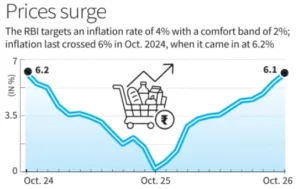
India’s retail inflation increased to 6.1% in October 2026, crossing the RBI’s upper tolerance limit of 6% for the first time in two years.
What Is Inflation?
- Inflation means a continuous increase in the general price level of goods and services.
- It reduces the purchasing power of money, meaning the same income buys fewer goods.
- Example: If inflation is 6%, a basket costing ₹1,000 may cost approximately ₹1,060 after one year.
- Measurement: Retail inflation is measured through the Consumer Price Index (CPI), released by the National Statistics Office (NSO), under MoSPI.
Major Findings: October 2026
- Overall CPI inflation: 6.1%.
- Food and beverages: 8.5%, reflecting pressure on household budgets.
- Transport: 5.8%, influenced by fuel costs.
- Restaurants and accommodation: 10.1%, indicating wider price increases.
- Clothing, healthcare, housing and education also experienced rising inflation.
What Causes Inflation?
- Demand-pull inflation: Demand exceeds available supply, increasing prices.
- Cost-push inflation: Higher fuel, wages or transport costs raise production expenses.
- Supply shocks: Poor harvests, floods and disrupted supply chains reduce availability.
- Imported inflation: A weaker rupee makes imported crude oil and other goods costlier.
Effects on the Economy
- Households: Food inflation disproportionately affects poor families.
- Savings: Money loses real value when returns remain below inflation.
- Businesses: Higher input costs reduce profits and discourage investment.
- Growth: Reduced purchasing power can weaken consumption and employment.
- Inequality: Fixed-income groups face greater financial pressure.
RBI’s Inflation-Control Framework
- Inflation Target: RBI aims for 4% CPI inflation, allowing fluctuations between 2% and 6%.
- Legal Basis: The RBI Act, 1934, amended in 2016, established India’s flexible inflation-targeting framework.
- Monetary Policy Committee (MPC): Six members decide the policy repo rate to maintain price stability.
- Repo-Rate Increase: Higher interest rates make borrowing expensive, reducing demand and controlling inflationary pressures.
Way Forward
- Strengthen agricultural storage, irrigation and food supply chains.
- Use buffer stocks and targeted imports to address shortages.
- Maintain coordination between RBI’s monetary policy and government fiscal measures.
Conclusion
Controlling inflation requires a balanced strategy that protects purchasing power, strengthens supply chains and sustains inclusive economic growth.
The proposed Siang Upper Multipurpose Project (SUMP) in Arunachal Pradesh has triggered protests by the Adi tribal community over displacement and environmental concerns.
What Is the Siang Upper Multipurpose Project?
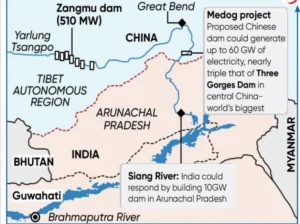
- Location: Siang River in Arunachal Pradesh, which later joins the Brahmaputra river system in Assam.
- Implementing agency: NHPC Limited, a public-sector hydropower company.
- Capacity: Approximately 11,000–11,200 MW, with a proposed dam height of 280–300 metres.
- Water storage: Around 9.2 billion cubic metres of usable reservoir capacity.
- Status: Currently at the Pre-Feasibility Report (PFR) stage; construction approval has not been granted.
Why Is the Project Important?
- Flood management: Regulated water releases could reduce downstream flooding in Arunachal Pradesh and Assam.
- Energy security: Hydropower can support renewable electricity generation and grid stability.
- Strategic importance: China’s proposed Medog hydropower project on the upstream Yarlung Tsangpo raises concerns about downstream water flows.
- Economic development: Construction and related activities may create employment and improve regional infrastructure.
- Water storage: Reservoir capacity could help manage seasonal changes in river discharge.
Why Is the Adi Community Protesting?
- Displacement: Protesters claim that 40 villages may be affected, including 27 facing submergence.
- Livelihood loss: Paddy cultivation, orange orchards and other traditional occupations could suffer.
- Cultural concerns: Ancestral burial sites, sacred landscapes and river-based customs may be threatened.
- Consent disputes: Villagers allege pressure and misleading practices during agreements for preliminary surveys.
- Social tensions: Detentions and reported police action have increased distrust between communities and authorities.
Environmental and Disaster Risks
- Biodiversity: Large reservoirs can submerge forests and fragment wildlife habitats.
- Seismic vulnerability: The eastern Himalayas are earthquake-prone, requiring strict dam-safety assessments.
- River ecology: Altered sediment movement can affect fisheries, agriculture and downstream ecosystems.
- Climate risks: Extreme rainfall, landslides and glacial hazards increase infrastructure vulnerability.
Legal and Governance Dimensions
- Environmental Impact Assessment: Requires detailed ecological and social assessment before clearance.
- Forest (Conservation) Act, 1980: Regulates diversion of forest land.
- Forest Rights Act, 2006: Protects recognised forest-related rights of eligible communities.
- Article 371H: Provides special constitutional arrangements for Arunachal Pradesh.
- Dam Safety Act, 2021: Establishes a framework for dam safety and monitoring.
Way Forward
- Conduct independent environmental studies, dam-break analysis and transparent public consultations.
- Ensure meaningful tribal participation, fair rehabilitation and protection of cultural heritage.
- Examine smaller tributary-based projects and other less-disruptive alternatives.
- Strengthen India-China hydrological data-sharing and early-warning mechanisms.
Conclusion
India must pursue strategic water security through scientifically sound projects that protect fragile Himalayan ecosystems and respect the rights of indigenous communities.
The Kurumba language, spoken by a Particularly Vulnerable Tribal Group (PVTG) in Kerala, faces the threat of gradual disappearance.
Who Are the Kurumbas?
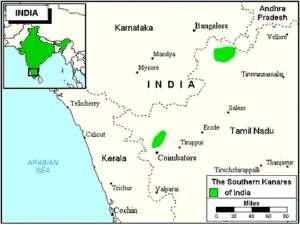
- Location: Mainly inhabit the forested hills of Attappady in Palakkad district, Kerala.
- Tribal status: Recognised as a Particularly Vulnerable Tribal Group (PVTG).
- Population: Approximately 2,719 people in 2024, according to the article.
- Language: Kurumba is primarily an oral language without a widely used written script.
- Cultural importance: It preserves traditional knowledge, customs, folklore and community identity.
Why Is the Language Endangered?
- Language shift: Younger generations increasingly adopt Malayalam for education and employment.
- Migration: Movement outside traditional settlements reduces opportunities to speak Kurumba.
- Educational barriers: Limited access to secondary schools within tribal habitations encourages linguistic assimilation.
- Lack of documentation: Oral traditions are vulnerable when elderly speakers pass away.
- Example: Younger speakers increasingly use Malayalam chechi instead of Kurumba akke for elder sister.
Census and Linguistic Invisibility
- Census classification: Mother tongues with fewer than 10,000 speakers are generally grouped under broader categories or “Others” in published language tables.
- Official recognition: The 2011 Census reported 121 languages, including 22 Scheduled and 99 non-Scheduled languages.
- People’s Linguistic Survey of India (PLSI): Documented approximately 800 languages, highlighting India’s greater linguistic diversity.
- Concern: Aggregated reporting can reduce the visibility of smaller languages in policymaking.
Constitutional and Government Safeguards
- Article 29: Protects the right to conserve distinct languages, scripts and cultures.
- Article 350A: Encourages mother-tongue instruction at the primary level for linguistic minorities.
- Eighth Schedule: Recognises 22 languages but does not cover every indigenous language.
- SPPEL (2013): The Ministry of Education’s scheme documents and preserves endangered languages.
- NEP 2020: Promotes education in home or mother tongues wherever possible.
Wider Implications
- Cultural loss: Language disappearance threatens oral histories, songs and traditional practices.
- Knowledge systems: Indigenous ecological and medicinal knowledge may be lost.
- Social exclusion: Language barriers can limit access to education, healthcare and government services.
- Identity: Linguistic decline weakens intergenerational cultural connections.
Way Forward
- Document Kurumba vocabulary, stories and oral traditions through community-led projects.
- Introduce bilingual learning materials and train teachers familiar with tribal languages.
- Record smaller mother tongues separately in Census databases and published statistics.
- Support local-language digital archives, community radio and youth participation.
Conclusion
Protecting endangered tribal languages is essential for safeguarding India’s cultural diversity, indigenous knowledge and constitutional commitment to inclusion.
The German Ambassador to India described the India–European Union Free Trade Agreement (FTA) as a potential game changer for trade and investment.
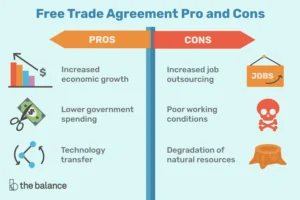
What Is a Free Trade Agreement?
- Definition: An FTA is an agreement between countries to reduce tariffs and other barriers to trade.
- Objective: Improve market access, encourage investment and strengthen economic cooperation.
- India–EU significance: The EU represents a large consumer market of approximately 450 million people.
- Strategic value: The partnership can help India diversify trade and reduce dependence on individual markets.
Economic and Industrial Opportunities
- Export growth: Indian manufacturers could access European markets more easily.
- Foreign Direct Investment: German companies may expand manufacturing operations in India.
- Supply-chain integration: Cooperation in automobile components can reduce production costs.
- Priority sectors: Engineering, pharmaceuticals, semiconductors, machinery, software and medical equipment.
- Make in India: Greater domestic production could strengthen India’s role in global value chains.
Importance of Indian Industrial Hubs
- Tamil Nadu: Emerging as an important destination for German manufacturing investment.
- Chennai–Oragadam: Supports automobile and commercial vehicle production.
- Hosur: Hosts BMW–TVS cooperation in two-wheeler manufacturing.
- Coimbatore: Offers opportunities in automotive components and wind-energy equipment.
- Example: Daimler Trucks’ proposed ₹4,000-crore expansion could strengthen export-oriented manufacturing.
Clean Energy and Climate Cooperation
- Green and Sustainable Development Partnership: Germany supports India’s clean-energy transition through technical and financial assistance.
- Financial cooperation: Germany has indicated support exceeding €1 billion annually under this partnership.
- Priority areas: Renewable energy, electric mobility, green technology and industrial decarbonisation.
- Energy security: Domestic manufacturing of solar panels and batteries can reduce import dependence.
Defence and Skilled Mobility
- Project 75(I): Proposed Indo-German cooperation involves constructing six submarines in India with increasing indigenous content.
- Technology transfer: Joint development can strengthen domestic defence manufacturing capabilities.
- Migration partnership: The 2022 India–Germany Migration and Mobility Partnership supports skilled-worker movement.
- Education: Growing Indian student enrolment in Germany strengthens professional and research links.
Way Forward
- Market competition: Indian MSMEs may face pressure from advanced European manufacturers.
- Trade barriers: Environmental standards, carbon-related rules and product regulations could affect exports.
- Policy priorities: Improve worker skills, logistics, quality certification and domestic industrial competitiveness.
- Balanced negotiations: Protect sensitive sectors while securing meaningful market access and investment opportunities.
Conclusion
A balanced India–EU FTA can transform India into a competitive global manufacturing hub while strengthening economic resilience and strategic cooperation.
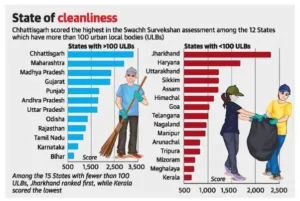
President Droupadi Murmu presented the Swachh Survekshan Awards 2025–26, with Greater Visakhapatnam topping the million-plus population category.
What Is Swachh Survekshan?
- Launched: 2016 by the Ministry of Housing and Urban Affairs (MoHUA).
- Objective: Assess urban cleanliness and encourage competition among cities.
- Coverage: Over 4,751 cities participated in the latest edition.
- Significance: Recognised as the world’s largest urban cleanliness survey.
- New focus: Special recognition for coastal, riverfront and Himalayan cities.
Major Rankings: 2025–26
- Million-plus cities: Visakhapatnam, Jabalpur and Lucknow secured the top three positions.
- Big cities: Ujjain, Chandigarh and Guntur.
- Medium cities: Dewas, NDMC and Sagar.
- Small cities: Vita, Aska and Panaji.
- Very small cities: Bilha, Panchgani and Budhni.
- Super Swachh League: Recognised sustained cleanliness performance, including Navi Mumbai, Surat and Vijayawada.
New Award Categories
- Riverfront towns: Rewa, Bilaspur and Varanasi.
- Coastal towns: Puri, Alappuzha and Ratnagiri.
- Himalayan cities: Rudrapur, Jammu and Shopian.
Swachh Shehar Jodi Initiative
- Purpose: Experienced cities mentor other cities to improve sanitation.
- Coverage: 70 mentor cities partnered with 191 mentee cities.
- Example: Ahmedabad–Sanand secured first position, followed by Indore–Depalpur.
Challenges
- Public health: Better sanitation reduces waterborne diseases.
- Environment: Waste segregation and recycling reduce pollution.
- Governance: Rankings encourage accountability and citizen participation.
- Challenges: Landfill dependence, plastic waste, funding shortages and unequal municipal capacity.
Way Forward
- Strengthen SBM-U 2.0, scientific waste processing and wastewater treatment.
- Promote circular economy practices, community participation and sustainable municipal financing.
Conclusion
Swachh Survekshan must translate competitive rankings into lasting improvements in public health, environmental sustainability and urban quality of life.
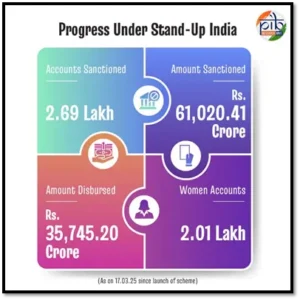
The Union Cabinet has reportedly approved extending the Stand-Up India Scheme until March 31, 2031, targeting 2.5 lakh additional entrepreneurs.
About Stand-Up India Scheme
- Launched: April 5, 2016, under the Ministry of Finance.
- Objective: Promote self-employment and enterprise creation among women and Scheduled Caste/Scheduled Tribe communities.
- Eligibility: Entrepreneurs aged above 18 years establishing new businesses.
- Nature: Supports greenfield enterprises, meaning first-time ventures in eligible sectors.
Key Features
- Loan amount: Above ₹10 lakh and up to ₹1 crore.
- Loan types: Term loans or composite loans covering fixed investment and working capital.
- Project financing: Bank assistance may cover up to 85% of project costs.
- Eligible sectors: Manufacturing, services, trading and agriculture-related activities.
- Credit guarantee: The supplied article mentions 85% coverage and a 0.50% standard guarantee fee.
Significance
- Financial inclusion: Improves institutional credit access for disadvantaged entrepreneurs.
- Women empowerment: Encourages business ownership and economic independence.
- Employment: New enterprises generate local jobs and strengthen rural economies.
- Example: An SC woman establishing a food-processing unit with bank financing.
Way Forward
- Challenges: Collateral difficulties, limited financial literacy and inadequate market access.
- Measures: Strengthen mentoring, digital skills, credit awareness and marketing support.
- Convergence: Link beneficiaries with Skill India, Startup India and MSME support programmes.
Conclusion
Stand-Up India can promote inclusive economic growth by converting access to institutional credit into sustainable entrepreneurship and employment.