Table of Contents
ToggleOrganized Crime in India
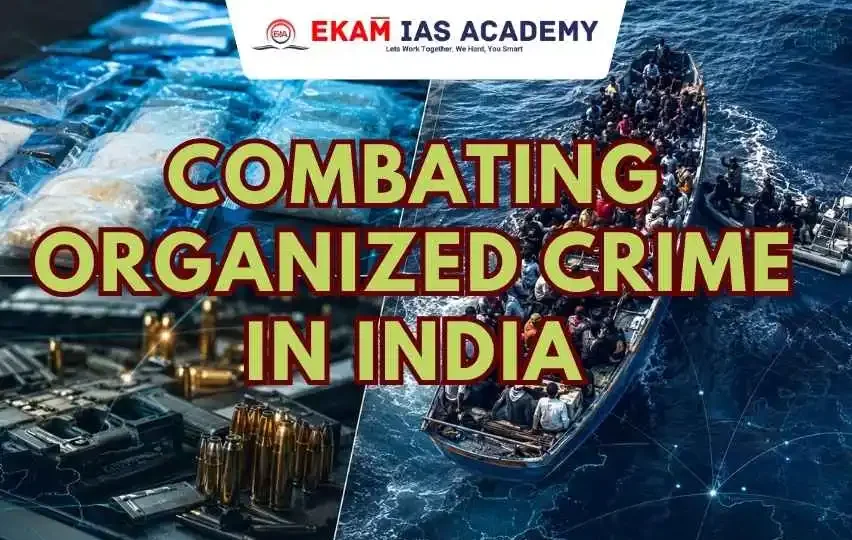
The structural blueprint of India’s national security is experiencing a profound paradigm shift. Organized Crime in India has transitioned from localized, street-level extortion rackets into highly sophisticated, borderless, and technology-driven operations. For aspirants reviewing Internal Security modules, understanding the strategies for Combating Organized Crime is essential. Modern criminal syndicates are systematically integrating illicit networks with global actors, presenting a direct challenge to the state’s sovereign authority and domestic peace.
Organized Crime
Organized crime involves a structured group of individuals who conspire to commit serious crimes for financial gain or territorial control, often utilizing violence, corruption, or intimidation. When these syndicates expand their operations across multiple international boundaries, they morph into Transnational Organized Crime networks. These entities function like corporate conglomerates, exploiting globalization, weak regulatory systems, and modern digital assets to mask their operations from law enforcement.
Major Forms of Organized Crime in India
- Drug Trafficking: Exploitation of India’s geographic position between the Golden Crescent and the Golden Triangle to move large shipments of contraband through maritime and land borders.
- Human Trafficking: The illegal trade and exploitation of vulnerable individuals for forced labor and commercial exploitation across interstate and international networks.
- Money Laundering: The three-stage process (Placement, Layering, Integration) used to clean illicit cash generated through criminal activities and integrate it into the formal economy.
- Cyber Crime: Deploying ransomware attacks, critical infrastructure sabotage, and financial fraud via anonymized darknet portals.
Causes and Structural Drivers
Several underlying factors accelerate the growth of syndicates across the subcontinent. India’s vast, porous international land borders and expansive coastline present deep geographical challenges for border forces. Furthermore, the rapid growth of the digital economy has outpaced traditional policing tools. The use of encrypted communication channels, dark-web marketplaces, and untraceable cryptocurrency payments allows operations to remain largely invisible to law enforcement.
Organized Crime and Internal Security
The convergence of criminal cartels and insurgent groups has given rise to a dangerous nexus. Organized crime actively feeds into Terror Financing, where cash generated from smuggling networks directly funds proxy conflicts along the border sectors or fuels Left-Wing Extremism (LWE). This symbiotic relationship allows non-state actors to bypass formal banking systems to purchase weapons and maintain active sleeper cells, making Combating Organized Crime an urgent national security priority.
Impact on India
The multi-dimensional impact of these operations damages India’s growth trajectory. Beyond the immediate threat to human lives and social stability, organized crime creates a sprawling parallel economy. This parallel system distorts market dynamics, reduces foreign direct investment (FDI) in sensitive regions, increases public security expenditures, and erodes public trust in democratic governance and rule-of-law frameworks.
India's Institutional & Legal Framework
To strengthen its defensive capabilities, India has built a comprehensive legal and administrative architecture:
- Prevention of Money Laundering Act (PMLA): The foundational legal weapon enabling enforcement directorates to freeze, seize, and forfeit criminal assets obtained through scheduled offences.
- Specialized Central Agencies: The Narcotics Control Bureau tracks illicit drug networks, while the National Investigation Agency (NIA) targets the crime-terror-financing nexus.
- State-Level Legislations: Acts such as the Maharashtra Control of Organised Crime Act (MCOCA) provide strict operational templates for preventative detention and special evidence admissibility.
International Cooperation & Initiatives
Because modern cartels operate without borders, India aligns its domestic strategies with global frameworks. India is a key signatory to the United Nations Convention against Transnational Organized Crime (UNTOC), facilitating cross-border legal assistance, extradition treaties, and intelligence sharing. Additionally, India collaborates closely with Interpol and the Financial Action Task Force (FATF) to track and choke the flow of dirty money globally.
Challenges in Counter-Operations
The primary bottleneck in modern counter-operations is the difficulty of technical attribution. Decentralized criminal networks use complex layering techniques across multiple tax havens, making tracking financial flows difficult. Furthermore, jurisdictional conflicts between state police forces and central agencies can slow down field operations, while legacy infrastructure in local cyber-cells hampers real-time digital investigations.
Way Forward
To achieve total deterrence, India must adopt a proactive, data-driven strategy:
- AI-Enabled Intelligence: Deploying advanced machine learning algorithms to identify irregular financial transactions and map darknet communications.
- Strengthening the PMLA: Enhancing inter-agency coordination between the Financial Intelligence Unit (FIU-IND) and state economic wings to freeze illicit assets rapidly.
- Capacity Building: Modernizing state police forces through technical training in digital forensics and blockchain tracking to address complex cyber threats.
Conclusion
Successfully Combating Organized Crime requires a comprehensive approach that bridges the gap between local enforcement and international legal frameworks like UNTOC. By prioritizing advanced digital forensics, modernizing border infrastructure, and closing financial loopholes, India can dismantle illicit syndicates and protect its internal security against modern asymmetric threats.
UPSC Prelims: PYQs & Practice Questions
Previous Year Questions (Prelims)
Q: With reference to the Prevention of Money Laundering Act (PMLA), 2002, consider the following statements: (UPSC CSE 2022)
1. The Enforcement Directorate (ED) is the sole agency responsible for investigating offences of money laundering under this Act.
2. An offence of money laundering can be investigated independently under PMLA without the existence of a prior scheduled or predicate offence registered by another agency.
Which of the statements given above is/are correct?
(a) 1 only
(b) 2 only
(c) Both 1 and 2
(d) Neither 1 nor 2
Answer: (a) 1 only
Explanation:
Statement 1 is correct. The Enforcement Directorate is mandated to investigate offences under the PMLA framework. Statement 2 is incorrect because money laundering under PMLA is a derivative offence. There must be a pre-existing scheduled or predicate offence from which the proceeds of crime were generated before PMLA proceedings can be legally initiated.
Q: The United Nations Convention against Transnational Organized Crime (UNTOC), which India ratified, includes specialized supplementary protocols to target specific criminal architectures. Which of the following areas are directly addressed by these protocols? (UPSC CSE 2019)
1. Trafficking in persons, especially women and children.
2. Smuggling of migrants by land, sea, and air.
3. Illicit manufacturing of and trafficking in firearms.
Select the correct answer using the code given below:
(a) 1 and 2 only
(b) 2 and 3 only
(c) 1 and 3 only
(d) 1, 2 and 3
Answer: (d) 1, 2 and 3
Explanation:
The UNTOC, also known as the Palermo Convention, is supported by three supplementary protocols: the Protocol to Prevent, Suppress and Punish Trafficking in Persons; the Protocol against the Smuggling of Migrants; and the Protocol against the Illicit Manufacturing of and Trafficking in Firearms. Hence, all three areas are covered.
Practice Questions
Q: In the context of Combating Organized Crime and tracking illegal wealth generation in India, consider the following statements regarding the Financial Intelligence Unit - India (FIU-IND):
1. It is an independent body that reports directly to the Economic Intelligence Council (EIC) headed by the Prime Minister.
2. It does not carry out independent field investigations or kinetic raids but acts as a central repository for collecting and analyzing Suspicious Transaction Reports (STRs).
Which of the statements given above is/are correct?
(a) 1 only
(b) 2 only
(c) Both 1 and 2
(d) Neither 1 nor 2
Answer: (b) 2 only
Explanation:
Statement 1 is incorrect because FIU-IND reports to the Economic Intelligence Council, which is headed by the Union Finance Minister, not the Prime Minister. Statement 2 is correct. FIU-IND is a non-kinetic analytical agency. It does not conduct field raids or arrests; instead, it receives, processes, analyzes, and shares financial intelligence with enforcement bodies like the ED, CBDT, and CBI.
Q: The term "Placement, Layering, and Integration" represents the three distinct operational stages of which of the following security threats?
(a) The lifecycle of a lone-wolf cyber terror strike.
(b) The operational steps involved in Money Laundering.
(c) The organizational pipeline for human smuggling across maritime zones.
(d) The process used to recruit and train Over-Ground Workers (OGWs).
Answer: (b) The operational steps involved in Money Laundering
Explanation:
Placement, Layering, and Integration are the three core stages of Money Laundering. Placement introduces illicit money into the legitimate financial system. Layering creates complex chains of transactions across multiple accounts or jurisdictions to hide the source. Integration reintroduces the laundered assets into the economy as apparently legitimate business investments.
UPSC Mains – Previous Year & Practice Questions
Mains Previous Year Questions
UPSC CSE 2024
Question: The linkage between international drug cartels, dark web networks, and local insurgent outfits creates a complex internal security matrix. Analyze how transnational syndicates leverage these connections to challenge the sovereignty of developing nations.
GS-3 | 15 Marks | 250 Words
UPSC CSE 2022
Question: Discuss the type of organized crimes happening in India. Also, analyze the link between terrorist outfits and organized crime syndicates at the national and international levels.
GS-3 | 15 Marks | 250 Words
UPSC CSE 2021
Question: Money laundering is a serious economic and security challenge that feeds the parallel economy. Evaluate the effectiveness of the Prevention of Money Laundering Act (PMLA) in checking the financial channels of organized syndicates.
GS-3 | 15 Marks | 250 Words
UPSC CSE 2018
Question: The terms Hot Spots and Secure Corridors are often used when mapping the networks of Human Trafficking and drug smuggling across India's borders. Elaborate on the structural drivers behind these routes and evaluate current border management strategies.
GS-3 | 15 Marks | 250 Words
UPSC CSE 2014
Question: International organized crime networks exploit the legal gaps between different national jurisdictions to protect their illicit assets. Discuss the role of global frameworks like the UNTOC and FATF in addressing these vulnerabilities.
GS-3 | 15 Marks | 250 Words
Mains Practice Questions
[15 Marks | 250 Words]
Question: The transition of Organized Crime in India from conventional street rackets to anonymized, decentralized cyber operations has outpaced traditional law enforcement tools. Critically analyze the structural challenges this shift poses to internal security coordination.
[15 Marks | 250 Words]
Question: Dismantling the crime-terror nexus requires tracking and choking the parallel financial systems that fund it. Evaluate how effectively the PMLA framework and the Financial Intelligence Unit (FIU-IND) collaborate to disrupt Terror Financing.
[10 Marks | 150 Words]
Question: While global frameworks like UNTOC offer solid baselines for international cooperation, federal friction between state police grids and central investigative bodies often slows down domestic counter-operations. Suggest legislative and administrative reforms to address these domestic coordination challenges.



Organized Crime in India-FAQs
What is organized crime?
Organized crime refers to planned criminal activities carried out by structured groups for financial gain, territorial control or illegal influence.
What are the major forms of organized crime in India?
Major forms include drug trafficking, human trafficking, money laundering, cyber crime, extortion, illegal arms trade and terror financing.
How does organized crime affect internal security?
Organized crime funds terrorism, supports insurgency, weakens law enforcement, creates a parallel economy and damages public trust in governance.
Which laws and agencies help combat organized crime in India?
Important laws and agencies include PMLA, MCOCA, NIA, NCB, Enforcement Directorate, state police, Interpol and FATF cooperation.
Why is organized crime important for UPSC?
It is important for UPSC because it connects with GS Paper III internal security, money laundering, cyber crime, drug trafficking, human trafficking, terrorism and border management.