
Table of Contents
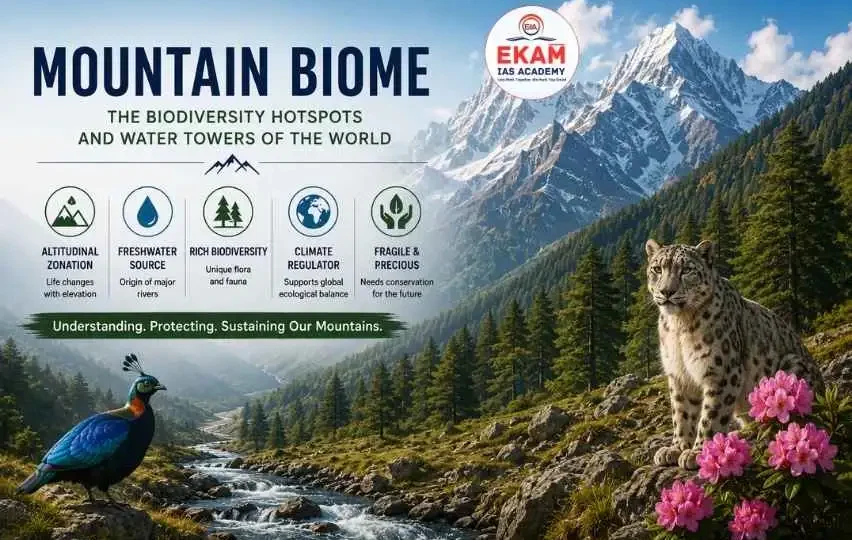
ToggleMountains cover approximately 25% of the Earth’s land surface and house unique biological communities. The mountain Ecosystem UPSC syllabus highlights these regions as “biodiversity hotspots” and “water towers of the world,” emphasizing their role in regulating global climate and freshwater cycles.
Definition of Mountain Biome
A mountain biome is a large-scale biotic community found on high-altitude terrains where environmental conditions change rapidly with elevation. It is not a single uniform biome but rather a collection of multiple biomes—ranging from tropical forests to icy tundras—compressed into a single geographic feature.
Characteristics of the Mountain Biome
- Vertical Stratification: Unlike latitudinal biomes, mountain biomes are defined by vertical layers.
- High Endemism: Isolation on “sky islands” leads to the evolution of species found nowhere else.
- Fragile Balance: The steep slopes and thin soils make the mountain ecosystem UPSC highly susceptible to erosion and landslides.
- Extreme Microclimates: Significant variations in sunlight and wind between windward and leeward slopes.
Climate of the Mountain Biome
- Temperature Lapse Rate: Temperature generally decreases at a rate of approximately 6.5°C per 1,000 meters of ascent.
- Precipitation: Higher altitudes often receive more precipitation (as rain or snow), though high-altitude plateaus can be cold deserts.
- Air Pressure: Lower atmospheric pressure at high altitudes leads to reduced oxygen levels.
Altitudinal Zonation
The most critical concept in mountain biome UPSC preparation is Altitudinal Zonation. This is the division of the mountain into distinct belts based on elevation:
Montane Sub-tropical: At the base (foothills), dominated by broad-leaved trees.
Montane Temperate: Mid-altitudes featuring oaks, chestnuts, and pines.
Sub-alpine (Coniferous): Higher reaches with deodars, firs, and spruces.
Alpine Tundra: Above the tree line, characterized by grasses, mosses, and lichens.
Nival Zone (Snow line): Above the permanent snow line, where only microorganisms and specialized algae survive.
Flora and Fauna
- Flora: Transition from deciduous forests at the base to rhododendrons in the sub-alpine zone, and finally cushion plants in the alpine meadows.
- Fauna: Iconic species include the Snow Leopard, Himalayan Tahr, Musk Deer, and Red Panda. Avian diversity includes the Himalayan Monal and Golden Eagle.
Adaptations in the Mountain Biome
- Plants: Many plants are stunted (krummholz) to avoid wind damage. Some have hairy leaves to trap heat and protect against intense UV radiation.
- Animals: Most possess thick fur, a high count of red blood cells (to carry more oxygen), and compact bodies (low surface-area-to-volume ratio) to conserve heat.
Importance of the Mountain Biome
- Freshwater Source: Mountains are the origin of major perennial rivers like the Ganges, Indus, and Brahmaputra.
- Carbon Sequestration: High-altitude peatlands and forests act as significant carbon sinks.
- Disaster Mitigation: Forests on slopes prevent downstream flooding and soil erosion.
Threats to the Mountain Ecosystem
- Climate Change: Accelerated glacial retreat and shifting of the tree line upward.
- Unregulated Tourism: Leading to plastic pollution and habitat destruction.
- Infrastructure Projects: Large dams and road constructions in the Himalayan ecosystem increasing seismic vulnerability.
Conservation Measures
- Integrated Mountain Development: Promoting sustainable livelihoods through eco-tourism.
- National Mission for Sustaining the Himalayan Ecosystem (NMSHE): One of the eight missions under India’s NAPCC.
- Transboundary Cooperation: Joint conservation efforts between India, Nepal, Bhutan, and China for migratory species.
Conclusion
The mountain biome is an ecological treasure that demands specialized protection. For the UPSC, understanding the sensitivity of the mountain ecosystem is vital for drafting policies that balance development with environmental integrity. As the “Third Pole,” the health of our mountains determines the water and food security of billions.
UPSC Prelims: PYQs & Practice Questions
Previous Year Questions (Prelims)
UPSC CSE Prelims 2012
Q: If you travel through the Himalayas, you are likely to see which of the following plants naturally growing there?
1. Oak
2. Rhododendron
3. Sandalwood
Select the correct answer using the code given below:
(a) 1 and 2 only
(b) 3 only
(c) 1 and 3 only
(d) 1, 2 and 3
Answer: (a) 1 and 2 only
Explanation:
Oak and Rhododendron are characteristic species of the temperate and alpine Himalayan ecosystems. Sandalwood, however, is a tropical deciduous species primarily found in the Western Ghats and southern India, not in the high-altitude Himalayan biome.
UPSC CSE Prelims 2021
Q: With reference to "palm oil", consider the following statements:
1. The palm oil tree is native to Southeast Asia.
2. Palm oil is a raw material for some industries producing lipstick and perfumes.
3. Palm oil can be used to produce biodiesel.
Which of the statements given above are correct?
(a) 1 and 2 only
(b) 2 and 3 only
(c) 1 and 3 only
(d) 1, 2 and 3
Answer: (b) 2 and 3 only
Explanation:
The oil palm is native to Africa, not Southeast Asia, making Statement 1 incorrect. Palm oil is widely used in the cosmetics industry and can also be processed into biodiesel. This question also highlights how mountain and tropical forest ecosystems in Southeast Asia are being cleared for large-scale palm plantations.
Practice Questions
Q: The phenomenon where the temperature increases with altitude instead of decreasing, often trapping pollutants in mountain valleys, is known as:
(a) Lapse Rate
(b) Thermal Inversion
(c) Orographic Lift
(d) Adiabatic Cooling
Answer: (b) Thermal Inversion
Explanation:
Thermal Inversion is common in mountain valleys where cold air becomes trapped beneath a layer of warmer air. This prevents vertical air circulation and leads to the accumulation of pollutants, especially in valley cities such as Srinagar and Kathmandu.
Q: In the context of Altitudinal Zonation, which of the following is the correct sequence of vegetation as one moves from the foothills to the peak of the Himalayas?
(a) Tropical → Alpine → Temperate → Coniferous
(b) Tropical → Temperate → Coniferous → Alpine
(c) Coniferous → Tropical → Temperate → Alpine
(d) Alpine → Coniferous → Temperate → Tropical
Answer: (b) Tropical → Temperate → Coniferous → Alpine
Explanation:
As altitude increases, climatic conditions become progressively colder. Vegetation therefore changes from Tropical forests at the foothills to Temperate forests (Oak), then Coniferous forests (Deodar and Fir), and finally Alpine meadows near the snowline.
UPSC Mains – Previous Year & Practice Questions
Mains Previous Year Questions
Question: Describe the various causes and effects of landslides. Mention the components of the National Landslide Risk Management Strategy. (Mains 2021)
(Highly relevant for the Himalayan mountain biome)
Question: How does the Himalayan ecosystem serve as the “Water Tower of Asia”? Discuss the threats posed by climate change to its stability. (Mains 2017)
Question: The Himalayas are highly prone to landslides. Discuss the causes and suggest suitable measures of mitigation. (Mains 2019)
Question: Discuss the environmental significance of the mountain ecosystem in India. How does it influence the Indian Monsoon? (Mains 2022)
Question: Enumerate the indirect services provided by an ecosystem. How do these help in sustainable development? (Mains 2014)
(Apply this to the carbon sequestration and water regulation services of mountains)
Mains Practice Questions
[10 Marks | 150 Words]
Question: Explain why the mountain biome exhibits high levels of biological endemism. Use the concept of “Sky Islands” in your answer.
[15 Marks | 250 Words]
Question: Analyze the impact of Glacial Lake Outburst Floods (GLOFs) on the downstream communities of the Himalayan region. Suggest policy interventions for disaster resilience.
[15 Marks | 250 Words]
Question: Evaluate the role of the National Mission for Sustaining the Himalayan Ecosystem (NMSHE) in addressing the challenges of climate change in the North-Western Himalayas.



Mountain Ecosystem-FAQs
What is the 'Lapse Rate'?
It is the rate at which atmospheric temperature decreases with an increase in altitude. The average value is 6.5°C per 1,000 meters.
What is a 'Krummholz' formation?
It refers to stunted, deformed vegetation found at the tree line of mountain biomes, caused by constant exposure to freezing winds and heavy snow.
Why are mountain soils generally poor in nutrients?
High slopes lead to rapid leaching and soil erosion. The cold temperatures also slow down the rate of organic matter decomposition.
What is the 'Tree Line' vs. the 'Snow Line'?
The Tree Line is the highest altitude where trees can grow. The Snow Line is the altitude above which snow remains on the ground throughout the year. The area between these two is usually the Alpine Tundra.
How do mountain animals adapt to low oxygen?
Animals like the Himalayan Yak have larger lungs, a larger heart, and a higher concentration of hemoglobin in their blood to efficiently transport oxygen in thin air.