
Table of Contents
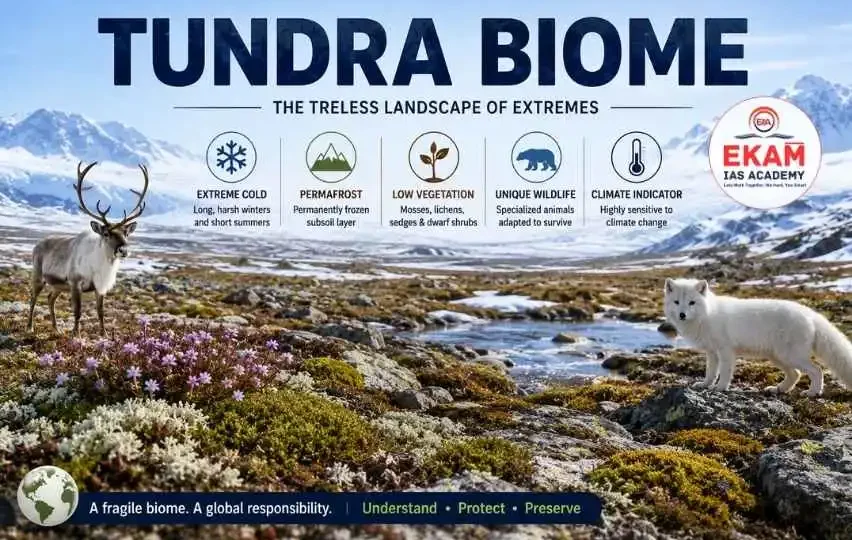
ToggleThe word “tundra” comes from the Finnish word tunturi, meaning “treeless plain.” It is a biome where the growth of trees is hindered by low temperatures and short growing seasons. Located primarily in the Northern Hemisphere, the tundra ecosystem acts as a critical indicator of the Earth’s climatic health.
Definition of Tundra Biome
A tundra biome is a vast, treeless geographic region characterized by extremely low temperatures, little precipitation, poor nutrients, and short growing seasons. The most defining feature of this biome is the permafrost—a layer of soil that remains permanently frozen throughout the year.
Characteristics of Tundra Biome
- Extreme Cold: Average winter temperatures can drop to -34°C, while summers rarely exceed 10°C.
- Low Precipitation: It receives less than 25 cm of rain annually, making it similar to a desert in terms of moisture.
- Permafrost: The subsoil is a solid block of ice, which prevents deep root penetration and inhibits drainage, creating bogs and ponds in summer.
- Short Growing Season: Plants have only about 50 to 60 days a year to grow and reproduce.
- Low Biodiversity: Due to harsh conditions, only a limited number of specialized species can survive here.
Types of Tundra UPSC
The types of tundra UPSC candidates must distinguish between are categorized by their location:
Arctic Tundra
- Location: Located in the Northern Hemisphere, encircling the North Pole and extending south to the coniferous forests of the Taiga.
- Features: Features vast expanses of permafrost. During summer, the top layer of soil thaws slightly, supporting the growth of lichens, mosses, and small shrubs.
Alpine Tundra
- Location: Found on high mountains across the globe, above the tree line.
- Features: Unlike the arctic variety, alpine soil is usually well-drained and lacks a permafrost layer. It experiences high UV radiation and extreme wind speeds.
Components of Tundra Ecosystem
- Abiotic: Solar radiation (limited), low temperature, frozen soil, and strong winds.
- Biotic:
- Producers: No trees. Dominated by lichens, mosses, sedges, and dwarf shrubs.
- Consumers: Herbivores like caribou, lemmings, and musk ox; carnivores like arctic foxes, wolves, and polar bears.
- Decomposers: Due to the cold, decomposition is incredibly slow, leading to the accumulation of organic matter.
Adaptations in Tundra Biome
Survival in the arctic tundra requires unique evolutionary strategies:
- Plants: Most are low-growing (prostrate) to stay below the wind and trap heat from the ground. Many are perennials, so they don’t have to grow from seed every year.
- Animals: Many possess thick layers of blubber or fur. Some change color (e.g., Arctic hare turning white in winter) for camouflage, while others hibernate or migrate to warmer regions during winter.
Importance of Tundra Biomes
- Carbon Sink: The tundra stores massive amounts of carbon in its frozen organic matter. If the permafrost melts, this could release huge amounts of methane and CO2.
- Global Cooling: The high albedo (reflectivity) of snow-covered tundra helps regulate the Earth’s temperature.
- Scientific Indicator: It is the most sensitive biome to climate change, serving as an early warning system for global warming.
Threats to Tundra
- Global Warming: The “Arctic Amplification” means the tundra is warming twice as fast as the rest of the world, leading to permafrost thaw.
- Industrial Activity: Mining and oil exploration disrupt fragile habitats and lead to pollution.
- Overgrazing: Changes in migratory patterns of large herbivores can lead to the depletion of slow-growing lichens.
Conservation Measures
- International Agreements: Implementing the Paris Agreement to limit global temperature rise.
- Protected Areas: Establishing sanctuaries where industrial activity is banned.
- Sustainable Management: Using “tundra-friendly” technology that does not melt the permafrost (e.g., building structures on stilts).
Conclusion
The tundra is a biome of extremes. For environment ecology notes UPSC, it represents the fragile balance of our planet. Protecting the tundra ecosystem is not just about saving the polar bear; it is about ensuring that the massive stores of greenhouse gases remains locked in the ice, preventing a runaway climate catastrophe.
UPSC Prelims: PYQs & Practice Questions
Previous Year Questions (Prelims)
Q: Which one of the following is the characteristic climate of the Tundra biome? (UPSC CSE Prelims 2011)
(a) Rainfall throughout the year
(b) Rainfall in winter only
(c) Very heavy rainfall and high humidity
(d) Very low precipitation and extremely cold winters
Answer: (d) Very low precipitation and extremely cold winters
Explanation:
The Tundra biome is often called a "cold desert" due to its very low precipitation (usually less than 25 cm annually). Winters are long, dark, and extremely cold, limiting vegetation growth.
Q: Which of the following is/are unique characteristic/characteristics of the Arctic Tundra? (UPSC CSE Prelims 2012)
1. Presence of permafrost
2. Absence of trees
3. Short growing season
Select the correct answer:
(a) 1 only
(b) 1 and 2 only
(c) 2 and 3 only
(d) 1, 2 and 3
Answer: (d) 1, 2 and 3
Explanation:
All three are defining features of the Arctic Tundra. Permafrost prevents deep root growth, leading to the absence of trees, while the short growing season (50–60 days) supports only mosses, lichens, and small shrubs.
Practice Questions
Q: How does the Alpine Tundra differ from the Arctic Tundra?
(a) Alpine Tundra has permafrost, while Arctic Tundra does not.
(b) Alpine Tundra is found at high latitudes, while Arctic Tundra is at high altitudes.
(c) Alpine Tundra usually has well-drained soil, while Arctic Tundra soil is often waterlogged in summer.
(d) Arctic Tundra has a longer growing season than Alpine Tundra.
Answer: (c) Alpine Tundra usually has well-drained soil
Explanation:
Alpine Tundra occurs on mountain slopes where gravity ensures better drainage. In contrast, Arctic Tundra has underlying permafrost, which prevents water infiltration and leads to bogs and marshes during summer.
Q: Which of the following is a characteristic adaptation of animals in the tundra ecosystem?
(a) Large surface-area-to-volume ratio to dissipate heat.
(b) Estivation during the summer months.
(c) Short ears and limbs to minimize heat loss.
(d) Deep roots to access groundwater.
Answer: (c) Short ears and limbs to minimize heat loss
Explanation:
This follows Allen’s Rule, where animals in cold climates evolve shorter extremities (ears, tails, limbs) to reduce heat loss. This adaptation is crucial for survival in extreme tundra conditions.
UPSC Mains – Previous Year & Practice Questions
Mains Previous Year Questions
Question: Explain the causes and effects of desertification. How is it related to the loss of biodiversity? (Mains 2021)
(Can be applied to the ‘greening’ or drying of the tundra biome)
Question: What is the economic significance of the mountain ecosystem? How does it affect the climate of India? (Mains 2019)
(Relates to Alpine Tundra in the Himalayas)
Question: Describe the various services provided by an ecosystem. (Mains 2017)
(Tundra provides carbon sequestration and global temperature regulation)
Question: How does biodiversity vary in India? How is the Biological Diversity Act, 2002 helpful in conservation? (Mains 2020)
(Relates to the cold desert/tundra ecosystem of Ladakh)
Question: Enumerate the indirect services provided by an ecosystem. How do these help in sustainable development? (Mains 2014)
Mains Practice Questions
[15 Marks | 250 Words]
Question: Discuss the concept of Arctic Amplification. How is the melting of permafrost in the tundra biome creating a dangerous feedback loop for global warming?
[10 Marks | 150 Words]
Question: Compare and contrast the flora and fauna adaptations in the hot desert biome versus the tundra (cold desert) biome.
[15 Marks | 250 Words]
Question: The Tundra is no longer a “pristine” wilderness. Analyze the impact of oil and gas exploration on the fragile tundra ecosystem.



Tundra Biome-FAQs
What is 'Permafrost' and why is it important?
Permafrost is ground that remains frozen for at least two years. It is a massive carbon sink, trapping ancient organic matter. If it melts, it releases methane (CH4), a greenhouse gas much more potent than CO2.
What are 'Lichens' and why are they dominant in the tundra?
Lichens are a symbiotic association of fungi and algae. They can survive on bare rock, handle extreme dehydration, and photosynthesize at very low temperatures where other plants fail.
Is there a tundra in India?
Yes, the Alpine Tundra. It is found in the high reaches of the Himalayas (above 4,000–4,500 meters), above the tree line where the environment becomes too harsh for forest growth.
What is the 'Albedo Effect' in the tundra?
Snow and ice have high albedo, meaning they reflect most of the sunlight back into space. As the tundra warms and snow melts, darker ground is exposed, which absorbs more heat and accelerates warming.
Which animals are the top predators in the tundra?
The Polar Bear (in coastal arctic areas) and the Arctic Wolf. Smaller predators include the Arctic Fox and the Snowy Owl.