
Table of Contents
ToggleSulphur is a vital element for life, serving as a key component of amino acids (like cysteine and methionine) and vitamins. The sulphur cycle process describes how this element circulates through the lithosphere, atmosphere, and biosphere. Unlike phosphorus, which is purely sedimentary, sulphur interacts heavily with the air, making its cycle more complex and dynamic.
Definition of the Sulphur Cycle
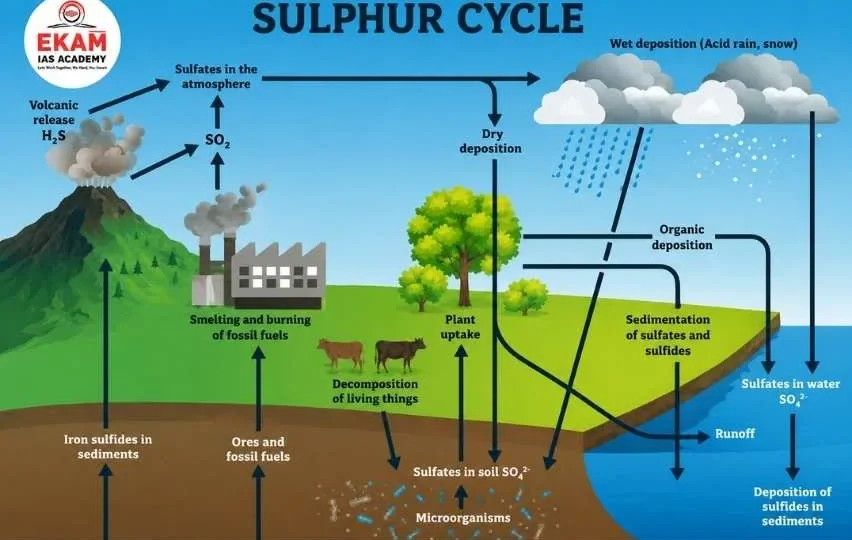
The sulphur cycle is a sedimentary biogeochemical cycle that involves the movement of sulphur between rocks, waterways, and living systems. It includes the release of sulphur from mineral deposits, its conversion into various chemical forms (like sulphates and hydrogen sulphide), and its eventual return to the Earth’s crust as organic or inorganic sediment.
Major Components of the Sulphur Cycle
- Lithosphere (Primary Reservoir): Sulphur is stored in rocks as pyrite (iron sulphide) and gypsum (calcium sulphate).
- Atmosphere: Sulphur enters the air as Sulphur Dioxide (SO2) from volcanoes and industrial combustion, and as Hydrogen Sulphide (H2S) from anaerobic decomposition.
- Hydrosphere: Dissolved sulphate ions in the ocean provide a major exchange pool for marine life.
- Biosphere: Plants absorb sulphates from the soil to build proteins, which then move through the food chain.
Key Processes Involved
- Weathering: The erosion of rocks releases stored sulphur into the soil and water systems.
- Volcanic Eruptions: Natural releases of SO2 and H2S into the atmosphere.
- Decomposition: Specialized bacteria break down organic matter, releasing sulphur back into the environment. In oxygen-poor environments, sulphate-reducing bacteria produce hydrogen sulphide (H2S).
- Oxidation and Reduction: Sulphur undergoes various chemical shifts. For instance, H2S is oxidized into SO2 in the atmosphere, which then reacts with water to form sulphuric acid.
Importance of the Sulphur Cycle
- Sulphur Cycle Importance for Plants: Sulphur is a “macronutrient” required for protein synthesis and the functioning of enzymes.
- Climate Regulation: Sulphur aerosols in the atmosphere reflect sunlight away from the Earth, acting as a global cooling agent.
- Soil Fertility: Adequate sulphur levels are necessary for the growth of oilseed and pulse crops in India.
Human Impacts and Pollution
Human activities have significantly accelerated the sulphur cycle, leading to severe sulphur pollution effects:
- Fossil Fuel Combustion: Burning coal and oil releases massive amounts of SO2 into the atmosphere.
- Acid Rain UPSC: This is a critical exam topic. Atmospheric SO2 reacts with water vapor to form sulphuric acid (H2SO4). When this falls as rain, it acidifies soil, damages forests, and corrodes monuments (e.g., the yellowing of the Taj Mahal).
- Smog Formation: Sulphur compounds contribute to the formation of industrial smog, causing respiratory illnesses in urban populations.
Conclusion
The sulphur cycle is a bridge between the Earth’s deep crust and the air we breathe. While it is naturally a sedimentary biogeochemical cycle, human-induced gaseous emissions have made it a central theme in environmental policy. For sustainable development, reducing sulphur emissions from industries is paramount to preventing acid rain and protecting ecological health.
UPSC Prelims: PYQs & Practice Questions
Previous Year Questions (Prelims)
Q: With reference to the 'Sulphur Cycle', consider the following statements: (UPSC CSE Prelims 2014)
1. Sulphur is released into the atmosphere by the weathering of rocks.
2. Sulphur is released into the atmosphere by volcanic eruptions.
Which of the statements given above is/are correct?
(a) 1 only
(b) 2 only
(c) Both 1 and 2
(d) Neither 1 nor 2
Answer: (b) 2 only
Explanation:
Weathering of rocks releases sulphur mainly into the soil and water (lithosphere and hydrosphere), not directly into the atmosphere. Volcanic eruptions release sulphur gases like SO₂ and H₂S into the atmosphere. Hence, only statement 2 is correct.
Q: Which of the following cycles does not have a gaseous phase in its natural state? (UPSC CSE Prelims 2011)
(a) Carbon Cycle
(b) Nitrogen Cycle
(c) Phosphorus Cycle
(d) Sulphur Cycle
Answer: (c) Phosphorus Cycle
Explanation:
While the Sulphur Cycle has a gaseous phase (SO₂, H₂S), the Phosphorus Cycle is a purely sedimentary cycle with no significant gaseous component. This makes it unique among major biogeochemical cycles.
Practice Questions
Q: Consider the following statements regarding the sulphur cycle:
1. Sulphate-reducing bacteria convert sulphates into hydrogen sulphide in anaerobic conditions.
2. Sulphur aerosols in the atmosphere contribute to global warming by trapping terrestrial radiation.
Which of the statements given above is/are correct?
(a) 1 only
(b) 2 only
(c) Both 1 and 2
(d) Neither 1 nor 2
Answer: (a) 1 only
Explanation:
Statement 1 is correct: sulphate-reducing bacteria convert sulphates into hydrogen sulphide (H₂S) under anaerobic conditions.
Statement 2 is incorrect: sulphur aerosols reflect incoming solar radiation (albedo effect) and contribute to global cooling, not warming.
Q: The primary form in which plants absorb sulphur from the soil is:
(a) Elemental Sulphur (S)
(b) Hydrogen Sulphide (H₂S)
(c) Sulphate ions (SO₄²⁻)
(d) Sulphur Dioxide (SO₂)
Answer: (c) Sulphate ions (SO₄²⁻)
Explanation:
Plants absorb sulphur mainly in the form of sulphate ions (SO₄²⁻), which are soluble and readily available. This is similar to how plants absorb nitrogen as nitrates in the nitrogen cycle.
UPSC Mains – Previous Year & Practice Questions
Mains Previous Year Questions
Question: Each year a large amount of plant material is produced by photosynthesis. Explain the mechanism of their decomposition. (Mains 2022)
(Sulphur is released from organic matter through specialized decomposers)
Question: What are the key features of the National Clean Air Programme (NCAP)? (Mains 2020)
(NCAP monitors pollutants like sulphur dioxide (SO₂))
Question: What do you understand by 'Environmental Ethics'? (Mains 2013)
(Industrial SO₂ emissions impact heritage sites like the Taj Mahal)
Question: What is an ecosystem? Describe the various services provided by an ecosystem. (Mains 2017)
(Sulphur nutrient cycling is a key supporting service)
Question: “The standard of living in a country can be raised only through sustainable development.” Discuss. (Mains 2015)
(Relates to reducing acid rain through cleaner fuels and emission control)
Mains Practice Questions
[10 Marks | 150 Words]
Question: The sulphur cycle is often described as a link between sedimentary and gaseous cycles. Elaborate on its major reservoirs and transfer pathways.
[15 Marks | 250 Words]
Question: Analyze the role of the sulphur cycle in climate change. Can 'Sulphate Aerosol Injection' be considered a viable geo-engineering solution for global warming?
[15 Marks | 250 Words]
Question: Discuss the chemistry of acid rain and its socio-economic impact on Indian agriculture and architecture.



Sulphur Cycle-FAQs
Why is the Sulphur cycle important for plants?
It is essential for the synthesis of proteins (cysteine and methionine) and chlorophyll. Without it, plants show chlorosis (yellowing of leaves).
What is the primary human impact on the sulphur cycle?
The burning of fossil fuels (coal and petroleum), which rapidly transfers sulphur from the deep lithosphere to the atmosphere as SO2, leading to acid rain.
How does the Sulphur cycle differ from the Phosphorus cycle?
Both are sedimentary, but the sulphur cycle has a significant atmospheric (gaseous) phase, whereas the phosphorus cycle does not.
What is 'Dimethyl Sulfide' (DMS)?
It is a biological sulphur compound produced by marine algae. It is the largest natural source of sulphur gas to the atmosphere and helps in cloud formation.
What are 'Sulphate-Reducing Bacteria'?
These are anaerobic microbes (e.g., Desulfovibrio) that “breathe” sulphate instead of oxygen, releasing H2S (rotten egg smell) as a byproduct.