Table of Contents
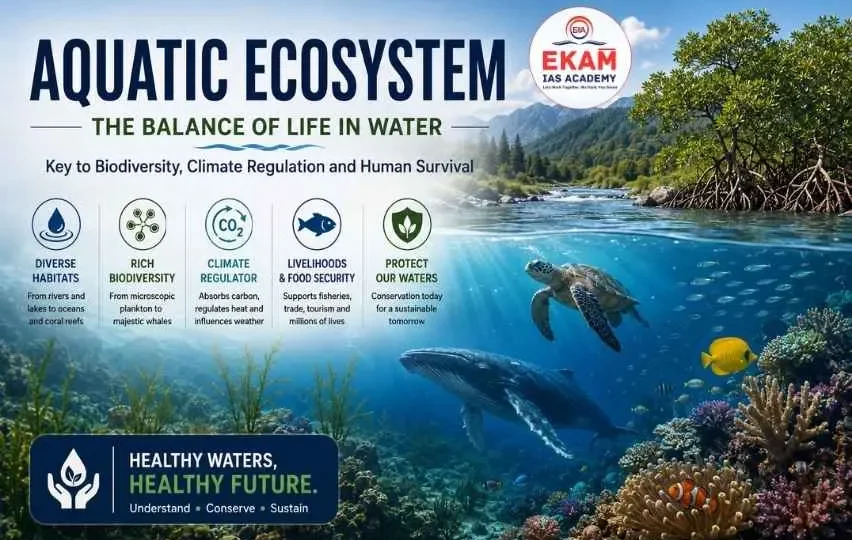
ToggleThe aquatic ecosystem UPSC syllabus focuses on the delicate balance of life in water bodies. From the microscopic phytoplankton to the massive blue whale, these systems facilitate critical biogeochemical cycles and provide essential ecosystem services to humanity.
Definition of Aquatic Ecosystem
An aquatic ecosystem is a water-based environment where living organisms (biotic) interact with the physical and chemical properties (abiotic) of the water. The primary distinguishing factor in these systems is the salinity of the water, which determines the type of species that can inhabit the area.
Characteristics of Aquatic Ecosystems
- Buoyancy: Water provides physical support to organisms, allowing for the existence of very large animals.
- Thermal Stability: Due to the high specific heat capacity of water, aquatic environments experience less temperature fluctuation than land.
- Limited Oxygen: Dissolved oxygen (DO) is a critical limiting factor, often measured in parts per million (ppm).
- Light Penetration: Sunlight decreases with depth, creating distinct vertical zones that dictate photosynthetic activity.
Components of Aquatic Ecosystem
- Abiotic Components: Sunlight, temperature, dissolved oxygen, pH levels, salinity, and nutrient concentration (nitrates/phosphates).
- Biotic Components:
- Neuston: Organisms resting on the water surface (e.g., water striders).
- Periphyton: Organisms attached to submerged stems or leaves.
- Plankton: Passive drifters; includes phytoplankton (producers) and zooplankton.
- Nekton: Active swimmers (e.g., fish, whales).
- Benthos: Bottom-dwellers (e.g., crabs, corals).
Types of Aquatic Ecosystems UPSC
The aquatic ecosystem types UPSC candidates must know are broadly divided into two categories:
Fresh Water Ecosystem
These have very low salinity (less than 5 ppt).
- Lotic: Moving water bodies like rivers and streams.
- Lentic: Still water bodies like lakes, ponds, and swamps.
Marine Ecosystem
These have high salinity (average 35 ppt).
- Oceans: The largest and most stable ecosystems.
- Estuaries: Coastal areas where fresh water from rivers meets salt water from the sea; highly productive zones.
- Coral Reefs: Known as the “Rainforests of the Sea.”
Zonation in Aquatic Ecosystems
Vertical and horizontal zonation is primarily determined by light penetration:
- Photic (Euphotic) Zone: The upper layer where light is sufficient for photosynthesis.
- Aphotic Zone: The deeper layer where light is absent; energy is derived from organic “snow” falling from above or chemosynthesis.
- Benthic Zone: The very bottom of the water body.
- Intertidal Zone: The area between high and low tide.
Food Chain in Aquatic Ecosystem
The energy flow typically follows this path:
Producers: Phytoplankton and algae.
Primary Consumers: Zooplankton and small crustaceans.
Secondary Consumers: Small fish and squids.
Tertiary Consumers: Apex predators like sharks, dolphins, or large predatory fish.
Importance of Aquatic Ecosystems
- Carbon Sequestration: Oceans act as the world’s largest carbon sinks, absorbing nearly 30% of anthropogenic CO2.
- Nutrient Cycling: Facilitates the movement of nitrogen, phosphorus, and sulphur.
- Livelihoods: Provides food (fisheries) and supports global trade through shipping lanes.
- Climate Regulation: Ocean currents redistribute heat across the globe, influencing weather patterns.
Threats to Aquatic Ecosystem
- Eutrophication: Excessive nutrient runoff (nitrates/phosphates) leading to algal blooms and “dead zones.”
- Ocean Acidification: Increased CO2 absorption lowering pH, which threatens calcifying organisms like corals.
- Microplastics: Accumulation of plastic debris in the marine food web.
- Thermal Pollution: Discharge of hot water from industries reducing dissolved oxygen.
Conservation Measures
- Marine Protected Areas (MPAs): Designated regions to restrict human activity and allow biodiversity recovery.
- Wetland Conservation: Implementing the Ramsar Convention guidelines to protect “Earth’s kidneys.”
- Sustainable Fisheries: Reducing “bycatch” and preventing overfishing through seasonal bans.
- Pollution Control: Strengthening the Water (Prevention and Control of Pollution) Act.
Conclusion
The fresh water and marine ecosystem balance is vital for the survival of the biosphere. For UPSC preparation, it is essential to understand that any disruption in the aquatic food chain or chemistry has far-reaching consequences for terrestrial life. Sustainable management of our water resources is not just an environmental choice but a necessity for global food and climate security.
UPSC Prelims: PYQs & Practice Questions
Previous Year Questions (Prelims)
Q: If a tropical rain forest is removed, it does not regenerate quickly as compared to a tropical deciduous forest. This is because:
(a) The soil of rain forest is deficient in nutrients.
(b) Propagules of the trees in a rain forest have poor viability.
(c) The rain forest species are slow-growing.
(d) Exotic species invade the fertile soil of rain forest.
Answer: (a) The soil of rain forest is deficient in nutrients
Explanation:
In tropical rainforests, most nutrients are stored within the biomass rather than the soil. Once vegetation is removed, heavy rainfall quickly leaches nutrients away, making regeneration difficult. This concept is also important in understanding nutrient cycling in aquatic ecosystems where nutrients are often concentrated in living organisms or deeper benthic zones.
Q: Which of the following can be found as pollutants in the drinking water in some parts of India?
1. Arsenic
2. Sorbitol
3. Fluoride
4. Formaldehyde
5. Uranium
Select the correct answer:
(a) 1 and 3 only
(b) 2, 4 and 5 only
(c) 1, 3 and 5 only
(d) 1, 2, 3, 4 and 5
Answer: (c) 1, 3 and 5 only
Explanation:
Arsenic, Fluoride, and Uranium are important geogenic contaminants found in groundwater in various regions of India. These pollutants pose major challenges to freshwater ecosystems and public health.
Practice Questions
Q: With reference to "Eutrophication" in a freshwater ecosystem, consider the following statements:
1. It leads to an increase in Dissolved Oxygen (DO) due to excessive algal growth.
2. It results in a high Biochemical Oxygen Demand (BOD) in the water body.
Which of the statements given above is/are correct?
(a) 1 only
(b) 2 only
(c) Both 1 and 2
(d) Neither 1 nor 2
Answer: (b) 2 only
Explanation:
Statement 1 is incorrect because although algae may release oxygen during photosynthesis, the decomposition of excessive algal biomass consumes large amounts of oxygen, causing a decline in Dissolved Oxygen (DO). Statement 2 is correct because Biochemical Oxygen Demand (BOD) increases as decomposers utilize more oxygen to break down organic matter.
Level: Moderate
Q: In which zone of a marine ecosystem is the rate of photosynthesis highest?
(a) Aphotic Zone
(b) Benthic Zone
(c) Euphotic Zone
(d) Abyssal Zone
Answer: (c) Euphotic Zone
Explanation:
The Euphotic Zone (or Photic Zone) is the uppermost layer of ocean water that receives sufficient sunlight for photosynthesis. Producers such as phytoplankton thrive in this zone, making it the most biologically productive part of the marine ecosystem.
UPSC Mains – Previous Year & Practice Questions
Mains Previous Year Questions
Question: What is a wetland? Explain the Ramsar concept of “wise use” in the context of wetland conservation in India. (Mains 2018)
Question: What are the main causes of ocean currents? How do they influence the regional climates and the fishing grounds of the world? (Mains 2020)
Question: Account for the variations in oceanic salinity and discuss its multi-dimensional effects. (Mains 2017)
Question: What is the economic importance of the marine ecosystem in India? Discuss the potential of the Blue Economy. (Mains 2015)
Question: Discuss the causes and effects of ocean acidification on the marine food chain. (Mains 2022)
Mains Practice Questions
[15 Marks | 250 Words]
Question: Evaluate the effectiveness of the National Plan for Conservation of Aquatic Eco-systems (NPCA) in restoring urban lakes in India.
[10 Marks | 150 Words]
Question: Compare and contrast the energy flow and nutrient cycling in a freshwater ecosystem and a marine ecosystem.
[15 Marks | 250 Words]
Question: How do “Dead Zones” form in coastal aquatic systems? Analyze the socio-economic impact of these zones on small-scale fisheries in India.



Aquatic Ecosystem-FAQs
What is the difference between 'Lentic' and 'Lotic' ecosystems?
Lentic refers to standing water (Lakes, Ponds, Swamps), while Lotic refers to running water (Rivers, Streams).
What is 'Biochemical Oxygen Demand' (BOD)?
BOD is the amount of dissolved oxygen needed by aerobic biological organisms to break down organic material present in a given water sample at a certain temperature. High BOD indicates high pollution.
Why are 'Estuaries' considered highly productive?
Estuaries are ecotones where rivers meet the sea. They receive a constant supply of nutrients from both the land (via rivers) and the sea, supporting a unique mix of species.
What is 'Ocean Acidification'?
It is the ongoing decrease in the pH of the Earth’s oceans, caused by the uptake of carbon dioxide (CO2) from the atmosphere. It makes it difficult for corals and shellfish to build their calcium carbonate shells.
What are 'Phytoplankton' and why are they important?
They are microscopic marine plants that form the base of the aquatic food chain. They produce about 50% of the world’s oxygen and are primary producers in the marine biome.