Table of Contents
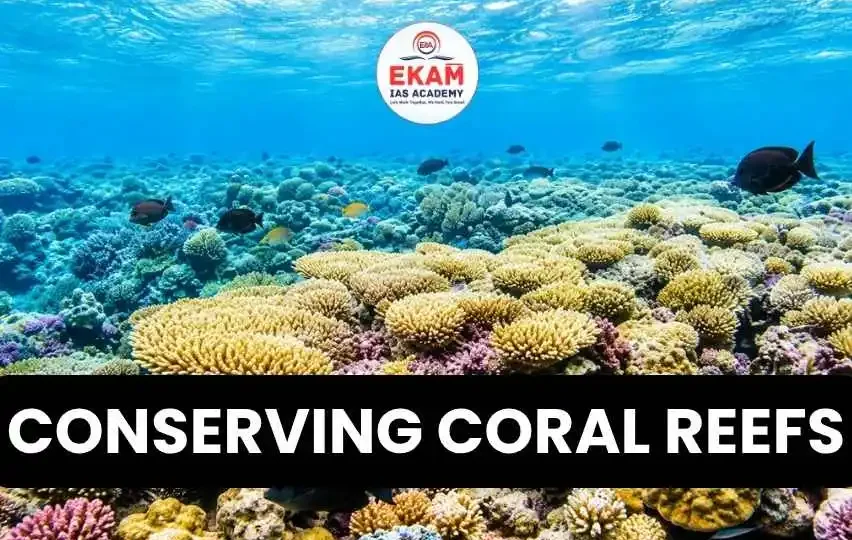
ToggleCoral reefs are the “biological engines” of the ocean. Despite their resilience over geological timescales, they are currently among the most threatened ecosystems due to anthropogenic pressures. The focus on coral reef conservation UPSC stems from the realization that these structures provide critical ecological services, yet are highly susceptible to even minor changes in sea chemistry and temperature.
Definition of Coral Reef Conservation
Coral reef conservation refers to the integrated management, protection, and restoration of coral ecosystems to ensure their long-term health and functional integrity. It involves a combination of legal protection, sustainable resource use, and active restoration techniques (like Biorock technology) to mitigate the effects of coral bleaching and habitat destruction.
Major Threats to Coral Reefs
Understanding the drivers of decline is the first step toward conservation:
- Climate Change: The primary driver behind coral bleaching in india and globally. Rising Sea Surface Temperatures (SST) cause the symbiotic zooxanthellae to leave the coral host.
- Ocean Acidification: Increased $CO_2$ absorption by oceans lowers pH levels, hindering the ability of corals to secrete calcium carbonate skeletons.
- Destructive Fishing: Use of dynamite, cyanide, and bottom trawling physically destroys the reef structure.
- Pollution: Agricultural runoff (causing eutrophication) and plastic debris lead to disease and “smothering” of polyps.
Causes of Coral Reef Degradation
- Siltation and Sedimentation: Deforestation and coastal construction lead to runoff that blocks sunlight, which is essential for photosynthesis.
- Overexploitation: Excessive harvesting of herbivorous fish (like parrotfish) leads to algae overgrowth that chokes the corals.
- Invasive Species: The outbreak of the Crown-of-Thorns Starfish can decimate entire reef systems in months.
Coral Reef Conservation in India
India has a robust framework for conserving coral reefs, focusing on its four major reef regions:
- Legal Protection: Corals are listed under Schedule I of the Wildlife Protection Act, 1972, providing them the same protection as tigers.
- ZSI Initiatives: The Zoological Survey of India (ZSI) has pioneered Biorock technology in the Gulf of Kachchh to restore degraded reefs.
- Marine Protected Areas (MPAs): Regions like the Mahatma Gandhi Marine National Park (Andamans) and Gulf of Mannar Biosphere Reserve are strictly monitored.
- Coastal Regulation Zone (CRZ): The CRZ notifications restrict industrial and construction activity near reef-rich areas.
International Initiatives
- International Coral Reef Initiative (ICRI): An informal partnership between Nations and organizations to preserve coral reefs.
- Global Coral Reef Monitoring Network (GCRMN): Provides data on the status of reefs worldwide.
- Ramsar Convention: Many coral reefs are designated as “Wetlands of International Importance.”
- Convention on Biological Diversity (CBD): Focuses on Aichi Biodiversity Targets (and the subsequent Kunming-Montreal Global Biodiversity Framework) for marine protection.
Importance of Conserving Coral Reefs
- Coastal Protection: Reefs act as natural breakwaters, absorbing 97% of wave energy, protecting India’s coast from tsunamis and storm surges.
- Fisheries: Over 25% of all marine fish species depend on reefs at some point in their life cycle.
- Medicine: Corals are sources of compounds used in treating HIV, cancer, and heart disease.
- Carbon Sequestration: They play a subtle but important role in the global carbon cycle.
Challenges in Conservation
- Warming Oceans: Local conservation measures are often negated by global thermal stress.
- Funding Gaps: Marine conservation often receives less funding than terrestrial projects.
- Enforcement: Monitoring remote island territories like the Andaman and Nicobar or Lakshadweep against illegal poaching is difficult.
- Lack of Public Awareness: The “out of sight, out of mind” nature of underwater ecosystems.
Conservation Measures
- Restoration: Artificial reef structures and “coral gardening” (transplanting healthy fragments).
- Sustainable Tourism: Regulating diving and snorkeling through “Blue Flag” certifications.
- Pollution Control: Reducing nitrogen and phosphorus runoff from coastal agriculture.
- Community Management: Empowering local fishing communities to act as stewards of the reefs.
Conclusion
For marine biodiversity conservation UPSC, the survival of coral reefs is a litmus test for our ability to manage the global commons. While local efforts in India, such as the use of Biorock and legal safeguards, are vital, they must be paired with global climate action. Conserving coral reefs is essential to ensure that the “blue heritage” of our oceans continues to provide food, protection, and wonder for future generations.
UPSC Prelims: PYQs & Practice Questions
Previous Year Questions (Prelims)
Q: Consider the following statements:
1. Most of the world's coral reefs are found in tropical waters.
2. More than one-third of the world’s coral reefs are located in the territories of Australia, Indonesia, and Philippines.
3. Coral reefs host far more number of animal phyla than those hosted by tropical rainforests.
Which of the statements given above is/are correct?
(a) 1 and 2 only
(b) 3 only
(c) 1 and 3 only
(d) 1, 2 and 3
Answer: (d) 1, 2 and 3
Explanation:
Statement 1 is correct because corals thrive in warm tropical waters with temperatures generally between 20°C and 28°C. Statement 2 is correct since Australia, Indonesia, and the Philippines form a major part of the Coral Triangle and include extensive reef systems such as the Great Barrier Reef. Statement 3 is also correct because coral reefs exhibit exceptionally high phyletic diversity, meaning they contain a wider variety of animal body plans than tropical rainforests.
Q: "Biorock technology" is talked about in which one of the following contexts?
(a) Restoration of damaged coral reefs
(b) Development of building materials using plant residues
(c) Identification of areas for exploration/extraction of shale gas
(d) Providing salt licks for wild animals in forests
Answer: (a) Restoration of damaged coral reefs
Explanation:
Biorock technology, also known as mineral accretion technology, uses low-voltage electrical currents to stimulate the deposition of carbonate minerals on underwater steel structures. These structures help corals attach, grow faster, and survive thermal stress, making the technology an advanced tool for coral reef restoration.
Practice Questions
Q: In the context of coral bleaching in India, which of the following organizations is primarily responsible for the "Coral Bleaching Alert System (CBAS)"?
(a) Zoological Survey of India (ZSI)
(b) INCOIS (Indian National Centre for Ocean Information Services)
(c) Wildlife Institute of India (WII)
(d) National Institute of Oceanography (NIO)
Answer: (b) INCOIS (Indian National Centre for Ocean Information Services)
Explanation:
INCOIS operates the satellite-based Coral Bleaching Alert System (CBAS), which monitors Sea Surface Temperature (SST) anomalies and predicts potential coral bleaching events in Indian reef ecosystems.
Q: Under the Wildlife Protection Act, 1972, corals in India are placed under which Schedule?
(a) Schedule I
(b) Schedule II
(c) Schedule IV
(d) Schedule V
Answer: (a) Schedule I
Explanation:
Corals are protected under Schedule I of the Wildlife Protection Act, 1972, which provides the highest degree of legal protection in India. The Act prohibits the hunting, collection, trade, or destruction of coral species without legal authorization.
UPSC Mains – Previous Year & Practice Questions
Mains Previous Year Questions
Question: Discuss the causes and effects of ocean acidification on the marine food chain. (Mains 2022)
(Focus on how acidification weakens the skeletal structure of coral reefs)
Question: Assess the impact of global warming on the coral life system with suitable examples. (Mains 2018)
(Use examples such as the 2016 coral bleaching event in Lakshadweep)
Question: Account for the variations in oceanic salinity and discuss its multi-dimensional effects. (Mains 2017)
(Coral reefs require stable salinity; glacier melt and river runoff can disrupt reef ecosystems)
Question: What is the economic importance of the marine ecosystem in India? Discuss the potential of the Blue Economy. (Mains 2015)
Question: Explain the formation of Atolls and distinguish them from Barrier Reefs. (Mains 2014)
(Important for understanding coral reef geography and conservation patterns)
Mains Practice Questions
[10 Marks | 150 Words]
Question: Examine the role of “Active Restoration” techniques such as Biorock and Coral Gardening in mitigating the impacts of coral bleaching in India.
[15 Marks | 250 Words]
Question: Critically evaluate the effectiveness of the Coastal Regulation Zone (CRZ) norms in protecting the fragile reef ecosystems of the Andaman and Nicobar Islands.
[15 Marks | 250 Words]
Question: The International Coral Reef Initiative (ICRI) represents a global effort toward reef conservation. Discuss its relevance for India’s marine conservation strategy.



Conserving Coral Reefs-FAQs
Can corals recover from a bleaching event?
Yes, if the water temperature returns to normal quickly, corals can re-acquire their zooxanthellae. However, if the thermal stress persists for weeks, the coral will die of starvation.
What is 'Coral Gardening'?
It is a two-step restoration process: first, small coral fragments are grown in underwater nurseries; second, once matured, they are “out-planted” onto degraded reef areas.
Which Indian reef is a UNESCO Biosphere Reserve?
The Gulf of Mannar was the first Marine Biosphere Reserve in India (and Southeast Asia), known for its high biodiversity and seagrass beds.
How does 'Ocean Acidification' stop coral conservation?
As oceans absorb CO2, they become more acidic, which reduces the concentration of carbonate ions. Corals need these ions to build their calcium carbonate skeletons; without them, the reef literally dissolves.
What is the 'Global Coral Reef Monitoring Network' (GCRMN)?
It is an operational network of the International Coral Reef Initiative (ICRI) that produces periodic reports on the health of reefs worldwide, serving as a data backbone for conservationists.