
Table of Contents
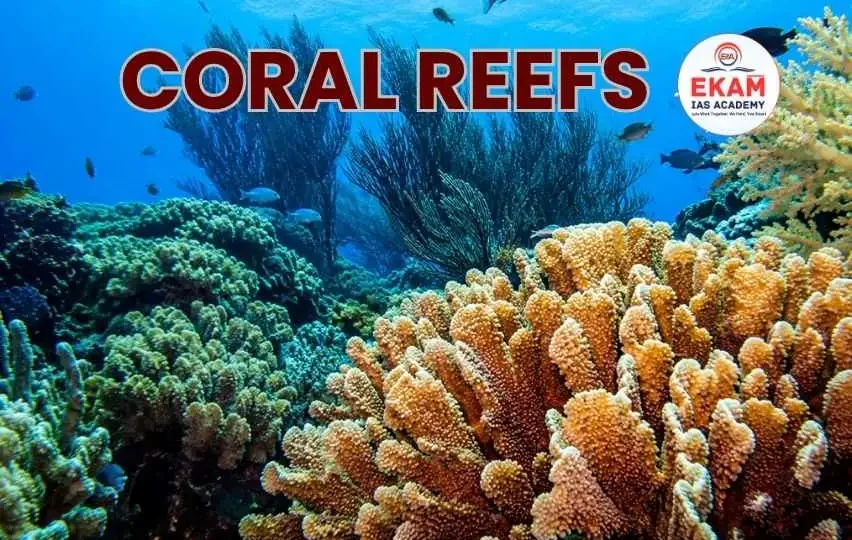
ToggleCoral reefs are among the most productive and biologically diverse ecosystems on Earth. They are massive structures built over thousands of years by tiny organisms called polyps. These reefs act as critical indicators of ocean health and provide invaluable services to coastal communities.
Definition of Coral Reefs
A coral reef is an underwater calcium carbonate structure produced by stony corals. Corals are a symbiotic association between polyp (animal) and zooxanthellae (a microscopic algae). The polyps provide a protected environment and the compounds necessary for photosynthesis, while the algae produce food and give corals their vibrant colors.
Characteristics of Coral Reefs
- Symbiotic Relationship: The core of the reef is the mutualism between polyps and zooxanthellae.
- Temperature Sensitive: They thrive in warm waters, ideally between 20°C and 28°C.
- Shallow Water: Most reefs require shallow water (less than 50m) to allow sunlight for photosynthesis.
- Salinity: They require stable salinity levels (average 35 ppt).
- Clear Water: Excessive turbidity (siltation) chokes the polyps and blocks sunlight.
Formation of Coral Reefs
Corals grow as larvae (planulae) attach to submerged rocks or other hard surfaces at the edges of islands or continents. As the corals grow and expand, reefs take on one of three major characteristic structures. This process is often explained by Darwin’s Subsidence Theory, which describes how reefs evolve in relation to sinking volcanic islands.
Types of Coral Reefs
The types of coral reefs UPSC candidates must distinguish include:
Fringing Reefs
These are the most common and grow directly from the shore. They are separated from the beach by only a narrow, shallow lagoon.
Barrier Reefs
These are separated from the coast by a much deeper and wider channel or lagoon. The Great Barrier Reef of Australia is the most famous example.
Atolls
These are circular or horseshoe-shaped reefs that surround a central lagoon, usually formed after a volcanic island has completely subsided below sea level.
Distribution of Coral Reefs
Corals are predominantly found in the tropical and subtropical waters between 30°N and 30°S latitudes.
- Global: The Indo-Pacific region (the “Coral Triangle”) has the highest diversity.
- India: Major reef locations include the Gulf of Mannar, Andaman and Nicobar Islands, Lakshadweep (Atolls), and the Gulf of Kachchh.
Components of Coral Ecosystem
- Producers: Zooxanthellae and various marine algae.
- Consumers: A vast array of fish, crustaceans, mollusks, and sea turtles.
- Decomposers: Bacteria and fungi that recycle nutrients in the nutrient-poor tropical waters.
Importance of Coral Reefs
- Biodiversity: They provide habitat and nursery grounds for millions of marine organisms.
- Coastal Protection: Reefs act as natural breakwaters, protecting shorelines from tsunamis, storms, and erosion.
- Economic Value: They support multi-billion dollar fisheries and tourism industries.
- Medicine: Corals are being used in the research of treatments for cancer, arthritis, and heart disease.
Threats to Coral Reefs
The most significant threat is coral bleaching UPSC. This occurs when corals, stressed by rising temperatures or pollution, expel their symbiotic zooxanthellae, turning white and eventually dying.
- Climate Change: Rising sea surface temperatures and ocean acidification.
- Pollution: Agricultural runoff and plastic waste leading to eutrophication.
- Destructive Fishing: Using dynamite or cyanide fishing.
- Siltation: Construction and deforestation leading to sediment runoff that smothers reefs.
Conservation Measures
- Marine Protected Areas (MPAs): Restricting fishing and tourism in sensitive reef zones.
- Coral Restoration: Techniques like “Biorock” technology (mineral accretion) and coral gardening.
- International Frameworks: The International Coral Reef Initiative (ICRI) and the Ramsar Convention.
- Legal Protection: In India, corals are protected under Schedule I of the Wildlife Protection Act, 1972.
Conclusion
Coral reefs are the “canaries in the coal mine” for our oceans. For marine ecosystem notes UPSC, it is clear that protecting reefs is vital for global food security and coastal resilience. Combating coral bleaching requires a dual approach: local management of pollution and global action on carbon emissions to ensure these “blue forests” survive for future generations.
UPSC Prelims: PYQs & Practice Questions
Previous Year Questions (Prelims)
Q: Which of the following have coral reefs?
1. Andaman and Nicobar Islands
2. Gulf of Kachchh
3. Gulf of Mannar
4. Sunderbans
Select the correct answer using the code given below:
(a) 1, 2 and 3 only
(b) 2 and 4 only
(c) 1 and 3 only
(d) 1, 2, 3 and 4
Answer: (a) 1, 2 and 3 only
Explanation:
Major coral reefs in India are found in the Andaman and Nicobar Islands, Gulf of Kachchh, Gulf of Mannar, and Lakshadweep. The Sunderbans is a mangrove ecosystem with high turbidity and low salinity due to freshwater inflow from the Ganga-Brahmaputra system, making it unsuitable for coral growth.
Q: Consider the following statements:
1. Most of the world’s coral reefs are in tropical waters.
2. More than one-third of the world’s coral reefs are located in the territories of Australia, Indonesia, and Philippines.
3. Coral reefs host far more number of animal phyla than those hosted by tropical rainforests.
Which of the statements given above is/are correct?
(a) 1 and 2 only
(b) 3 only
(c) 1 and 3 only
(d) 1, 2 and 3
Answer: (d) 1, 2 and 3
Explanation:
Most coral reefs occur between 30°N and 30°S latitudes in warm tropical waters. The Coral Triangle region and the Great Barrier Reef account for a major share of global coral reefs. Coral reefs also exhibit extremely high phyletic diversity, supporting a wider range of animal body plans than tropical rainforests.
Practice Questions
Q: With reference to coral bleaching, consider the following statements:
1. It is a process where corals expel their symbiotic zooxanthellae due to environmental stress.
2. Corals can recover from bleaching if the environmental stress is short-lived.
3. Ocean acidification promotes coral growth by providing more carbon for calcium carbonate shells.
Which of the statements given above is/are correct?
(a) 1 and 2 only
(b) 2 and 3 only
(c) 1 only
(d) 1, 2 and 3
Answer: (a) 1 and 2 only
Explanation:
Statements 1 and 2 are correct because corals expel zooxanthellae under environmental stress such as rising sea temperature, causing bleaching. If the stress is temporary, corals may recover. Statement 3 is incorrect because ocean acidification reduces the availability of carbonate ions required for coral skeleton formation, weakening reef structures over time.
Q: The "Biorock" technology, recently seen in the news in India, is related to:
(a) Direct capture of carbon from the atmosphere.
(b) Restoration of damaged coral reefs using mineral accretion.
(c) Extraction of rare earth metals from the seabed.
(d) Development of artificial islands in the South China Sea.
Answer: (b) Restoration of damaged coral reefs using mineral accretion
Explanation:
Biorock technology uses low-voltage electric currents to deposit minerals on submerged steel structures, promoting faster coral growth and improved resilience against thermal stress. This mineral accretion technology has been tested for coral restoration in regions such as the Gulf of Kachchh.
UPSC Mains – Previous Year & Practice Questions
Mains Previous Year Questions
Question: Discuss the causes and effects of ocean acidification on the marine food chain. (Mains 2022)
(Directly impacts coral reef stability and marine biodiversity)
Question: Assess the impact of global warming on the coral life system with suitable examples. (Mains 2018)
Question: Account for the variations in oceanic salinity and discuss its multi-dimensional effects. (Mains 2017)
(Salinity is a critical factor for coral reef survival)
Question: What is the economic importance of the marine ecosystem in India? Discuss the potential of the Blue Economy. (Mains 2015)
Question: Explain the formation of Atolls and distinguish them from Barrier Reefs. (Mains 2014)
Mains Practice Questions
[10 Marks | 150 Words]
Question: Describe the symbiotic relationship between coral polyps and zooxanthellae. Why is this relationship referred to as a “biological paradox” in nutrient-poor tropical waters?
[15 Marks | 250 Words]
Question: Analyze the role of coral reefs as “Natural Breakwaters”. How does reef degradation increase the vulnerability of coastal India to cyclones and tsunamis?
[15 Marks | 250 Words]
Question: Critically evaluate the legal and institutional framework for the protection of coral reefs in India. Suggest measures for community-based reef management.


Coral Reefs-FAQs
Why are corals called 'Rainforests of the Sea'?
Because they harbor immense biodiversity. They occupy less than 0.1% of the ocean’s surface but support approximately 25% of all marine life.
What is the 'Coral Triangle'?
A roughly triangular area of the tropical marine waters of Indonesia, Malaysia, Papua New Guinea, Philippines, Solomon Islands, and Timor-Leste that contains at least 500 species of reef-building corals.
Can corals live in cold water?
Yes. While types of coral reefs UPSC focuses on are tropical (shallow-water), there are Cold Water Corals (e.g., Lophelia) that live in the deep, dark sea. However, they do not have zooxanthellae and grow very slowly.
What is the main cause of coral bleaching?
The primary trigger is the rise in Sea Surface Temperatures (SST) due to climate change. Other factors include solar irradiance, pollution (siltation), and changes in salinity.
What are 'Atolls' and how are they formed?
Atolls are ring-shaped reefs surrounding a lagoon. According to Darwin’s theory, they form when a fringing reef around a volcanic island continues to grow upward as the island slowly subsides (sinks) into the ocean.