

Rising nighttime temperatures in Indian cities are emerging as a serious public health risk, often more dangerous than daytime heatwaves.
Heat Waves
- A heat wave is a period of abnormally high temperatures compared to the normal climatology of a region.
- Occurrence: Common between March and June, sometimes extending into July.
- Criteria (IMD):
- Plains: Maximum temperature ≥ 40°C.
- Hilly regions: Maximum temperature ≥ 30°C.
- Departure from normal: Heat Wave: +4–6°C above normal. Severe Heat Wave: +6°C or more.
- Absolute temperature: Heat Wave: ≥ 45°C. Severe Heat Wave: ≥ 47°C.
- Declaration: Must be observed in at least two stations in a meteorological subdivision for two consecutive days; declared on the second day.
Rising NightTime Temperatures in India
- Longterm warming trend: India’s average temperature increased by 0.7°C between 1901 and 2018, reflecting a steady rise in both daytime and nighttime heat.
- Future projections: By 2100, the warmest day is expected to rise by 4.7°C, while the coldest night may rise by 5.5°C — showing that nighttime warming will outpace daytime heat.
- IMD confirmation: Data from the India Meteorological Department (IMD) confirms that nighttime temperatures are rising faster than daytime averages, intensifying continuous heat stress.
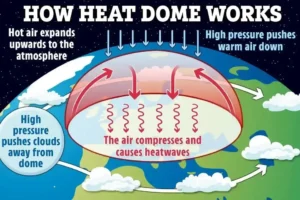
- Urban heat island effect: Cities like Delhi, Mumbai, and Bengaluru record nighttime temperatures 2–3°C higher than rural surroundings, worsening health risks in dense urban areas.
Impact on Residents
- Poorly ventilated homes trap heat, leaving no nighttime relief.
- Leads to: sleep discomfort, exhaustion, reduced productivity, and higher mortality.
- Mortality data:
- Daytime >45°C but nights <28°C → ~100 deaths/day.
- Nights 28–30°C → ~165 deaths/day.
- Nights >30°C → ~265 deaths/day.
Challenges in Current Heat Action Plans
- Limited Coverage: India has Heat Action Plans (HAPs) in 23 states and 200+ cities, but their reach is uneven. Studies show that over 60% of districts lack localized plans, leaving millions vulnerable.
- Focus on Episodic Heatwaves: Most HAPs are designed for shortterm daytime heatwaves, not continuous nighttime heat exposure. Data indicates night temperatures in Indian cities have risen by 0.2–0.3°C per decade, yet policies rarely address this.
- Weak Implementation: A 2023 study found that only 30% of HAPs allocate funds for structural measures like housing upgrades or urban greening.
- Urban Heat Island Effect: Cities like Delhi, Ahmedabad, and Hyderabad record nighttime SUHI intensities of 2–3°C higher than rural surroundings, but HAPs lack strategies to mitigate this.
Way Forward
- Heatresilient housing: Promote lowcost insulation materials, doubleglazed windows, and passive cooling designs.
- Green spaces: Expanding urban tree cover and rooftop gardens can reduce local temperatures by 1–2°C, mitigating the urban heat island effect.
- Reflective roof coatings: White roofs can lower indoor night temperatures by 2–3°C, especially in lowincome housing clusters.
- Whitewashing & ventilation: Simple measures like limebased paints and crossventilation designs reduce trapped heat.
Conclusion
Warm nights are a hidden health hazard in India’s summers. In short: Addressing nighttime heat stress is crucial for public health, urban resilience, and climate adaptation.
ISRO has highlighted the lifesupport system of the Gaganyaan mission, which will ensure astronaut safety during India’s first human spaceflight.
Gaganyaan’s ECLSS
- India’s First Crewed Mission: The Gaganyaan mission marks India’s entry into human spaceflight, scheduled for launch in the coming years.
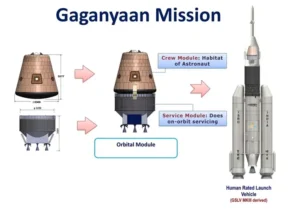
- Critical Role of ECLSS: Its success depends on the Environmental Control and Life Support System (ECLSS), which ensures astronauts can survive and function in orbit.
- Earthlike Conditions in Space: The ECLSS replicates Earthlike living conditions inside the crew module by managing air composition, water recycling, temperature regulation, and waste disposal.
- Safety & Sustainability: By maintaining a stable and habitable environment, the system protects astronauts from the harsh realities of space, ensuring mission safety and longduration viability.
Air Revitalisation
- Oxygen supply: Maintained at safe levels to support astronaut survival.
- Carbon dioxide removal: Achieved through lithium hydroxide canisters, while activated charcoal absorbs odours.
- Atmospheric control: Pressure and humidity are regulated to mimic Earthlike conditions inside the crew module.
Thermal Regulation
- Cabin temperature: Maintained between 20–26°C for optimal comfort.
- Humidity control: Relative humidity kept within 30–70%, ensuring crew wellbeing.
- Electronics safety: Systems are designed to prevent overheating of onboard equipment and electronics.
Water Management
- Recycling & storage: Essential in microgravity, where water conservation is critical.
- Microgravity risks: Water forms floating globules, which can cause short circuits or accidental inhalation.
- Safe usage systems: Special containment and dispensing mechanisms ensure safe handling and consumption.
Waste Management
- Chemical treatment: Human waste is treated to neutralise odours and inhibit bacterial growth.
- Sealed storage: Waste is stored in airtight containers for disposal after return.
- Hygiene assurance: Prevents contamination and maintains crew health inside the module.
Fire Safety
- Suppression systems: Integrated fire suppression mechanisms ensure rapid response.
- Emergency depressurisation: As a last resort, the cabin can be depressurised (similar to Russia’s Soyuz) to extinguish fire, after astronauts wear protective spacesuits.
Significance of Gaganyaan’s ECLSS
- Crew Survival & Comfort: The system ensures astronauts have safe oxygen levels, controlled temperature, clean water, and waste management, enabling survival and comfort in orbit.
- Human Spaceflight Capability: Demonstrates India’s technological competence in designing and operating advanced lifesupport systems, a critical milestone in human spaceflight.
- Foundation for Future Missions: Builds the groundwork for space station modules, longduration missions, and deepspace exploration, expanding India’s role in global space research.
- Strategic Advancement: Strengthens India’s position as a spacefaring nation, enhancing scientific prestige and international collaborations
Conclusion
The ECLSS is the backbone of Gaganyaan, replicating Earthlike conditions in space. In short: It ensures astronaut safety, marking a crucial step in India’s journey toward human space exploration.
The Indian rupee has recently weakened against the US dollar, sparking debate on whether depreciation should be allowed to continue or if intervention is necessary.
Rupee Depreciation
- Rupee depreciation refers to the decline in the value of the Indian currency against foreign currencies, especially the US dollar.
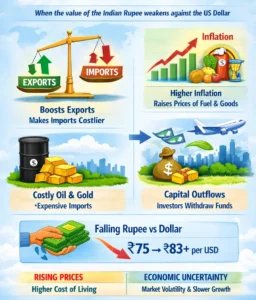
- Economic Impact: While a weaker rupee can make Indian exports more competitive, it simultaneously raises import costs, particularly for crude oil, electronics, and gold.
- Inflationary Pressure: Higher import bills fuel domestic inflation, affecting essential commodities and household budgets.
- Capital Outflows: Concerns include speculative capital outflows, which destabilize financial markets and weaken investor confidence.
- Recent Trends: The rupee has seen sharp fluctuations in recent years, often linked to global oil prices, US Federal Reserve policies, and geopolitical tensions.
Causes of Depreciation
- Global factors: Strong US dollar, rising US interest rates, and global capital flight.
- Speculative flows: Foreign Institutional Investors (FIIs) pulling out funds, driven by market sentiment.
- Current Account Deficit (CAD): Higher imports of crude oil and essential goods increase demand for foreign exchange.
- Domestic inflation: Weakens investor confidence and currency stability.
Implications
- Inflationary impact: Costlier imports of crude oil, food, and essential commodities.
- Capital outflows: Reduced foreign investment inflows, affecting liquidity.
- Export competitiveness: Shortterm boost for exporters, but volatility reduces longterm gains.
- Debt burden: External borrowings become more expensive when repaid in dollars.
Policy Debate
- Arguments for letting rupee fall:
- Marketdetermined exchange rate reflects true fundamentals.
- Boosts exports and tourism competitiveness.
- Arguments for intervention:
- Prevents runaway inflation.
- Stabilises investor confidence.
- Protects vulnerable households from rising import costs.
Way Forward
- RBI’s Strategic Role: The Reserve Bank of India (RBI) should intervene to smooth volatility rather than rigidly fixing exchange rates. In FY 2023–24, RBI sold over $40 billion from forex reserves to stabilise the rupee.
- Structural Reforms: Reducing the Current Account Deficit (CAD) is crucial. India’s CAD stood at 1.2% of GDP in FY 2024, largely due to oil imports. Diversifying energy sources and boosting domestic manufacturing under Make in India can reduce dependence on imports.
- Strengthening Forex Reserves: Maintaining adequate reserves cushions external shocks. India’s forex reserves are currently around $640 billion (May 2026), providing cover for over 10 months of imports.
- LongTerm Resilience: Promoting rupee internationalisation (already accepted in trade settlements with countries like Russia and Sri Lanka) and deepening domestic financial markets will enhance stability.
Conclusion
Rupee depreciation is a doubleedged sword beneficial for exports but risky for inflation and capital stability. India needs a balanced approach combining RBI intervention with structural reforms to safeguard economic stability.
The National Commodity and Derivatives Exchange (NCDEX) has launched RAINMUMBAI, India’s first SEBIapproved weather derivatives contract.
Weather Derivatives
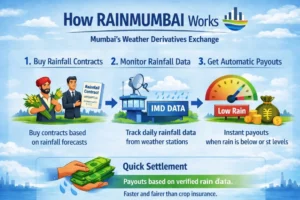
- Definition: Weather derivatives are financial instruments whose value is linked to observed weather data (rainfall, temperature, etc.) rather than physical loss assessments.
- Faster Payouts: Unlike conventional insurance, they provide quicker settlements, reducing operational delays for farmers and businesses.
- Sectoral Benefits: Aim to help agriculture, logistics, and energy sectors hedge risks from unpredictable monsoon rainfall. For example, India’s agriculture sector, which contributes ~18% of GDP, is highly dependent on monsoon variability.
- Market Development: India recently launched RAINMUMBAI, the first SEBIapproved exchangetraded weather derivative. Globally, the weather derivatives market is valued at over $10 billion annually, showing strong potential for India’s financial ecosystem.
- Risk Management: With 50% of India’s workforce engaged in climatesensitive sectors, weather derivatives provide a modern tool to manage climate risk and income volatility.
About RAINMUMBAI
- Developed by NCDEX in collaboration with IIT Bombay.
- Based on Mumbai’s rainfall data from IMD stations at Santacruz and Colaba.
- Cashsettled contract tracking deviation from the city’s longperiod average (LPA) rainfall.
- Available only for monsoon months (June–September).
- Traded in lots at ₹50 per mm of rainfall, with weekday trading hours from 10:00 a.m. to 11:30 p.m.
Significance
- Risk management tool for farmers, power companies, construction, logistics, and tourism.
- Helps hedge against monsoon variability, crucial for India where agriculture is highly rainfalldependent.
- Encourages financial innovation in commodity markets, diversifying beyond traditional futures.
- Supports India’s move toward climateresilient economic planning.
NCDEX
- Established in 2003, headquartered in Mumbai.
- Focuses on agricultural commodities like wheat, sugar, spices, cotton.
- Regulated by SEBI, ensuring transparency and investor protection.
Conclusion
RAINMUMBAI marks a milestone in India’s financial innovation, linking weather risk with market instruments. It strengthens climate risk management while deepening India’s derivatives market ecosystem.
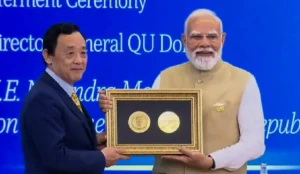
The Prime Minister of India was recently awarded the FAO’s prestigious Agricola Medal, recognizing his leadership in advancing global food security and sustainable agriculture.
Agricola Medal
- Highest FAO Honour: The Agricola Medal is the top distinction conferred by the Food and Agriculture Organization (FAO) of the United Nations.
- Purpose: It honours individuals who have made exceptional contributions to agricultural development, nutrition improvement, and food security worldwide.
- Significance: The award symbolizes global recognition of leadership in promoting inclusive and sustainable food systems.
- Past Recipients: Previous awardees include Heads of State, scientists, and policymakers who have advanced FAO’s mission.
Food and Agriculture Organization (FAO)
- Establishment: Founded on 16 October 1945 in Quebec City, Canada, FAO is the oldest specialized UN agency.
- Headquarters: Located in Rome, Italy.
- Membership: Comprises 195 members — 194 countries and the European Union. India is a founding member.
- Mandate: To defeat hunger, improve nutrition, raise rural living standards, and enhance agricultural productivity.
- Functions:
- Coordinates global agricultural, forestry, and fisheries programs.
- Serves as a forum for policy negotiation between developed and developing nations.
- Provides technical expertise and data for sustainable development.
- Collaborated with the UN to establish the World Food Programme (WFP).
- Key Reports:
- State of the World’s Forests (SOFO)
- State of World Fisheries and Aquaculture (SOFIA)
- State of Food Security and Nutrition (SOFI)
- State of Agricultural Commodity Markets (SOCO)
- Funding: Supported by member contributions and voluntary partnerships.
- World Food Day: Observed annually on 16 October, marking FAO’s founding anniversary.
India and FAO
- India collaborates with FAO on climateresilient agriculture, digital farming, and nutritionbased programs.
- FAO supports India’s initiatives like Millet Mission, Soil Health Card Scheme, and Zero Hunger projects.