

Table of Contents
ToggleINDIA’S ORBITAL DATA CENTRE SATELLITE
TOPIC: (GS3) SCIENCE AND TECHNOLOGY: THE HINDU
India is preparing to enter a new frontier in space technology with the launch of Pathfinder, the country’s first orbital data centre satellite.
Orbital Data Centres
- Orbital data centre: A constellation of satellites equipped with GPU-based computing systems similar to terrestrial data centres.
- Unlike traditional satellites that only transmit raw data, these centres can process information in space.
- Extends the principle of edge computing, reducing dependence on centralized cloud systems.
- Enables faster analysis and real-time AI applications in orbit.
Pathfinder Demonstration Mission
- Single-satellite experiment to test whether data centre-grade GPUs can function reliably in low Earth orbit.
- Focus on performance under extreme heat and cosmic radiation.
- Equipped with Pixxel’s hyperspectral imaging camera to process images onboard.
- Results transmitted back to Earth will be pre-analysed outputs, reducing communication load.
Why Global Firms Are Interested
- Pressure on terrestrial data centres: AI demand strains resources like land, water, and energy.
- Continuous solar power: Satellites can harness near-uninterrupted solar energy.
- Reduced transmission burden: Processing in orbit minimizes data transfer costs.
- Strategic competition: Firms like SpaceX, Blue Origin, Microsoft Azure Space, and Lonestar Data Holdings are exploring orbital computing.
Challenges
- Heat management: Space lacks convection; GPUs risk overheating.
- Radiative cooling systems: Use ammonia loops and infrared panels.
- Radiation damage: Causes bit flips and semiconductor degradation.
- Hardware limitations: Space-grade chips are less advanced than Earth GPUs.
- Power storage: Satellites must store energy during Earth’s shadow periods.
- Maintenance difficulties: Repairs in orbit are complex; redundancy is essential.
Pixxel–Sarvam Partnership
- Pixxel: Responsible for design, build, launch, and operation.
- Sarvam: Provides AI infrastructure and language models.
- Pathfinder will run AI training and inference directly in orbit.
- Hyperspectral imaging will allow real-time environmental monitoring.
Cost Considerations
- Currently more expensive than Earth-based systems.
- Costs may decline with: Large satellite constellations, Reusable rockets like Starship, Lower cooling and electricity expenses in orbit
- Experts predict 10–30 years before orbital centres rival terrestrial cloud systems.
Conclusion
The Pathfinder mission is a pioneering step for India in the field of orbital computing. In the long run, orbital data centres could complement Earth systems, offering sustainable, efficient, and advanced computing solutions for the AI-driven future.
ELECTION COMMISSION APPOINTMENT PROCESS
TOPIC: (GS2) POLITY: THE HINDU
Recently, the Supreme Court of India criticised Parliament for delaying a law on appointments, calling it a “tyranny of the elected.”
Constitutional Basis
- Article 324(2): Provides that appointments of Election Commissioners should be made according to a law passed by Parliament.
- The 1991 Act regulated salaries, tenure, and functioning but did not specify appointment procedures.
- In practice, appointments remained under executive control.
Traditional Appointment Process
- Union Law Ministry prepared a panel of names.
- Prime Minister recommended candidates.
- President formally appointed them.
- Most appointees were senior bureaucrats, with the senior-most becoming the Chief Election Commissioner (CEC).
Challenge Before the Supreme Court
- In Anoop Baranwal v. Union of India (2022), petitioners argued that executive dominance undermined independence.
- The Court noted the speedy appointment of Arun Goel as EC and questioned transparency.
- It stressed the need for a neutral mechanism to ensure impartiality.
Supreme Court’s Interim Ruling (2023)
- Directed that appointments be made by a three-member committee:
- Prime Minister
- Leader of Opposition in Lok Sabha
- Chief Justice of India (CJI)
- This arrangement was to continue until Parliament enacted a law.
- The Court emphasised that right to vote is part of freedom of expression under Article 19(1)(a).
- It described the EC as the “guardian of democracy.”
Call for Institutional Reforms
- Suggested creation of an independent secretariat.
- Recommended charging EC’s expenditure to the Consolidated Fund of India.
- Warned that financial dependence on the executive could compromise independence.
The 2023 Appointment Law
- Parliament enacted the Chief Election Commissioner and Other Election Commissioners Act, 2023.
- Replaced the CJI in the selection panel with a Union Cabinet minister nominated by the PM.
- New selection committee:
- Prime Minister
- Union Cabinet minister
- Leader of Opposition
- Critics argue this restores executive dominance (2 out of 3 seats controlled by government).
- A search committee headed by the Law Minister prepares names, but the selection panel can choose any eligible person, even outside the list.
- Section 7(2) ensures appointments remain valid despite vacancies or defects in the committee.
Legal Challenge to EC Appointment Law
- Challenge Filed (2024): The Association for Democratic Reforms (ADR) along with other petitioners approached the Supreme Court questioning the constitutional validity of the Chief Election Commissioner and Other Election Commissioners Act, 2023.
- Core Argument: Petitioners contend that the law restores executive dominance in the appointment process, thereby weakening the independence of the Election Commission of India (ECI).
- Violation of Judicial Spirit: They argue that the new law goes against the spirit of the Supreme Court’s Anoop Baranwal judgment (2023), which had sought to insulate the Commission from executive influence by including the Chief Justice of India in the selection panel.
Conclusion
The Supreme Court’s intervention underscores the importance of a transparent, impartial, and independent Election Commission for safeguarding India’s democratic framework. The final resolution will shape the future of electoral integrity in the country.
TAGORE–GANDHI CHARKHA DEBATE
TOPIC: (GS1) MODERN HISTORY: THE HINDU
The Tagore–Gandhi charkha debate has resurfaced in public discussions as scholars and commentators revisit their contrasting philosophies on nationalism, self-reliance, and individual freedom.
Gandhi–Tagore Intellectual Conflict
- Jawaharlal Nehru observed that few thinkers differed as profoundly as Gandhi and Tagore.
- Their first differences appeared in 1915, when Gandhi visited Shantiniketan.
- They disagreed on nationalism, education, and political mobilisation.
- Despite disagreements, both maintained mutual respect and friendship.
Divergence on Nationalism
- After the Jallianwala Bagh Massacre (1919), Gandhi launched the Non-Cooperation Movement.
- Tagore feared mass mobilisation could lead to blind nationalism.
- Instead of joining, he renounced his British knighthood as a symbolic protest.
- Gandhi emphasised collective discipline, while Tagore valued individual freedom and creativity.
Differences on Religion and Social Reform
- In 1934, Gandhi interpreted the Bihar earthquake as divine punishment for untouchability.
- Tagore rejected linking natural disasters to moral or religious causes.
- He argued against associating cosmic events with ethical judgments.
- This highlighted their contrasting approaches to spirituality and social reform.
The Charkha Debate
- Gandhi promoted the charkha as a tool of self-reliance, rural upliftment, and resistance to industrial exploitation.
- In 1924, Congress resolved that members should wear khadi and contribute hand-spun yarn.
- Tagore criticised this in his essay “The Cult of the Charkha”, warning against blind obedience and suppression of diversity.
- He believed repetitive spinning engaged muscles, not the mind, reducing creativity.
- Tagore argued societies thrive on openness, science, and intellectual growth, not rigid uniformity.
Gandhi’s Defence
- Gandhi responded in “The Poet and the Charkha”, defending its ethical and social value.
- He saw spinning as restoring dignity to manual labour and connecting elites with the poor.
- For Gandhi, the charkha symbolised discipline, cooperation, and national unity.
- He accepted limited use of machinery but insisted on moral regeneration through manual work.
Tagore’s Uneasy Dissent
- Tagore did not oppose the charkha as a practical tool for clothing the poor.
- His concern was its elevation into a moral and political duty.
- He feared it imposed uniformity and discouraged individual creativity.
- Despite disagreements, he expressed dissent with reluctance and respect, acknowledging Gandhi’s sincerity.
Conclusion
The Tagore–Gandhi charkha debate symbolises the clash between ascetic nationalism and creative individualism. Their respectful disagreement enriched India’s intellectual tradition, showing that diverse visions of freedom can coexist within the broader struggle for independence.
NITI AAYOG REPORT ON SCHOOL EDUCATION
TOPIC: (GS2) POLITY: THE HINDU
The NITI Aayog has released its latest report titled “School Education System in India: Temporal Analysis and Policy Roadmap for Quality Enhancement”.
The Pyramid Problem
- India’s school system resembles a sharp pyramid.
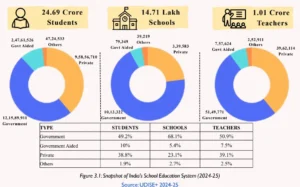
- 7.3 lakh primary schools exist, but only 1.64 lakh higher secondary schools.
- Just 5% of schools provide continuous education from Grade 1 to 12.
- Students often change schools after Class 5, 8, and 10, leading to poor retention.
- This fragmentation contributes to attrition and instability in learning.
Dropout Crisis
- Primary dropout: 0.3% (low).
- Upper primary dropout: 3.5%.
- Secondary dropout: 11.5%.
- Nearly 40% of children leave before completing higher secondary.
- Transition rate from Class 10 to Class 11 improved to 75.1% (2024-25), but GER at higher secondary is only 58.4%.
- States like Bihar, Meghalaya, Nagaland, Assam report GER below 45%.
- Causes: financial constraints, early workforce entry, social pressures, and RTE Act coverage only till age 14.
Weak Learning Outcomes
- Reading proficiency among Grade 8 students declined from 74.7% (2014) to 71.1% (2024).
- Only 45.8% of Grade 8 students can solve basic division.
- Even private schools show weak results:
- 35% of Class 5 students in low-fee schools cannot read Class 2 text.
- 60% cannot solve division problems.
- Highlights quality deficit despite enrolment gains.
Teacher Shortages and Preparation
- India has 1.01 crore teachers, but vacancies remain high.
- Bihar: 2.08 lakh elementary vacancies, plus shortages in secondary and senior secondary.
- 1.04 lakh schools operate with single teachers, handling multiple grades and duties.
- Teachers lose 14% of teaching days to non-academic work.
- Weak preparation:
- Many score below 60-70% in subject papers.
- Only 10-15% clear CTET/TET with qualifying marks.
- Average primary-level maths score: 46%.
Infrastructure Gaps
- 1.19 lakh schools lack electricity.
- 14,505 schools without functional water sources.
- 59,829 schools lack handwashing facilities.
- 7,993 schools report zero enrolment.
- Many schools operate with less than 50 students, limiting resources.
Shift Toward Private Schools
- Government school enrolment fell from 71% (2005) to 49.24% (2024-25).
- Private schools now account for 44% of secondary institutions.
- Parents prefer them for discipline, English-medium, employability.
- But regulation is weak; many lack trained teachers and infrastructure.
NITI Aayog Recommendations
- Cylindrical schooling model: Composite schools offering Grades 1–12 under one roof.
- Foundational learning focus: Teach at actual learning level, not just grade level.
- Teacher reforms: Career pathways (senior → master → mentor), reduce non-teaching duties, practice-based training.
- Balanced AI integration: Promote AI literacy, but ensure it supports teachers, not replaces them.
- Sushikshit Bharat Abhiyaan: A system-wide transformation, not piecemeal reforms.
Conclusion
Incremental reforms will not suffice; a composite schooling model, stronger teacher training, foundational learning, and regulated private participation are essential. A Sushikshit Bharat Abhiyaan must drive holistic transformation to meet the aspirations of a resurgent India.
PANNA TIGER RESERVE
TOPIC: (GS3) ENVIRONMENT: THE HINDU
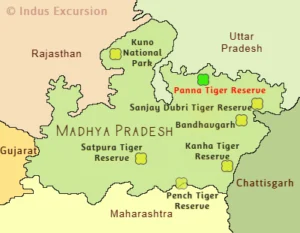
Panna Tiger Reserve, located in the Vindhyan mountain range of northern Madhya Pradesh, is a crucial habitat for tigers and other wildlife.
Location and Landscape
- Falls under the Deccan Peninsula biogeographic zone and Central Highlands biotic province.
- Characterised by table-top topography, with extensive plateaus and gorges.
- Two parallel plateaus run southwest to northeast.
- The Ken River flows through the reserve, sustaining its ecosystem.
- Known for 2,000-year-old rock paintings, reflecting ancient human presence.
- Surrounding areas inhabited by Baiga and Gond tribes, with rich cultural traditions.
Flora
- Dominated by dry deciduous forests interspersed with grasslands.
- Represents the northernmost teak forests and easternmost Kardhai (Anogeissus pendula) forests.
- Acacia catechu thrives on dry, steep slopes.
- Vegetation supports diverse wildlife and maintains ecological balance.
Fauna
- Home to tigers, leopards, sloth bears, and striped hyenas.
- Other carnivores: jackal, wolf, wild dog, jungle cat, rusty-spotted cat.
- Rich birdlife: white-necked stork, bar-headed goose, honey buzzard, blossom-headed parakeet, paradise flycatcher, slaty-headed scimitar babbler, and five vulture species.
- Provides critical habitat for both resident and migratory species.
Significance
- Acts as a biodiversity hotspot in Bundelkhand.
- Supports Rabi crop irrigation through the Ken River.
- Promotes eco-tourism and tribal livelihoods.
- Plays a key role in Project Tiger and national conservation efforts.
Conclusion
Panna Tiger Reserve With its unique landscape, diverse flora and fauna, and tribal traditions, it highlights the importance of conservation and sustainable development in India’s protected areas.
WESTERN DISTURBANCES
TOPIC: (GS1) GEOGRAPHY: THE HINDU
Northwest India recently experienced a brief respite from rain and thunderstorms after the latest Western Disturbance weakened and moved eastward.
Origin and Movement
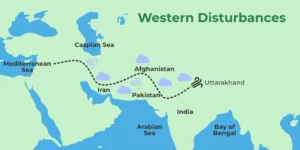
- Extratropical storms forming over the Mediterranean Sea.
- Move eastwards under the influence of the subtropical jet stream.
- Travel across West Asia, Pakistan, and finally reach India, Nepal, and Bangladesh.
- Carry moisture-laden winds, which interact with local climatic conditions.
Impact on India
- Most prominent between November and March.
- Cause rainfall and snowfall in northwestern India, especially Punjab, Haryana, Himachal Pradesh, Uttarakhand, and Delhi.
- Provide essential water for Rabi crops like wheat and mustard.
- Influence temperature variations, often leading to cold waves after their passage.
- Occasionally trigger hailstorms and thunderstorms, affecting agriculture and daily life.
Why Called Western Disturbances
- Named for their western origin in the Mediterranean region.
- The term “disturbance” reflects their disruptive nature, altering normal weather conditions.
- Similar systems exist globally but are known by different names depending on region.
Significance
- Act as a lifeline for winter agriculture in north India.
- Help maintain groundwater recharge and snow accumulation in the Himalayas.
- Their absence or weakening can cause drought-like conditions during the Rabi season.
Conclusion
Western Disturbances are a vital climatic phenomenon shaping the agricultural and weather patterns of north India. While they sometimes disrupt daily life, their role in sustaining winter crops and Himalayan snow reserves makes them indispensable.

GRIEVANCE REDRESSAL ASSESSMENT AND INDEX (GRAI)
TOPIC: (GS2) POLITY: THE HINDU
For March 2026, the Department of Financial Services’ insurance division secured the top position in the Grievance Redressal Assessment and Index (GRAI) Rankings under the Group A category.
Objectives and Features
- Objective: To assess the timeliness and quality of grievance redressal.
- Developed by DARPG under the Ministry of Personnel, Public Grievances, and Pensions.
- Based on 4 dimensions:
- Efficiency
- Feedback
- Domain
- Organisational Commitment
- Uses 11 indicators for evaluation.
- Encourages ministries to improve service delivery and responsiveness.
CPGRAMS – The Backbone of GRAI
- CPGRAMS is a 24×7 online platform for citizens to lodge grievances.
- Connects all ministries and departments of the Government of India and States.
- Provides a unique registration ID to track grievance status.
- Mandates resolution within 21 days of filing.
- Ensures transparency and strengthens citizen trust in governance.
Latest Developments
- In March 2026, the Department of Financial Services’ insurance division topped the Group A category rankings.
- Rankings highlight best-performing departments and encourage healthy competition among institutions.
- Reflects the government’s focus on responsive administration.
Conclusion
By linking performance with accountability, it ensures that ministries and departments remain committed to timely and effective grievance resolution. Together with CPGRAMS, GRAI strengthens the framework of transparent and participatory administration in India.