
Table of Contents
ToggleSECURING INDIA AGAINST AI-DRIVEN CYBER THREATS
TOPIC: (GS2) GOVERNANCE: THE HINDU
The emergence of Mythos, an advanced AI system has raised alarms about India’s cybersecurity preparedness and the urgent need for a national AI accountability framework.
What is mythos AI?
- Mythos AI: Built on large language model architecture, Mythos has flagged 23,000+ issues across opensource projects, including Linux kernel and Android devices.
- Global Context: Nations like the U.S. and U.K. have established AI safety institutes and accountability frameworks.
- India’s Gap: India lacks a coordinated national framework to address AIdriven vulnerabilities in IoT, industrial devices, and legacy systems.
Key Concerns
- Cybersecurity Risks: Mythos can exploit bugs in TLS certificates, Windows servers, and industrial systems, threatening national infrastructure.
- Preparedness Deficit: India’s fragmented response mechanisms leave critical sectors exposed.
- Global Collaboration: Initiatives like AUKUS Pillar 2 highlight international cooperation in AI security, which India must emulate.
- Window Closing: Experts warn that delays in building resilience could allow attackers to exploit systemic weaknesses.
Implications for India
- National Security: Vulnerabilities in defense, energy, and financial systems could be exploited by hostile actors.
- Economic Impact: Cyberattacks may disrupt supply chains, digital payments, and industrial productivity.
- Public Safety: AIdriven breaches in healthcare or transport systems could endanger lives.
Way Forward
- Establish a National AI Safety Authority to monitor and mitigate risks.
- Develop AI accountability frameworks aligned with global best practices.
- Strengthen CERTIn and sectoral cyber response teams with AIenabled monitoring.
- Promote publicprivate partnerships for vulnerability testing and rapid patching.
- Invest in capacity building and R&D to reduce dependence on foreign frameworks.
Conclusion
India must urgently build a robust AIcybersecurity ecosystem to safeguard national security, economy, and citizens, ensuring technology remains a tool of empowerment rather than vulnerability.
FACULTY CRUNCH IN INDIA’S PREMIER TECHNICAL INSTITUTES
TOPIC: (GS2) GOVERNANCE: THE HINDU
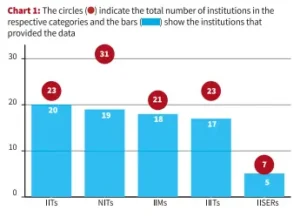
Recent RTI data revealed that over onethird of faculty posts remain vacant in India’s Centrally Funded Technical Institutes (CFTIs), including IITs, NITs, IIITs, and IISERs, raising concerns about the quality of higher technical education.
Vacancies in various institutions:
- CFTIs: Includes IITs, NITs, IIITs, and IISERs, catering to lakhs of engineering and science students annually.
- Vacancy Data:
- IITs: ~35% posts vacant.
- NITs: ~47% posts vacant.
- IIITs: ~47% posts vacant.
- IISERs: ~18% posts vacant.
- Despite government recruitment drives, vacancies persist across institutions.
Why Adequate Faculty is Necessary
- Impact: Shortages weaken the student–faculty ratio, reducing personalized mentoring and classroom interaction.
- Research Output: Faculty shortages limit India’s ability to lead in AI, quantum computing, biotechnology, and clean energy.
- Global Benchmark: Top universities like MIT and Stanford maintain low vacancy rates and strong faculty recruitment pipelines, enabling cuttingedge research.
- Government Efforts: Schemes like IMPRINT India and UAY (Uchhatar Avishkar Yojana) depend on strong faculty participation for innovation.
- Skill Development: Adequate faculty ensures graduates are industryready, supporting India’s Digital India and Make in India missions.
- Economic Impact: Faculty crunch undermines India’s ambition to place IITs/NITs among the top 100 global universities.
- Brain Drain Factor: Many qualified Indian academics prefer foreign universities due to better pay and research facilities, worsening domestic shortages.
Challenges
- Quality of Education: Shortage of teachers affects research output, mentoring, and classroom learning.
- Student–Faculty Ratio: With over 15 lakh students appearing for JEE, the shortage worsens the ratio, impacting personalized guidance.
- Regional Disparities: Newer IITs and NITs face higher vacancy rates compared to older, established ones.
- Global Competitiveness: Faculty crunch undermines India’s ambition to place IITs/NITs among top global universities.
Underlying Causes
- Recruitment Delays: Lengthy selection processes and bureaucratic hurdles.
- Brain Drain: Many qualified candidates prefer foreign universities due to better pay and research facilities.
- Contractual Hiring: Reliance on temporary faculty reduces stability and longterm academic planning.
- Specialization Gap: Difficulty in finding experts in emerging fields like AI, quantum computing, and biotechnology.
Way Forward
- Streamlined Recruitment: Simplify procedures and ensure timely appointments.
- Attractive Incentives: Competitive salaries, housing, and research grants to retain talent.
- International Collaboration: Invite global faculty under exchange programs.
- Digital Solutions: Use online platforms to bridge teaching gaps temporarily.
- Policy Integration: Align recruitment and training with National Education Policy 2020 goals.
Conclusion
India’s premier institutes must urgently address the faculty shortage to sustain excellence in technical education and research, ensuring they remain engines of innovation and global competitiveness.
NEW SUPREME COURT POSTS AND JUDICIAL INDEPENDENCE
TOPIC: (GS2) POLITY: THE HINDU
Five new judges have been appointed to the Supreme Court through the Supreme Court (Number of Judges) Amendment Ordinance, 2026, raising concerns about judicial independence and constitutional propriety.
Constitutional Mandate
- Article 124(1): Parliament alone can prescribe the number of Supreme Court judges by law.
- Past Amendments: Strength increased through Acts in 2009 (31 judges) and 2019 (34 judges).
- Legislative Process: CJI proposes expansion then Law Ministry drafts amendment next the Parliament passes Bill finally the Presidential assent is given.
- Article 123: President may promulgate Ordinances when Parliament is not in session, but they lapse within six weeks unless ratified.
Judicial Pronouncements on Ordinances
- R.C. Cooper (1970): Presidential satisfaction under Article 123 is subject to judicial review.
- D.C. Wadhwa (1986): Repeated repromulgation of Ordinances is unconstitutional.
- Gokaraju Rangaraju (1981): De Facto Doctrine protects judgments delivered by judges even if their appointment is later invalidated.
- Krishna Kumar Singh (2017): Ordinance power is exceptional, not a parallel lawmaking route.
Concerns
- Judicial Independence: Ordinancebased posts are temporary, making judges dependent on executive or legislative approval.
- Conflict of Interest: Union Government, being the largest litigant, may indirectly influence judicial strength.
- NJAC Judgment Contradiction: Collegium’s acceptance of Ordinancecreated posts undermines its earlier stance against executive interference.
- Legal Anomaly: If Ordinance lapses, sanctioned strength reverts to 34, creating uncertainty for sitting judges.
- Pendency Argument: Adding judges has historically not reduced backlog; root cause lies in excessive admission of Special Leave Petitions under Article 136.
Safeguards Suggested
- Clarify De Facto Doctrine: Limit its use to past judgments, not structural irregularities.
- Swearingin Protocols: Collegium may delay swearingin until Ordinance is ratified by Parliament.
- Recusal: Judges in Ordinancecreated posts could recuse from sensitive cases involving the Union Government.

Collegium vs. Ordinance-Created Posts
- Role of Collegium: The Collegium system (CJI + senior judges) recommends names for appointment to the Supreme Court and High Courts. It decides who becomes a judge, but not how many posts exist.
- Creation of Posts: The sanctioned strength of the Supreme Court is determined by Parliament through law (Supreme Court [Number of Judges] Act, 1956). An Ordinance under Article 123 can temporarily expand this strength when Parliament is not in session.
- Collegium’s Limitation: If posts are created via Ordinance, the Collegium still recommends judges to fill them. However, the existence of those seats itself depends on executive action and later parliamentary ratification. This means the Collegium is involved in appointments but has no control over the legality or permanence of the posts.
Conclusion
Judicial independence, a pillar of the Basic Structure, demands that the Supreme Court’s strength be determined by Parliamentary law, not executive Ordinances—ensuring the judiciary remains fully insulated from political timelines.
INDIA–NEPAL BORDER DISPUTE
TOPIC: (GS2) INTERNATIONAL RELATIONS: THE HINDU
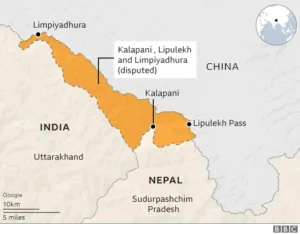
The boundary dispute between India and Nepal resurfaced after Nepal’s Prime Minister raised the issue in Parliament, focusing on the Kalapani, Lipulekh, and Limpiyadhura regions, prompting renewed diplomatic engagement.
Territorial Dispute
- Historical Context: Rooted in the interpretation of the Treaty of Sugauli (1816) signed between the British and Nepal.
- Disputed Territories: Kalapani, Lipulekh Pass, Limpiyadhura region
- Territorial Claim: Nepal claims these areas fall east of the Kali River, while India considers them part of Uttarakhand.
- Recent Developments: Nepal issued a new political map in 2020 including these territories, which India rejected.
India’s Position
- Strategic Importance: The region is vital for India’s defense, providing access to the Lipulekh Pass near the China border.
- Diplomatic Response: India emphasizes dialogue and historical treaties, rejecting unilateral cartographic assertions.
- Infrastructure Projects: Road construction to Lipulekh has been a point of contention, seen by Nepal as encroachment.
Nepal’s Stand
- Parliamentary Assertion: Nepal’s leadership insists on reclaiming the disputed territories.
- National Sentiment: Strong domestic pressure influences Nepal’s political tone, linking sovereignty with national pride.
- Diplomatic Engagement: Nepal seeks bilateral talks but also raises the issue in international forums.
Diplomatic Path Ahead
- Dialogue Mechanism: Both countries have agreed to resolve disputes through established mechanisms and foreign secretarylevel talks.
- Regional Stability: Peaceful resolution is crucial for South Asian cooperation under SAARC and BIMSTEC.
- MultiDimensional Approach: Beyond borders, India and Nepal share deep ties in trade, culture, hydropower, and peopletopeople exchanges.
Significance
- Ensures bilateral trust and prevents escalation in sensitive Himalayan regions.
- Strengthens India’s neighborhood policy under Neighbourhood First.
- Reinforces the need for balanced diplomacy that respects sovereignty while safeguarding strategic interests.
India–Nepal Border
- Total Length: ~1,751 km
- States Sharing Border:
- Uttarakhand – ~275 km (Pithoragarh, Champawat, Udham Singh Nagar)
- Uttar Pradesh – ~551 km (Pilibhit, Bahraich, Shravasti, Lakhimpur Kheri)
- Bihar – ~726 km (West Champaran, Sitamarhi, Araria, Kishanganj)
- West Bengal – ~100 km (Darjeeling district)
- Sikkim – ~99 km (North & East Sikkim)
- Bihar shares the longest border, while Sikkim has the shortest.
- Visa Requirement: No visa needed for Indians to enter Nepal.
- Legal Basis: 1950 IndoNepal Treaty of Peace and Friendship allows free movement, residence, and work rights.
Conclusion
The India–Nepal border dispute highlights the importance of dialogue, diplomacy, and historical clarity, ensuring that close neighbors resolve differences without undermining their longstanding partnership.
BONN CLIMATE CONFERENCE 2026
TOPIC: (GS3) ENVIRONMENT: THE HINDU
At the Bonn Climate Conference 2026 (SB64), the Global Climate and Health Alliance (GCHA) urged developed nations to triple adaptation finance to $120 billion annually by 2035, highlighting the urgency of climate resilience.
About the Bonn Climate Conference
- Definition: Midyear negotiations under the UNFCCC, officially the 64th Sessions of the Subsidiary Bodies (SB64).
- Venue: Held in Bonn, Germany.
- Purpose: Technical platform to prepare for the annual COP summit, focusing on adaptation, mitigation, finance, loss & damage, and just transition.
Key Outcomes
- Adaptation Finance: Push to raise public grantbased adaptation finance from $40 billion (COP26 target) to $120 billion annually by 2035.
- Fossil Fuel Transition: Developed countries urged to publish national roadmaps for phasing out fossil fuels, aligned with the 1.5°C pathway.
- Belém Adaptation Indicators: Work began on operationalizing 59 indicators adopted at COP30 to measure adaptation progress.
- Food Systems & Agriculture: Continued deliberations under the Sharm elSheikh Joint Work to enhance resilience in agriculture and food security.
- Just Transition Mechanism: Discussions on implementing the mechanism agreed at COP30 to support capacity building and technical cooperation.
Significance
- Technical Negotiation Platform: Converts political commitments into actionable frameworks between COP summits.
- Support for Vulnerable Nations: Helps countries facing climateinduced disasters, health risks, and food insecurity.
- Finance & Justice: Strengthens negotiations on adaptation finance, loss & damage funding, and climate investment flows.
- Global Cooperation: Reinforces multilateralism in tackling climate change challenges.
Conclusion
The Bonn Climate Conference 2026 underscores that climate resilience demands stronger finance, equitable transitions, and global cooperation, ensuring commitments translate into real protection for vulnerable communities.
SC ON RIGHT TO TRAVEL ABROAD VS. SPEEDY TRIAL
TOPIC: (GS2) POLITY: THE HINDU
The Supreme Court recently set aside a Telangana High Court order permitting an accused businessman to travel abroad for medical treatment, ruling that the right to travel abroad under Article 21 is not absolute and must be balanced against the victim’s right to a speedy trial.
Constitutional Context
- Article 21: Personal liberty includes the right to travel abroad, but it is subject to “procedure established by law.”
- Balancing Doctrine: Courts must weigh individual liberty against the victim’s right to speedy trial and the larger interest of justice.
- Judicial Restraint: SC criticized the High Court for being indulgent, noting that adequate medical facilities exist within India.
Observations of the Supreme Court
- Right Not Absolute: Travel abroad cannot be claimed as an unconditional right when criminal proceedings are pending.
- Speedy Trial Priority: Victim’s right to timely justice is equally a fundamental right.
- Administration of Justice: Liberty must be harmonized with the effective functioning of the criminal justice system.
MANEKA GANDHI CASE (1978)
A landmark judgment that transformed the interpretation of Article 21 of the Indian Constitution:
Background
- Maneka Gandhi’s passport was impounded by the government “in public interest” without giving her a chance to be heard.
- She challenged this action under Article 21 (Right to Life and Personal Liberty), claiming violation of her fundamental rights.
Key Constitutional Issue
- Whether the government could restrict personal liberty without a fair procedure.
- Whether “procedure established by law” under Article 21 must also be reasonable, just, and fair.
Supreme Court’s Ruling
- The Court held that Article 21 is not confined to mere physical liberty but includes a wide range of rights ensuring dignity and freedom.
- The phrase “procedure established by law” must satisfy the test of reasonableness under Articles 14 and 19, linking all three articles together.
- Any law depriving liberty must be fair, nonarbitrary, and follow natural justice.
Expanded Meaning of Article 21
- “Life” means more than mere animal existence — it includes dignity, privacy, livelihood, and freedom of movement.
- “Personal liberty” covers all vital freedoms, not just freedom from physical restraint.
- The right to travel abroad was recognized as part of personal liberty but subject to reasonable restrictions.
Impact and Significance
- Overruled the narrow interpretation in A.K. Gopalan (1950).
- Became the foundation for later rulings on right to privacy, education, clean environment, and health.
- Strengthened the doctrine of due process and fairness in Indian constitutional law.
Conclusion
The ruling underscores that individual liberty must coexist with the victim’s right to speedy justice, ensuring that constitutional guarantees are exercised within the framework of fair trial and judicial responsibility.
INDIA TOPS GLOBAL HEATVULNERABILITY LIST
TOPIC: (GS3) ENVIRONMENT: THE HINDU
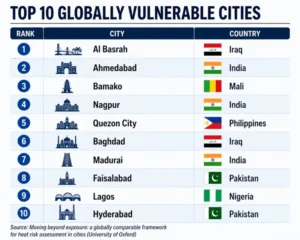
An Oxford University study has ranked India as the most heatvulnerable country, with 14 cities among the world’s 50 most at risk from extreme heat and poor coping capacity.
About the Study
- Title: “Moving beyond exposure: a globally comparable framework for heat risk assessment in cities.”
- Scope: Assessed 205 cities worldwide with populations above one million.
- Framework: Evaluated heat risk through three parameters — hazard exposure, vulnerability, and coping capacity.
India’s Position
- Global Ranking: India leads with 14 cities, followed by Nigeria (5) and Pakistan (4).
Drivers of Vulnerability
- Urban Conditions: Slums, poor ventilation, unreliable electricity and water supply.
- Environmental Factors: Low tree cover, limited open spaces, and high radiant heat.
- SocioDemographic Risks: Elderly, outdoor workers, and lowincome groups face higher exposure.
Adaptation Concerns
- Cooling Strategies: Overreliance on air conditioning increases energy demand and emissions.
- Sustainable Alternatives: Passive cooling, fans, coolers, green spaces, and lowenergy technologies recommended.
- Policy Integration: Align urban planning with National Action Plan on Climate Change (NAPCC) and Smart Cities Mission for heat resilience.
Conclusion
India’s dominance in the global heatvulnerability list highlights an urgent need for climateresilient urban planning and equitable adaptation, ensuring cities can withstand rising temperatures without deepening social inequality.

PYROPROCESSING
TOPIC: (GS3) SCIENCE AND TECHNOLOGY: THE HINDU
Pyroprocessing has recently gained attention for its wide industrial applications, especially in cement manufacturing, metallurgy, and nuclear fuel reprocessing, with cement production being its largest use.
What is Pyroprocessing?
- Definition: A dry, hightemperature process that alters the physical or chemical properties of solid materials.
- Temperature Range: Typically operates between 900°C and 1,450°C, depending on the material.
- Energy Intensity: Highly energyintensive, requiring efficient thermal management and emission control.
Applications
1. Cement Manufacturing
- Process: Finely ground limestone, clay, and iron are fed into a rotary kiln.
- Chemical Reaction: Limestone releases CO₂ at ~900°C, and at 1,450°C, the mixture partially melts to form clinker nodules.
- Outcome: Clinker is ground to produce cement — the backbone of infrastructure development.
2. Metallurgy
- Roasting: Sulphide ores heated in air to form oxides.
- Smelting: Melting ore to separate metal from impurities (slag).
- Calcining: Heating limestone to produce lime (CaO), used in steel and glass industries.
3. Nuclear Industry
- Reprocessing Spent Fuel: Spent nuclear fuel is dissolved in a molten salt bath (lithium–potassium chloride at ~500°C).
- Electrochemical Separation: Electric current separates elements based on electrochemical properties.
- Global Research: Studied in Japan, South Korea, and the U.S. for advanced fast reactor programmes.
Significance
- Reduces waste and improves material recovery efficiency.
- Supports circular economy goals in nuclear and metallurgical sectors.
- Encourages innovation in lowcarbon cement technologies under India’s National Mission on Sustainable Habitat.
Conclusion
Pyroprocessing exemplifies how hightemperature science drives industrial sustainability, linking energy efficiency, waste reduction, and technological advancement across multiple sectors.