
Table of Contents
ToggleOUTOFPOCKET HEALTH EXPENDITURE AND RISING PUBLIC SPENDING IN INDIA
TOPIC: (GS2) POLITY: THE HINDU
India’s latest National Health Accounts (2022–23) report shows that outofpocket expenditure (OOPE) on health has declined, while government spending on health has steadily increased, aided by Ayushman Bharat wellness centres and expanded insurance coverage.
Health Financing in India
- OOPE: OutofPocket Expenditure (OOPE) refers to the direct payments made by households for medical services, medicines, diagnostics, and hospital care, excluding any reimbursement from insurance or government schemes.
- High OOPE often leads to catastrophic health spending and pushes families into poverty.
- Historical Challenge: India has long struggled with inequality in health financing, where households bore a disproportionate share of medical costs due to limited public spending.
- Recent Structural Shift: Latest data shows a decline in OOPE alongside rising government expenditure on health, reflecting progress toward Universal Health Coverage (UHC).
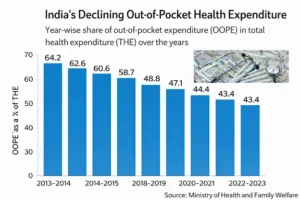
Decline in (OOPE)
- OutofPocket Expenditure (OOPE) fell OutofPocket Expenditure from 64.2% in 2013–14 to 43.4% in 2022–23.
- Drivers:
- Ayushman Bharat Health & Wellness Centres: Free medicines, diagnostics, and preventive care.
- Insurance Expansion: Rise in private health insurance penetration, covering nearly 20 crore individuals.
- Government Schemes: PMJAY provides ₹5 lakh coverage per family, reducing catastrophic health spending.
Rise in Government Health Spending
- Public Expenditure: Increased to 1.84% of GDP in 2021–22, largely due to pandemicrelated allocations.
- Infrastructure Boost: Expansion of 1.6 lakh Health & Wellness Centres under Ayushman Bharat.
- Preventive Focus: Greater emphasis on vaccination, maternal health, and NCD screening.
Challenges Ahead
- Low GDP Share: Still below the global average of 6% of GDP.
- Rural Gaps: Access remains uneven; rural households spend 30% more proportionally on health than urban.
- Insurance Inequality: Coverage skewed toward urban and formal sector workers.
- Quality Concerns: Public facilities face shortages of doctors, medicines, and diagnostic equipment.
Way Forward
- Increase Public Spending: Raise health expenditure to at least 2.5% of GDP by 2025 (as per National Health Policy target) and move toward 3% by 2030, aligning with global averages.
- Strengthen Primary Healthcare: Expand Ayushman Bharat Health & Wellness Centres with better staffing, diagnostics, and telemedicine to reduce dependence on costly tertiary care.
- Improve Insurance Penetration: Ensure wider coverage of PMJAY and integrate private insurance schemes to cover informal sector workers and rural households, reducing inequality.
- Digital Health Integration: Scale up Ayushman Bharat Digital Mission (ABDM) for electronic health records, epharmacy, and AIbased diagnostics to improve efficiency and reduce leakages.
Conclusion
India’s health financing is witnessing a positive structural shift, with declining OOPE and rising public expenditure. This marks progress toward equitable healthcare access and UHC, though challenges of low GDP allocation and rural gaps remain.
REGULATING THE DIGITAL GAMING ECONOMY
TOPIC: (GS3) ECONOMY: THE HINDU
The Supreme Court of India has upheld the constitutional validity of levying Goods and Services Tax (GST) on organised online gaming platforms involving monetary stakes.
India’s Expanding Online Gaming Economy
- Market Size: Valued at ₹30,000 crore (approx. USD 3.7 billion) in 2024, projected to reach ₹9.1 billion by 2029 and USD 60 billion by 2034.
- User Base: Around 600 million gamers in 2024, expected to rise to 952 million by 2029.
- Employment Impact: The sector employs 130,000+ professionals, with potential to create 2 million highskilled jobs by 2034.
- Revenue Mix: Freetoplay dominates, but ads, subscriptions, and microtransactions are diversifying revenue streams.
- Growth Rate: Projected CAGR of 19.6% (FY24–29E), making gaming one of the fastestgrowing segments in India’s digital economy.
- Global Position: India currently contributes 1.1% of the global gaming economy, expected to rise to 20% by 2034 with proper regulation and investment
Supreme Court Judgment
- Constitutional Validity: The Court upheld the GST levy on online gaming platforms, rejecting challenges from operators claiming exemption for skillbased games.
- Actionable Claims: Games involving monetary stakes were classified as betting and gambling, regardless of skill components, due to the uncertainty of outcomes.
- Bench Composition: The verdict was delivered by Justices J.B. Pardiwala and R. Mahadevan, emphasizing the need for fiscal discipline in digital gaming.
- Public Health Concerns: The Court noted the social and psychological risks of excessive gaming, urging regulatory oversight to protect youth.
- Industry Impact: Platforms offering fantasy sports, rummy, and poker must now pay 28% GST on the full value of bets, significantly altering their revenue models.
Implications for Governance and Economy
- Revenue Generation: The ruling strengthens the government’s ability to capture tax from digital transactions, improving fiscal transparency.
- Legal Clarity: Ends ambiguity between games of skill and chance, providing a uniform taxation framework.
- Consumer Protection: Encourages responsible gaming practices and deters illegal betting networks.
- Regulatory Evolution: Paves the way for a comprehensive national gaming policy integrating taxation, licensing, and addiction control.
Way Forward
- Balanced Regulation: Develop a central regulatory authority to oversee online gaming and ensure ethical compliance.
- Tax Rationalisation: Consider differentiated GST rates for skillbased games to support innovation while curbing gambling.
- Awareness Campaigns: Promote digital literacy and mental health awareness among youth.
- Data Transparency: Mandate disclosure of user spending patterns and algorithmic fairness in gaming platforms.
Conclusion
The Supreme Court’s decision to bring organised online gaming under GST marks a turning point in India’s digital economy, balancing fiscal accountability with social responsibility.
FOOD SECURITY IN INDIA
TOPIC: (GS2) POLITY: THE HINDU
The Government of India has approved the SARTHAK Public Distribution System (PDS) scheme to strengthen Food Security in India by modernizing PDS operations with technologydriven transparency, security, and sustainability.
What is the Public Distribution System (PDS)?
- PDS is a governmentrun system that distributes subsidized food grains (rice, wheat, coarse cereals) through Fair Price Shops (FPS) to eligible households.
- Legal Framework: Implemented under the National Food Security Act (2013), covering Antyodaya Anna Yojana (AAY) and Priority Households (PHH).
- Objective: To ensure food security, price stability, and social justice, especially for vulnerable groups.
- Mechanism: Food grains are procured at Minimum Support Price (MSP), stored by the Food Corporation of India (FCI), and distributed via FPS.
Features of SARTHAKPDS Scheme
- Financial Outlay: ₹25,530 crore allocated for five years.
- Technology Integration: Use of advanced IT systems for realtime monitoring, transparency, and accountability.
- Unified Framework: Strengthens NFSA implementation under a single administrative structure.
- Support for Logistics: Financial aid for intraState movement, handling of food grains, and dealer margins.
- Fair Price Shops: Enhanced margins to sustain shopkeepers and improve service delivery.
Significance of the Scheme
- Food Security Strengthening: Ensures equitable access to subsidized food grains.
- Leakage Reduction: Technology minimizes diversion and corruption in PDS.
- Economic Impact: Supports rural employment through logistics and fair price shops.
- Social Justice: Reinforces the Right to Food under NFSA, benefiting vulnerable groups.
- Sustainability: Promotes efficient resource use and reduces wastage.
Challenges Ahead
- Digital Divide: Rural areas may face issues in accessing techenabled systems.
- Implementation Capacity: States vary in administrative efficiency.
- Monitoring: Continuous oversight needed to prevent misuse of funds.
- Awareness: Beneficiaries must be educated about new processes.
INDIA’S PDS ECOSYSTEM
- Coverage: About 80 crore beneficiaries (nearly twothirds of India’s population).
- Annual Allocation:
- AAY households: ~99.4 lakh tonnes (Rice 71.6, Wheat 27.7).
- PHH households: ~429.5 lakh tonnes (Rice 277.7, Wheat 143.9, Nutricereals 7.8).
- Total TPDS allocation: ~555 lakh tonnes of food grains.
- Other Welfare Schemes:
- PM Poshan (MidDay Meal): ~22.3 lakh tonnes.
- ICDS Nutrition Programme: ~23 lakh tonnes.
- Welfare Institutions & Hostels: ~5.7 lakh tonnes.
- Fair Price Shops: Over 5.3 lakh FPS outlets across India.
- PMGKAY Extension: Free food grains distribution extended for five years from Jan 2024, covering NFSA beneficiaries.
Conclusion
The SARTHAKPDS scheme is a major step toward modernizing India’s food security system, combining financial support with technology to ensure transparency and sustainability.
ELECTORAL INTEGRITY IN INDIA
TOPIC: (GS2) POLITY: THE HINDU
The Supreme Court of India has upheld the Special Intensive Revision (SIR) of electoral rolls, affirming that the Election Commission (EC) has a constitutional duty to verify citizenship before inclusion or exclusion of voters.
Supreme Court’s Reinforcement of EC’s Role
- Cornerstone of Democracy: Free and fair elections are the foundation of democratic governance, ensuring legitimacy and public trust.
- Constitutional Mandate: Under Article 324 of the Constitution, the Election Commission (EC) is empowered to conduct elections and maintain electoral rolls.
- Supreme Court Ruling: The Court reaffirmed that the EC must ensure only eligible citizens are enrolled, making citizenship verification a constitutional duty.
- Democratic Safeguard: By excluding noncitizens and verifying voter lists, the EC protects the legitimacy and fairness of India’s electoral process.
- Strengthened Role: The ruling reinforces the EC’s role as the guardian of electoral integrity, balancing administrative efficiency with constitutional responsibility.
Supreme Court Judgment
- Constitutional Duty: The EC must verify citizenship before adding or removing names from electoral rolls.
- Special Intensive Revision: SIR was upheld as a valid exercise to ensure accuracy in voter lists.
- Bench Observation: Chief Justice Surya Kant stressed that citizenship is a condition precedent for voter enrollment.
- Political Reactions: Congress expressed disagreement, while BJP welcomed the ruling as a step toward electoral integrity.
- Legal Basis: Article 324 empowers the EC to supervise elections, including maintaining authentic electoral rolls.
Significance of the Ruling
- Electoral Integrity: Ensures that only citizens participate in elections, preventing dilution of democratic rights.
- Administrative Clarity: Strengthens EC’s authority to conduct revisions and verifications.
- Legal Precedent: Provides judicial backing to EC’s powers under Article 324.
- Political Impact: May influence debates on citizenship verification and voter eligibility.
- Public Trust: Enhances confidence in the fairness of electoral processes.
Challenges Ahead
- Implementation Issues: Largescale verification may face logistical hurdles.
- Risk of Exclusion: Genuine citizens may be wrongly excluded if verification is not robust.
- Political Sensitivity: Citizenship verification can become contentious in diverse states.
- Need for Transparency: Clear communication with citizens is essential to avoid mistrust.
Way Forward
- Strengthen Verification Mechanisms: Use technology and Aadhaar linkage with safeguards.
- Ensure Transparency: Publish clear guidelines and grievance redressal mechanisms.
- Community Participation: Involve local bodies in awareness and verification drives.
- Balance Rights and Duties: Protect genuine voters while ensuring noncitizens are excluded.
Conclusion
The Supreme Court ruling on SIR reinforces the constitutional responsibility of the Election Commission to maintain accurate electoral rolls. It strengthens democratic legitimacy by ensuring that only citizens can vote, while highlighting the need for transparent and fair verification processes.
COLLEGIUM SYSTEM IN INDIA
TOPIC: (GS2) POLITY: THE HINDU
The Supreme Court Collegium, headed by Chief Justice of India Surya Kant, recommended the elevation of four High Court Chief Justices (Sheel Nagu, Shree Chandrashekhar, Sanjeev Sachdeva, and Arun Palli) and senior advocate V. Mohana to the apex court.
About Collegium System
The Collegium System is the mechanism through which judges of the Supreme Court and High Courts are appointed and transferred in India. It evolved through judicial pronouncements, not by legislation. Here are three clear points:
- Composition: The Supreme Court Collegium consists of the Chief Justice of India (CJI) and the four seniormost judges. For High Courts, the Collegium includes the CJI and two seniormost judges.
- Function: It recommends names for appointment, elevation, and transfer of judges in higher judiciary. The government can return a recommendation once, but if the Collegium reiterates, it becomes binding.
- Origin: The system was established through the Second Judges Case (1993) and strengthened in the Third Judges Case (1998), giving primacy to the judiciary over the executive in judicial appointments.
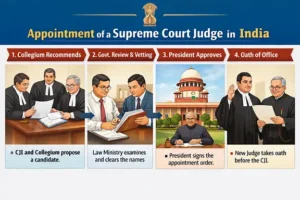
Recommendations by the Collegium
- Justice Sheel Nagu: Chief Justice of Punjab and Haryana High Court.
- Justice S. Chandrashekhar: Chief Justice of Bombay High Court.
- Justice Sanjeev Sachdeva: Chief Justice of Madhya Pradesh High Court.
- Justice Palli: Judge of Punjab and Haryana High Court.
- Woman Senior Advocate: Recommended for direct elevation, marking a step toward gender balance in the apex court.
Significance of the Recommendations
- Regional Representation: Ensures diverse perspectives from different High Courts.
- Gender Inclusivity: First woman advocate recommended since August 2021, addressing gender imbalance.
- Strengthening Judiciary: Adds experienced judges with administrative and judicial expertise.
- Public Trust: Enhances confidence in the judiciary by promoting merit and inclusivity.
- Constitutional Balance: Reinforces the principle of judicial independence under Articles 124 and 217.
Challenges Ahead
- Transparency Debate: Collegium decisions often face criticism for lack of openness.
- Gender Gap: Women still form less than 10% of Supreme Court judges.
- Pending Vacancies: Timely appointments are crucial to reduce case backlog.
- Executive-Judiciary Relations: Collegium recommendations sometimes face delays in government approval.
Way Forward
- Institutional Transparency: Publish detailed criteria for selections.
- Gender Representation: Encourage more women judges and advocates for elevation.
- Capacity Building: Strengthen High Courts to create a robust pipeline of future SC judges.
- Balanced Reforms: Consider reforms in the Collegium system while preserving judicial independence.
Conclusion
The Collegium’s latest recommendations reflect a progressive step toward inclusivity and diversity in India’s Supreme Court. By balancing regional and gender representation, the judiciary strengthens its legitimacy and independence.
LINKING DEMOGRAPHY WITH SECURITY
TOPIC: (GS3) SECURITY: THE HINDU
The Union Government has set up a HighLevel Committee on Demographic Changes (HLCDC) under the Ministry of Home Affairs to study “unnatural demographic shifts” linked to illegal immigration and other abnormal factors.
India’s New Policy
- Governance Link: Demographic trends directly influence resource distribution, welfare delivery, and social stability, making them central to governance.
- Population Trends: While India’s fertility rates are steadily declining (TFR at 2.0 in NFHSV, 2022), certain border regions show abnormal growth patterns, raising policy concerns.
- Security Concerns: Rapid demographic changes in sensitive areas are linked to illegal immigration, tribal identity erosion, and national security risks, requiring urgent intervention.
- HLCDC Mandate: The newly formed HighLevel Committee on Demographic Changes (HLCDC) aims to provide a scientific and policy framework to study these shifts and recommend corrective measures.
Composition of the Committee
- Headed by Justice Prakash Prabhakar Navlekar (Retd.), Supreme Court.
- Members include Durga Shanker Mishra (Census Commissioner), Balaji Srivastava, and Shamika Ravi.
- Joint Secretary (ForeignersI), MHA acts as Member Secretary.
- Mandated to submit report within one year, extendable by six months.
Mandates of the Committee
- Scientific Study: Analyse demographic shifts across regions, focusing on illegal immigration, fertility variations, and socioeconomic factors.
- Identification of Abnormal Trends: Study settlement patterns, religious demographic changes, and migration diverging from national averages.
- Illegal Immigration Framework: Recommend mechanisms for identification, detention, and deportation of illegal immigrants.
- Population Stabilisation: Suggest institutional measures for stabilising population growth.
- Census Concerns: Provide inputs for the upcoming 2027 Census, ensuring accurate demographic mapping.
Challenges
- National Security: Illegal infiltration linked to border threats and governance challenges.
- Social Cohesion: Risks to tribal identity and cultural balance.
- Human Rights: Possible debates on citizenship rights and due process.
- Data Reliability: Need for clear definitions of “abnormal demographic change”.
Conclusion
The HLCDC represents a strategic policy intervention connecting demography with national security and governance. Its recommendations could reshape India’s immigration and population policies in the coming decade.
CAUVERY WATER DISPUTE AND MEKEDATU PROJECT
TOPIC: (GS2) POLITY: THE HINDU
The Supreme Court recently dismissed Tamil Nadu’s petition seeking review of its 2025 order, which had termed the challenge to Karnataka’s proposed Mekedatu Balancing Reservoir cum Drinking Water Project as “premature.”
Mekedatu Project
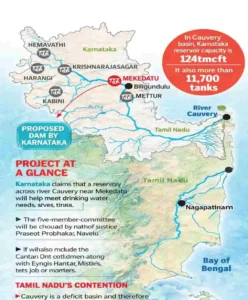
- The Mekedatu Project is a multipurpose initiative by Karnataka aimed at providing drinking water to Bengaluru and generating hydropower.
- However, it has become a contentious issue between Karnataka and Tamil Nadu, reflecting the larger Cauvery water dispute.
- Location: Near Kanakapura in Ramanagara district, Karnataka, ~90 km from Bengaluru and 4 km from the Tamil Nadu border.
- Design: A 99metrehigh, 735metrelong concrete gravity dam with an underground powerhouse and water conductor system.
- Capacity: Storage of 67 TMC ft of water, supplying drinking water to Bengaluru and generating 400 MW of power.
- Environmental Impact: Will submerge over 5,000 hectares of Cauvery Wildlife Sanctuary, raising ecological concerns.
Issues and Concerns
- Tamil Nadu’s Opposition: Argues the project will block free flow of Cauvery water into Tamil Nadu. Claims it violates the Cauvery Water Disputes Tribunal Award and Supreme Court directions.
- Karnataka’s Stand: Project is essential for Bengaluru’s drinking water needs. Will not affect Tamil Nadu’s share as per tribunal allocations.
- Environmental Concerns: Submergence of protected forest areas threatens biodiversity and tribal livelihoods.
- Legal Dimension: Supreme Court termed Tamil Nadu’s challenge “premature” as clearances and approvals are pending.
Significance of the Project
- Water Security: Addresses Bengaluru’s rising urban water demand.
- Energy Generation: Adds 400 MW renewable hydropower capacity.
- InterState Dispute: Highlights persistent Cauvery water sharing tensions.
- Ecological Balance: Raises debate on development vs conservation.
Conclusion
The Mekedatu Project represents the intersection of water security, energy needs, and ecological concerns, but also deepens the Karnataka–Tamil Nadu Cauvery dispute. Its future depends on legal clearances, environmental safeguards, and interstate cooperation.
VACCINIUM PILIFERUM
TOPIC: (GS3) ENVIRONMENT: THE HINDU
Researchers have rediscovered Vaccinium piliferum, a rare wild relative of the blueberry, in the remote forests of Vijoynagar, Changlang district, Arunachal Pradesh, nearly after 188 years. This finding revives interest in India’s Eastern Himalayan biodiversity.
Vaccinium piliferum
- Taxonomy: Belongs to the Ericaceae family, which includes blueberries and cranberries.
- Habitat: Found near tributaries of the NoaDihing River in dense forests of Arunachal Pradesh.
- Conservation Status: Listed as ‘Endangered’ by the IUCN.
- Ecological Role: Acts as a wild genetic resource for improving cultivated blueberry varieties.
- Historical Record: First documented in 1836, rediscovered in 2024–25 after nearly two centuries.

Blueberries
- Family: Ericaceae or heath family.
- Types: Lowbush (Vaccinium angustifolium), Highbush (Vaccinium corymbosum), and Bilberry (Vaccinium myrtillus).
- Climate: Requires cold conditions with 150–1200 chill hours to break dormancy.
- Soil: Prefers acidic, welldrained sandy loam rich in organic matter (>3%).
- Nutritional Value: Rich in vitamin C, vitamin K, fiber, and antioxidants that combat free radicals.
Significance of Rediscovery
- Biodiversity Conservation: Reinforces the need to protect Eastern Himalayan ecosystems.
- Scientific Importance: Offers potential for genetic research and crop improvement.
- Policy Implication: Calls for habitat protection and species monitoring under India’s biodiversity mission.
Conclusion
The rediscovery of Vaccinium piliferum after 188 years underscores India’s hidden ecological wealth and the importance of scientific exploration for conservation.