Table of Contents
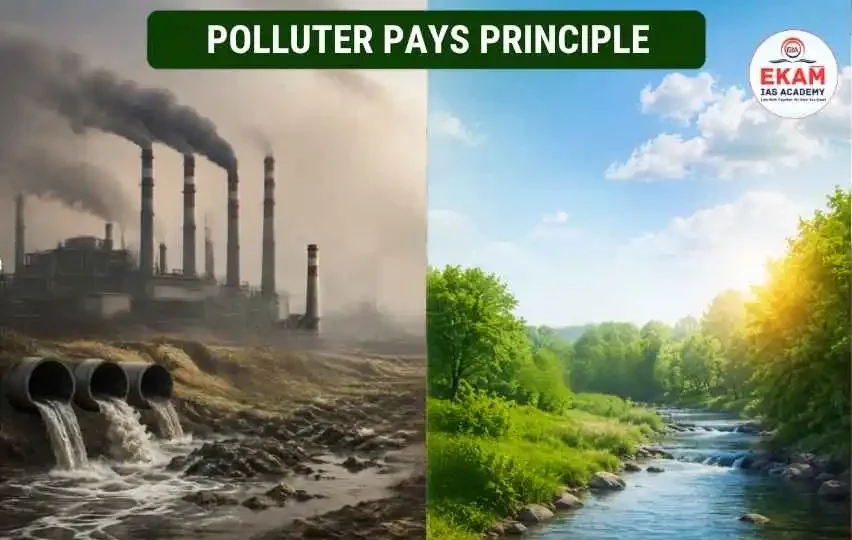
ToggleUnchecked industrial expansion historically treated nature as a free dumping ground for waste. To correct this market failure, global environmental law established the Polluter Pays Principle (PPP).
Definition
The principle dictates that whichever entity is responsible for causing environmental pollution must bear the full financial costs of managing the waste, preventing further degradation, and fully restoring the damaged ecosystem to its natural baseline state. It converts a vague social harm into a clear, quantifiable corporate liability.
Origin, Evolution, and International Law
The economic foundation of the principle was first introduced at the international level by the Organization for Economic Co-operation and Development (OECD) in 1972 as a guide to prevent national environmental subsidies from distorting international trade.
Its formal legal evolution into global environmental governance occurred during the 1992 Rio Earth Summit, where it was explicitly written into Principle 16 of the Rio Declaration on Environment and Development. Today, it forms the basis of major international environmental law treaties, including the Stockholm Convention and the Basel Convention on hazardous waste tracking.
Legal Basis and Application of PPP in India
India has integrated this principle deeply into its domestic environmental legal architecture. The statutory and judicial application of the polluter pays principle in India relies on landmark interventions:
A. Statutory Frameworks
- The National Green Tribunal (NGT) Act, 2010: Section 20 of the NGT Act explicitly mandates the tribunal to apply the Polluter Pays Principle, the Precautionary Principle, and the principle of Sustainable Development when issuing final orders and awards.
- Environment (Protection) Act, 1986: Grants the central government broad executive power to calculate and levy heavy environmental compensation fines on non-compliant industries.
Landmark Case Key Contribution Vellore Citizens (1996) Integrated PPP & Precautionary Principle into Indian law. Indian Council (1996) Absolute Liability rule applied to toxic chemical sludge dumping. M.C. Mehta (Oleum Gas) Strict enforcement of restitutive compensation fines on industries.
B. Landmark Supreme Court Judgments
- Indian Council for Enviro-Legal Action v. Union of India (1996): The Supreme Court ruled that the financial liability for reversing environmental damage is an absolute liability that extends directly to repairing affected soils, local aquifers, and compensating impacted communities.
- Vellore Citizens Welfare Forum v. Union of India (1996): The Court declared that the Polluter Pays Principle and the Precautionary Principle are recognized parts of the Customary International Law and are therefore implicitly part of domestic Indian environmental law under Article 21 (Right to Life) of the Constitution.
Key Differences: Polluter Pays Principle vs. Precautionary Principle
While both are fundamental to environmental preservation, they operate at different stages of ecological damage control:
- The Precautionary Principle: Functions as a proactive, preventive tool. It mandates that if an industrial activity poses a risk of severe or irreversible ecological damage, regulatory bodies must pause or alter the project even before definitive scientific proof of harm is established.
- The Polluter Pays Principle: Functions primarily as a curative, retroactive, or internalizing tool. It steps in to ensure that once a risk is taken or actual pollution occurs, the financial burden of cleanup, compensation, and ecological restoration falls entirely on the operator, not on taxpayers.
Challenges and Recent Developments
Despite its strong legal framework, executing the principle faces systemic operational challenges. A major hurdle is the difficulty of valuation—accurately quantifying the exact monetary value of long-term ecosystem degradation, such as a localized loss of biodiversity or a permanently damaged aquifer. Additionally, many small-scale polluters can hide behind complex corporate shells, leading to lengthy litigation that delays cleanup efforts.
Recent Developments in India:
- Online Continuous Emission Monitoring Systems (OCEMS): The Central Pollution Control Board (CPCB) has mandated real-time data tracking for high-pollution industrial sectors, using objective digital logs to calculate exact environmental compensation penalties.
- Extended Producer Responsibility (EPR): EPR frameworks for plastic, electronic, and battery waste legally bind manufacturers to fund and manage nationwide recycling loops, representing a direct application of consumer-product level polluter-pays logic.
Conclusion
Analyzing the polluter pays principle UPSC syllabus details covers shows that sustainable development cannot exist without strict environmental accountability. Shifting from a “pollute-now, pay-later” approach to a model of complete corporate accountability is essential for long-term ecological survival. By refining natural capital valuation models, expanding EPR enforcement, and leveraging the NGT’s judicial power, India can protect its delicate ecosystems while fostering sustainable, green economic growth.
UPSC Prelims: PYQs & Practice Questions
Previous Year Questions (Prelims)
UPSC CSE Prelims 2019
Q: With reference to the National Green Tribunal (NGT), which of the following statements is/are correct?
1. The NGT was established under an Act of Parliament in 2010.
2. It is guided by principles of natural justice and is not bound by the procedure laid down under the Code of Civil Procedure, 1908.
3. In deciding cases, the NGT is explicitly mandated to apply the principles of sustainable development, precautionary principle, and polluter pays.
Select the correct answer using the code given below:
(a) 1 and 2 only
(b) 2 and 3 only
(c) 1 and 3 only
(d) 1, 2 and 3
Answer: (d) 1, 2 and 3
Explanation:
All three statements are correct. The
National Green Tribunal was established under the
National Green Tribunal Act, 2010.
Under Section 19 of the Act, the Tribunal is not bound by the strict procedure of the Code of Civil Procedure, 1908. Instead, it is guided by the principles of natural justice.
Under Section 20, the NGT is legally required to apply the Principle of Sustainable Development, the Precautionary Principle, and the Polluter Pays Principle while deciding environmental disputes.
UPSC CSE Prelims 2016
Q: Correct application of the Polluter Pays Principle implies which of the following?
(a) The government should fully subsidize all high-polluting industries to help them buy expensive pollution control equipment.
(b) The costs of pollution control, waste management, and environmental restoration should be borne entirely by the entity responsible for causing the pollution.
(c) Taxes collected from ordinary citizens should be pooled together to clean up polluted industrial rivers.
(d) High-polluting multinational corporations are granted legal immunity if they pay a fixed annual environmental tax.
Answer: (b) The costs of pollution control, waste management, and environmental restoration should be borne entirely by the entity responsible for causing the pollution.
Explanation:
The Polluter Pays Principle is a major doctrine of environmental law.
It means that the financial burden of pollution control, waste management, clean-up operations, and ecological restoration must be borne by the polluting entity.
The principle prevents the cost of environmental damage from being shifted to the general public or the state treasury. It converts environmental harm into direct legal and financial responsibility for the polluter.
Practice Questions
Q: The Absolute Liability Doctrine, which significantly strengthened the implementation of the Polluter Pays Principle in India, was established by the Supreme Court in the wake of which historic event?
(a) The Bhopal Gas Tragedy, 1984, via the Charan Lal Sahu case.
(b) The Oleum Gas Leak case, 1985, via M.C. Mehta v. Union of India.
(c) The Ganga Pollution case, 1987, via M.C. Mehta v. Union of India.
(d) The Taj Trapezium case, 1996, via M.C. Mehta v. Union of India.
Answer: (b) The Oleum Gas Leak case, 1985, via M.C. Mehta v. Union of India.
Explanation:
The doctrine of Absolute Liability was formulated by the Supreme Court of India in the historic
M.C. Mehta v. Union of India, also known as the
Oleum Gas Leak Case, 1985.
The Court held that an enterprise engaged in a hazardous or inherently dangerous activity owes an absolute and non-delegable duty to the community.
If harm occurs, the enterprise is absolutely liable to compensate the victims. Unlike strict liability, it allows no exceptions such as Act of God, third-party fault, or lack of negligence.
This doctrine gave strong judicial support to the Polluter Pays Principle in India.
Q: Which of the following policy mechanisms represents a direct modern application of the Polluter Pays Principle at the consumer product level in India?
(a) Renewable Purchase Obligations (RPO)
(b) Extended Producer Responsibility (EPR) frameworks for E-Waste and Plastics
(c) National Clean Air Programme (NCAP) city action plans
(d) Subsidized distribution of LED bulbs under the UJALA scheme
Answer: (b) Extended Producer Responsibility (EPR) frameworks for E-Waste and Plastics
Explanation:
Extended Producer Responsibility (EPR) is a modern regulatory extension of the
Polluter Pays Principle.
Under EPR, producers, importers, and brand owners are made financially and operationally responsible for the collection, recycling, treatment, and safe disposal of post-consumer waste.
It is especially important in managing plastic waste, e-waste, and batteries. The mechanism shifts the burden of waste management from municipalities and taxpayers to the industries that place these products in the market.
UPSC Mains – Previous Year & Practice Questions
Mains Previous Year Questions
Mains 2024
Question: Discuss the ecological and economic importance of
wetlands in India. What are the major threats faced by them?
(Can connect to how courts impose polluter pays penalties on builders encroaching on wetlands.)
Mains 2020
Question: How does the draft
Environment Impact Assessment (EIA) Notification differ from the existing
EIA Notification, 2006?
(Tests how violations are regularized, often involving retrospective fines under the polluter pays model.)
Mains 2019
Question: Coastal regions of India are prone to
cyclones. Discuss the role of
mangroves in reducing the impact of such disasters.
(Useful for linking ecosystem protection, coastal regulation, and environmental liability for destructive coastal activities.)
Mains 2018
Question: How city-states like
Delhi are dealing with severe
air pollution crises? Suggest structural measures.
(Can involve discussing environmental compensation charges levied on high-polluting commercial trucks entering cities.)
Mains 2013
Question: Enumerate the
National Green Tribunal’s roles and responsibilities in handling
environmental clearance disputes.
(Requires detailing the application of Section 20 of the NGT Act.)
Mains Practice Questions
[15 Marks | 250 Words]
Question: The Polluter Pays Principle has transitioned from an economic concept into a vital part of Customary International Law and India’s constitutional jurisprudence. Discuss this evolution with reference to landmark Supreme Court judgments.
[15 Marks | 250 Words]
Question: While the statutory mandate of the Polluter Pays Model is well established under the National Green Tribunal (NGT) Act, its implementation is hindered by challenges in natural capital valuation. Examine the difficulties in mathematically quantifying ecological damage for compensatory penalties.
[10 Marks | 150 Words]
Question: Compare and contrast the Precautionary Principle with the Polluter Pays Principle within the context of environmental governance frameworks. How can both be applied together to handle industrial hazardous waste?



polluters pay model-FAQs
What is Polluter Pays Principle?
The Polluter Pays Principle means the polluter must pay for pollution control, cleanup, and restoration. It prevents the burden from falling on taxpayers or society.
Impact of Vellore Citizens Welfare Forum case?
In this case, the Supreme Court accepted Polluter Pays and Precautionary Principles as part of Indian environmental law. It linked them to Article 21 and ordered polluting industries to pay for restoration.
Difference between Strict Liability and Absolute Liability?
Strict Liability allows some exceptions like Act of God or third-party fault. Absolute Liability, evolved in India, allows no exceptions for hazardous industries causing harm.
How does NGT calculate environmental compensation?
NGT considers factors like duration of violation, type of industry, location sensitivity, and economic gain from non-compliance. CPCB guidelines help in calculating fines.
What is Greenwashing?
Greenwashing means falsely presenting a company as eco-friendly while continuing harmful practices. It hides real pollution and helps companies avoid accountability.