Table of Contents
ToggleRiver valleys have historically served as the cradles of human civilization. In modern times, managing these river channels through engineering networks has become a primary driver of agricultural and industrial expansion. However, altering natural river hydrology introduces deep, long-term ecological risks that demand careful scientific evaluation.
Understanding Multipurpose River Valley Projects
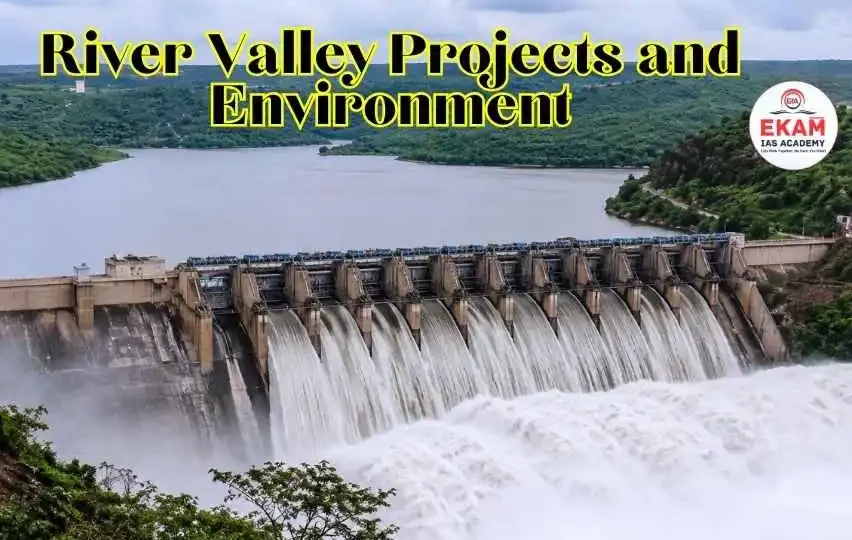
A river valley project involves constructing large dams, reservoirs, canals, and hydro-power stations across a river basin. They are classified as “multipurpose” because they are designed to fulfill a diverse matrix of socio-economic requirements simultaneously:
Core Objectives:
- Hydroelectric Power Generation: Providing clean, baseload renewable energy to support rapid industrialization.
- Command Area Irrigation: Supplying a steady, regulated flow of water to water-scarce agricultural zones to boost food security.
- Flood Mitigation: Using massive reservoirs to store excess surface runoff during heavy monsoon seasons, protecting down-stream settlements.
- Inland Navigation & Aquaculture: Creating new aquatic channels for local transport and commercial fish breeding.
Major Historical Projects in India:
- Bhakra-Nangal Project: Built across the Sutlej River, serving as a primary lifeline for the Green Revolution in Punjab and Haryana.
- Damodar Valley Project (DVC): Modeled after America’s Tennessee Valley Authority, designed to tame the seasonal floods of the Damodar River.
- Hirakud Dam: One of the longest earthen dams in the world, built across the Mahanadi River in Odisha.
Environmental Effects of Dams
- While these projects offer clear economic benefits, the environmental effects of dams disrupt natural Earth and river systems across both upstream and downstream landscapes:
                        ┌──> Upstream: Submergence, Deforestation, Methane emissions
                        │
[River Valley Projects] ┼──> Reservoir Triggered Seismicity (RTS)
  Ecological Pressures  │
                        └──> Downstream: Silt trapping, Hypoxic water, Reduced delta growth
- Loss of Forest Cover and Terrestrial Habitats: Creating massive reservoirs floods pristine valleys, causing widespread deforestation and driving localized biodiversity loss.
- River Fragmentation and Aquatic Disruption: High concrete dams block the natural migratory paths of aquatic fauna, disrupting the breeding cycles of critical native species like the Mahseer fish.
- Siltation and Delta Starvation: Dams trap nutrient-rich alluvial silt within their reservoirs. This reduces the storage capacity of the dam over time, while downstream deltas are starved of nutrients, leading to coastal erosion and lower soil fertility.
- Reservoir-Triggered Seismicity (RTS): The immense weight of billions of cubic meters of water stored in a reservoir exerts heavy pressure on underlying geological fault lines, which can trigger localized earthquakes in seismically sensitive zones.
Climate Concerns and Social Impacts
- Submerged Methane Generation: When vast areas of forests and grasslands are flooded, the trapped organic material rots in an oxygen-depleted (anaerobic) environment at the bottom of the reservoir. This anaerobic decomposition releases significant amounts of methane ($CH_4$), a potent greenhouse gas.
- Involuntary Human Displacement: The social cost of large-scale river valley projects UPSC modules highlight is immense. Reservoirs submerge ancestral lands, displacing millions of indigenous forest communities and small-holder farmers, often leading to inadequate rehabilitation and long-term socio-economic vulnerability.
Environmental Impact Assessment (EIA) and Mitigation
- To prevent unchecked ecological damage, all modern river valley projects must undergo a rigorous, statutory Environmental Impact Assessment (EIA) framework under the Environment (Protection) Act, 1986.
Key Mitigation Measures:
- Catchment Area Treatment (CAT): Extensive afforestation drives carried out around the upper catchment areas to anchor the soil, reduce erosion, and minimize reservoir siltation.
- Mandatory Environmental Flows (E-Flows): Enforcing legal mandates that require dams to release a minimum volume of water continuously, preserving downstream aquatic life and river health.
- Constructing Fish Ladders: Designing specialized structural bypasses or stepped channels within dams to allow migratory fish to travel upstream to their natural spawning grounds.
Government Frameworks and Policy Shifts
India’s approach to river management uses a combination of constitutional bodies and targeted safety policies:
- Dam Safety Act: Establishes a robust statutory framework to standardize surveillance, inspection, and operations across all major dams, reducing the risk of catastrophic structural failures.
- Shift Toward Run-of-the-River Projects: Recognizing the heavy ecological costs of mega-dams, policy is increasingly favoring low-impact run-of-the-river hydropower, which generates electricity using the natural flow of water without requiring massive reservoirs.
Conclusion
Analyzing river valley projects UPSC notes demonstrates that true sustainability requires balancing industrial utility with ecological preservation. While large dams have driven India’s agricultural and industrial growth, their long-term environmental costs can no longer be ignored. By strictly enforcing EIA mandates, securing environmental flows, and prioritizing low-impact run-of-the-river designs, India can secure its energy and water future while protecting its rich river ecosystems.
UPSC Prelims: PYQs & Practice Questions
Previous Year Questions (Prelims)
UPSC CSE Prelims 2021
Q: With reference to the Indus river system, of the following four rivers, three of them pour into one of them which joins the Indus direct. Among the following, which one is such river that joins the Indus direct?
(a) Chenab
(b) Jhelum
(c) Ravi
(d) Sutlej
Answer: (a) Chenab
Explanation:
According to hydrological tracking, the Jhelum joins the Chenab near Jhang, and the Ravi also merges into the Chenab further downstream.
The Sutlej then meets the Chenab near Uch Sharif to form the Panjnad, meaning “Five Rivers”, which flows onward to join the Indus main stem near Mithankot.
However, in standard geographical interpretation, the Chenab is treated as the primary river system that receives the other tributaries before joining the Indus. This question is important for understanding precise river mapping in the context of major river valley projects such as the Bhakra-Nangal Project.
UPSC CSE Prelims 2018
Q: Consider the following statements:
1. The Earth’s magnetic field has reversed every few hundred thousand years.
2. When the Earth was created more than 4,000 million years ago, there was 54% oxygen and no carbon dioxide.
3. When living organisms modified the early atmosphere, they inside-out changed the composition of the atmosphere.
Which of the statements given above is/are correct?
(a) 1 only
(b) 2 and 3 only
(c) 1 and 3 only
(d) 1, 2 and 3
Answer: (c) 1 and 3 only
Explanation:
Statement 1 is correct. Geomagnetic reversals have occurred periodically over geological time scales.
Statement 2 is incorrect. The primordial atmosphere did not contain free oxygen. It was a reducing atmosphere composed mainly of gases such as methane, ammonia, water vapour, and carbon dioxide.
Statement 3 is correct. Photosynthetic organisms, especially early cyanobacteria, released oxygen and triggered the Great Oxidation Event, transforming the composition of the atmosphere.
This question helps build the baseline concept of how biological processes can alter global environmental systems, which is useful while studying modern human-induced impacts such as reservoir-triggered emissions and large-scale ecological change.
Practice Questions
Q: In the context of the environmental effects of dams, consider the following statements regarding Reservoir-Triggered Seismicity (RTS):
1. It occurs because the immense weight of water stored in a massive reservoir increases
pore pressure within the underlying rock fractures, destabilizing existing geological faults.
2. The Koyna Dam earthquake of 1967 in Maharashtra remains one of the world's primary examples of an earthquake triggered by reservoir loading.
Which of the statements given above is/are correct?
(a) 1 only
(b) 2 only
(c) Both 1 and 2
(d) Neither 1 nor 2
Answer: (c) Both 1 and 2
Explanation:
Both statements are correct.
Reservoir-Triggered Seismicity (RTS) is a well-documented environmental hazard associated with large dams and reservoirs.
When billions of cubic metres of water are stored behind a mega-dam, the reservoir exerts massive downward pressure on local rock layers. Water also seeps into underlying cracks and faults, increasing pore fluid pressure. This can reduce friction along fault planes and release accumulated tectonic stress, triggering earthquakes.
The 1967 Koyna earthquake in Maharashtra, with a magnitude of around 6.3, is widely cited as a classic global example of severe reservoir-triggered seismicity in a historically stable peninsular region.
Q: How do modern river valley projects implement Catchment Area Treatment (CAT) plans to counter a primary environmental threat?
(a) By deploying extensive chemical coagulants into reservoirs to neutralize heavy metal pollution.
(b) By executing large-scale afforestation and engineering measures in the upper reaches of the river to anchor topsoil and minimize reservoir siltation.
(c) By installing high-voltage electric barriers to prevent exotic fish species from swimming upstream.
(d) By artificially raising the water temperature to eliminate local toxic algal blooms.
Answer: (b) By executing large-scale afforestation and engineering measures in the upper reaches of the river to anchor topsoil and minimize reservoir siltation.
Explanation:
Catchment Area Treatment (CAT) plans are ecological restoration measures used in river valley and dam projects to reduce
soil erosion and reservoir siltation.
In the upper catchment, heavy rainfall, slope instability, deforestation, and loose soil can wash large quantities of silt into reservoirs. This reduces the water storage capacity and operational lifespan of dams.
CAT plans address this threat through afforestation, vegetation restoration, check dams, contour trenches, slope stabilization, and other soil-conservation measures that help anchor topsoil and reduce sediment inflow.
UPSC Mains – Previous Year & Practice Questions
Mains Previous Year Questions
Mains 2023
Question: Identify the main causes of the loss of
biodiversity in India.
(Requires detailing how building concrete barriers across river basins fragments aquatic habitats and isolates populations.)
Mains 2022
Question: Describe the various causes and the effects of
landslides in the Himalayan region.
(Can connect to how blasting, tunnelling, slope cutting, and deep water loading for mountain hydropower destabilize fragile slopes.)
Mains 2016
Question: Major cities of India are becoming vulnerable to
flood conditions. Discuss.
(Can discuss how abrupt water releases from upstream dams during extreme monsoons can exacerbate downstream urban flash floods.)
Mains 2014
Question: Enumerate the
indirect services provided by an ecosystem.
How do wetlands act as “Earth’s Kidneys”?
(Can contrast with how reservoirs trap sediment, alter natural river flow, and degrade downstream river wetlands.)
Mains 2020
Question: How does the draft
Environment Impact Assessment (EIA) Notification differ from the existing
EIA Notification, 2006?
(Useful for assessing how river valley, hydropower, and dam projects are scrutinized before environmental clearance.)
Mains Practice Questions
[10 Marks | 150 Words]
Question: While hydropower is promoted as a low-carbon energy source, large-scale multipurpose river valley projects can generate significant greenhouse gas emissions. Critically evaluate this paradox.
[15 Marks | 250 Words]
Question: Examine the downstream environmental impacts of mega-dams. Analyze how sediment trapping in reservoirs leads to the degradation of coastal deltas and the loss of riverine biodiversity.
[15 Marks | 250 Words]
Question: Enforcing mandatory Environmental Flows (E-Flows) is vital to preserve river ecosystems. Discuss the challenges India faces in balancing agricultural and energy needs with the legal enforcement of E-Flows.



River Valley Projects and Environment-FAQs
What are Environmental Flows?
Environmental Flows are the minimum water flow that dams must release downstream. They keep rivers alive, protect aquatic life, dilute pollution, and support local livelihoods.
What are 'Lichens' and why are they dominant in the tundra?How do dam reservoirs produce methane?
Reservoirs flood forests and vegetation. This organic matter decomposes without oxygen under water and releases methane, a powerful greenhouse gas.
What is Delta Starvation?
Dams trap river sediments inside reservoirs. As less silt reaches the coast, deltas shrink, erode, face saltwater intrusion, and lose mangrove protection.
How do Fish Ladders help?
Fish ladders are step-like water passages built beside dams. They help migratory fish cross dams and reach upstream breeding grounds.
Why prefer Run-of-the-River hydropower?
Run-of-the-River projects need smaller or no large reservoirs. They reduce forest submergence, displacement, methane emissions, and overall ecological damage.