Table of Contents
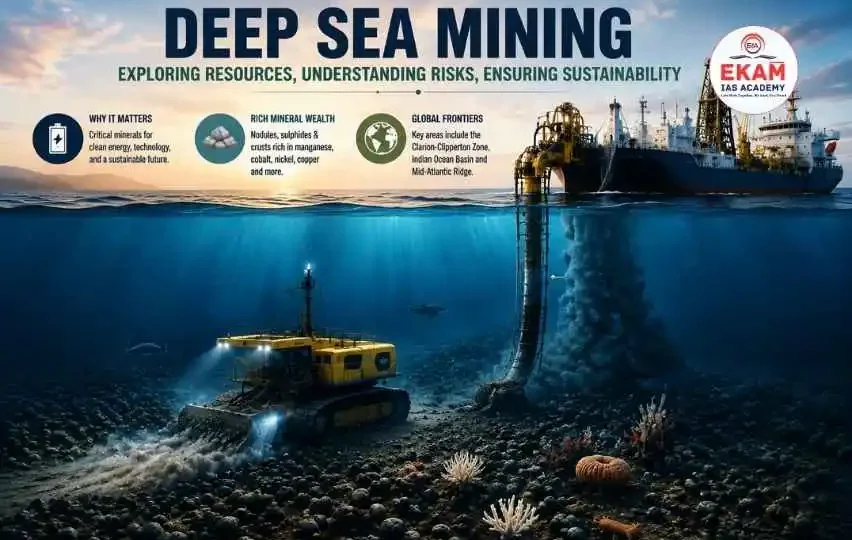
ToggleDeep sea mining is the process of retrieving mineral deposits from the ocean floor at depths greater than 200 meters. Operating far below the photic zone, this form of extraction targets remote areas of the ocean bed to secure metals vital for high-tech manufacturing and clean energy infrastructure.
The Need for Deep Sea Mining & Economic Significance
The accelerating global transition toward renewable energy has driven a major surge in demand for critical minerals like cobalt, copper, nickel, and manganese—all essential components for electric vehicle (EV) batteries, wind turbines, and solar panels.
Terrestrial mining is constrained by declining ore grades, severe geopolitical supply bottlenecks, and heavy social costs like deforestation and human displacement. Consequently, nations are turning to the ocean floor as a vast alternative repository. This shift forms a cornerstone of the blue economy, which aims to balance marine economic development with long-term ecological sustainability.
Major Mineral Resources and Deposit Types
Deep-sea mining primarily targets three distinct geological formations across the ocean floor:
- Polymetallic Nodules: Potato-sized mineral accretions found loosely on abyssal plains at depths between 4,000 and 6,000 meters. These polymetallic nodules UPSC modules track are incredibly rich in manganese, nickel, cobalt, and copper.
- Polymetallic Sulphides: Massive mineral deposits formed along hydro-thermal vents via volcanically heated water. These contain high concentrations of copper, gold, zinc, and silver.
- Cobalt-Rich Ferromanganese Crusts: Metallic layers that accumulate on the flanks of underwater seamounts at depths of 400 to 7,000 meters, valued primarily for their high cobalt and platinum content.
The Process of Deep Sea Mining
The deep-sea extraction sequence relies on heavy engineering across thousands of meters of water:
| Component | Function |
|---|---|
| Seabed Harvester / Crawler | Scrapes and crushes seafloor mineral deposits. |
| Vertical Riser Piping System | Pumps slurry (water, rock, and silt) to the surface. |
| Surface Production Vessel | Separates ore and dumps waste water/silt back into the sea. |
Areas of Deep Sea Mining and Geopolitical Frontiers
The primary focus of international extraction is the Clarion-Clipperton Zone (CCZ), a vast abyssal plain spanning 4.5 million square kilometers in the Eastern Pacific Ocean between Hawaii and Mexico. The CCZ is estimated to hold more cobalt, nickel, and manganese than all known land-based reserves combined.
Other major exploration zones include the Central Indian Ocean Basin, the Mid-Atlantic Ridge, and various exclusive economic zones (EEZs) surrounding Pacific island nations.
Environmental Impacts and Threats to Marine Biodiversity
The environmental impacts of deep sea mining are profound, far-reaching, and potentially permanent.
A. Destruction of Benthic Ecosystems
The use of heavy, tractor-like seabed crawlers physically crushes fragile benthic organisms, including deep-sea sponges, anemones, and unique cold-water corals. Because these species grow slowly in the cold, dark conditions of the deep ocean, disturbed habitats can take centuries to regenerate.
B. Underwater Plume Generation
Mining operations generate two types of sediment plumes:
Benthic Plumes: Stirred up by harvesters crawling across the seabed.
Mid-Water Plumes: Created when surface vessels pump waste water and fine silt back into the mid-ocean water column.
These massive, muddy plumes travel across thousands of kilometers, smothering filter-feeding marine life and blocking the natural light needed by plankton.
C. Anthropogenic Noise and Light Pollution
The machinery introduces bright artificial lights and loud, continuous low-frequency vibrations into an ecosystem that has evolved in complete darkness and near silence. This pollution disrupts the communication, hunting, and navigation systems of marine mammals like whales and dolphins.
Deep Sea Mining and Climate Change
The deep ocean functions as a critical global carbon sink, locking away vast amounts of carbon in its seabed sediment and within specialized organic cycles. Large-scale mechanical churning could disturb these stable sediment layers, releasing stored carbon back into the water column. This disruption risks altering the ocean’s chemistry, reducing its capacity to absorb greenhouse gases, and accelerating ocean acidification.
International Regulation and Governance Gaps
Under the United Nations Convention on the Law of the Sea (UNCLOS), the deep seabed in international waters is designated as the “Common Heritage of Mankind”. It is governed by the International Seabed Authority (ISA), based in Kingston, Jamaica.
While the ISA has granted dozens of licenses for exploration, it has faced long-standing delays in finalizing its formal “Exploitation Code” due to deep disagreements over environmental safety standards. These regulatory delays have created significant geopolitical tensions. For example, unilateral mining authorizations issued by some nations challenge the ISA’s multilateral authority and underscore the urgent need to integrate protections from the Biodiversity Beyond National Jurisdiction (BBNJ) Agreement
India's Deep Sea Mining Programme: The Deep Ocean Mission
India has established a strong presence in this field through its flagship Deep Ocean Mission UPSC dossiers track closely.
| Component | Details |
|---|---|
| MATSYA 6000 Submersible | Manned deep-submergence vehicle built to dive 6,000 m for mineral research. |
| Central Indian Ocean Basin | Exploration rights secured for 75,000 sq km to extract polymetallic nodules. |
Strategic and Economic Significance for India
- Resource Independence: Securing long-term access to nickel and cobalt helps India reduce its dependence on foreign imports, advancing its clean energy goals and supporting domestic manufacturing.
- Geopolitical Presence: Active exploration helps India project its strategic influence across the Indian Ocean Region (IOR), countering the expanding maritime presence of other regional powers.
Opportunities vs. Risks: The Policy Dilemma
| Core Dimension | Opportunities & Advantages | Risks & Core Challenges |
| Resource Supply | Yields vast quantities of high-grade copper, cobalt, and nickel. | Causes irreversible damage to unstudied deep-sea species. |
| Socio-Political Factors | Avoids the land-use conflicts and displacement seen in terrestrial mining. | Impacts indigenous coastal cultures and marine livelihoods. |
| Economic Dynamics | Delivers massive financial gains for nations leading the blue economy. | Operates under uncertain liability laws for international environmental damage. |
Conclusion
Analyzing the deep sea mining UPSC syllabus highlights reveals a fundamental policy dilemma: balancing the demand for green tech minerals against the preservation of our last untouched ecosystems. Extracting minerals from the ocean floor to build green technology cannot come at the expense of marine biodiversity. For India, successfully navigating the Deep Ocean Mission requires combining advanced marine engineering with strict environmental safeguards, ensuring that our economic development aligns with global conservation commitments.
UPSC Prelims: PYQs & Practice Questions
Previous Year Questions (Prelims)
UPSC CSE Prelims 2021
Q: With reference to the International Seabed Authority (ISA), consider the following statements:
1. India was the first developing country to be given the status of a 'Pioneer Investor' for deep-seabed exploration in the Central Indian Ocean.
2. The mandate of the ISA comes from the United Nations Convention on the Law of the Sea (UNCLOS).
Which of the statements given above is/are correct?
A. 1 only
B. 2 only
C. Both 1 and 2
D. Neither 1 nor 2
Answer: C (Both 1 and 2)
Explanation:
The International Seabed Authority (ISA) was established under the UNCLOS (1982) to regulate mineral-related activities in the international seabed area. India became the first developing country to be recognized as a Pioneer Investor in 1987, securing exploration rights over ~75,000 sq. km in the Central Indian Ocean Basin.
UPSC CSE Prelims 2024
Q: Consider the following statements regarding Polymetallic Nodules found on the ocean floor:
1. They are mineral accretions composed primarily of nickel, cobalt, copper, and manganese.
2. They are exclusively found along active hydro-thermal vent chimneys in volcanically active maritime zones.
Which of the statements given above is/are correct?
A. 1 only
B. 2 only
C. Both 1 and 2
D. Neither 1 nor 2
Answer: A (1 only)
Explanation:
Polymetallic nodules are potato-shaped mineral concretions rich in manganese, nickel, cobalt, and copper. They are found on abyssal plains (4000–6000 m depth), not at hydrothermal vents. The latter hosts polymetallic sulphides, not nodules.
Practice Questions
Q: In the context of India’s Deep Ocean Mission, consider the following statements regarding the 'MATSYA 6000' platform:
1. It is a manned deep-submergence vehicle designed to carry three human researchers to a depth of 6,000 meters to conduct scientific exploration of deep-sea minerals.
2. The vehicle is engineered with a specialized titanium alloy personnel sphere to withstand extreme hydrostatic pressures encountered at the ocean floor.
Which of the statements given above is/are correct?
A. 1 only
B. 2 only
C. Both 1 and 2
D. Neither 1 nor 2
Answer: C (Both 1 and 2)
Explanation:
MATSYA 6000, developed by the National Institute of Ocean Technology (NIOT), is India’s manned deep-sea submersible under the Deep Ocean Mission. It can carry up to three scientists to ~6000 m depth. Its pressure-resistant titanium alloy sphere ensures survival under extreme abyssal conditions.
Q: The 'Clarion–Clipperton Zone (CCZ)', frequently discussed in international environmental law debates on deep-sea mining, is located in which ocean basin?
A. Central Indian Ocean
B. North Atlantic Ocean
C. Eastern Pacific Ocean
D. Southern Ocean
Answer: C (Eastern Pacific Ocean)
Explanation:
The Clarion–Clipperton Zone is a vast abyssal plain in the Eastern Pacific Ocean between Hawaii and Mexico. It contains one of the richest deposits of polymetallic nodules, making it a major focus of deep-sea mining and environmental governance debates.
UPSC Mains – Previous Year & Practice Questions
Mains Previous Year Questions
Mains 2022
Question: What is the 'Blue Economy' and how can it help India achieve its long-term sustainable development goals? Discuss its main components.
(Directly tests how maritime resource extraction must be balanced with ecosystem sustainability and ocean governance)
Mains 2021
Question: Evaluate the economic and strategic significance of India’s 'Deep Ocean Mission' for securing resource independence.
(Direct link to deep-sea exploration, seabed mining, and technological capacity building for ocean resources)
Mains 2018
Question: With growing scarcity of clean energy minerals, look at the potential of unexplored regions. Discuss how deep-sea minerals can reshape the global energy transition.
(Focus on polymetallic nodules, cobalt, nickel reserves and their role in future energy systems)
Mains 2016
Question: Give an account of the current status and the targets to be achieved pertaining to renewable energy sources in the country.
(Links indirectly to reducing fossil fuel dependence and marine energy potential like tidal and offshore wind)
Mains 2013
Question: What are the reasons for oil pollution around the world's oceans? What are its impacts on marine ecosystems?
(Marine ecosystem degradation due to shipping, offshore drilling, and oil spills affecting biodiversity)
Mains Practice Questions
[15 Marks | 250 Words]
Question: The environmental impacts of deep-sea mining extend far beyond the immediate seafloor footprint. Analyze how the generation of benthic and mid-water sediment plumes threatens marine food chains and disrupts the biological carbon pump.
[15 Marks | 250 Words]
Question: Several nations and scientific groups are calling for a global moratorium on deep-sea extraction until the International Seabed Authority (ISA) completes its 'Exploitation Code'. Examine the conflicting interests between green-energy mineral demands and the preservation of unexplored marine biomes.
[10 Marks | 150 Words]
Question: Explain how the recent adoption of the Biodiversity Beyond National Jurisdiction (BBNJ) Agreement alters the governance framework for deep-sea mining exploration in international waters.



Deep Sea Mining-FAQs
What are polymetallic nodules and why are they valuable?
Polymetallic nodules are metal-rich rocks found on the deep ocean floor. They contain manganese, nickel, cobalt, and copper, which are important for batteries, renewable energy systems, and electronics.
What are benthic plumes and why are they harmful?
Benthic plumes are underwater sediment clouds created by deep-sea mining. They spread slowly, smother deep-sea organisms, block feeding systems, and damage fragile benthic ecosystems.
What is the role of ISA?
The International Seabed Authority regulates mining in international waters under UNCLOS. It issues exploration permits and develops rules to balance resource extraction with environmental protection.
How can deep-sea mining affect climate change?
Mining disturbs seabed carbon stored in sediments, potentially releasing it into ocean systems. This can reduce the ocean’s carbon absorption capacity and worsen acidification.
What is India’s Deep Ocean Mission?
It aims to explore deep-sea resources, build the MATSYA 6000 submersible, study marine ecosystems, and develop technology for extracting polymetallic nodules from the Indian Ocean.