Table of Contents
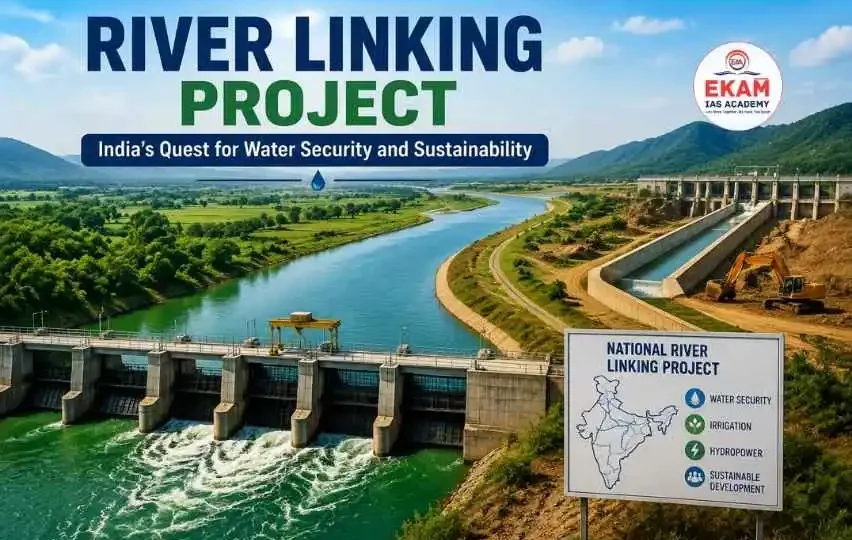
ToggleA river linking project involves the large-scale engineering of channels, canals, and reservoirs to transfer water from a “surplus” river basin to a “deficit” river basin. The background of the interlinking of rivers in India dates back to the British colonial era, when engineer Sir Arthur Cotton proposed connectivity to improve inland navigation. In the modern era, the plan was formalized under the National River Linking Project (NRLP), managed by the National Water Development Agency (NWDA). The NRLP is divided into two main components: the Himalayan Component (focusing on northern glacial rivers) and the Peninsular Component (focusing on rain-fed southern rivers).
Core Objectives and Major Projects
The primary objective of the river linking project UPSC syllabus highlights is to address India’s geographical water imbalance by routing water to drought-prone regions, expanding irrigation, and generating hydroelectric power.
| Component of NRLP | Details |
|---|---|
| Himalayan Component | 14 river links (e.g., Kosi–Mechi) |
| Peninsular Component | 16 river links (e.g., Godavari–Cauvery) |
| Flagship Pioneer Project | The Ken–Betwa Link Project |
The flagship pioneer project under this initiative is the Ken Betwa River Linking Project UPSC notes closely monitor. This project aims to transfer surplus water from the Ken River in Madhya Pradesh to the water-scarce Betwa River in Uttar Pradesh, providing crucial irrigation to the drought-prone Bundelkhand region.
Positive Environmental and Developmental Impacts
When executed with strict safeguards, river linking can offer distinct advantages:
- Combating Droughts: Provides reliable irrigation water to arid regions, preventing crop failures and stabilizing food security.
- Groundwater Recharge: Diverting surface water to dry river beds helps naturally recharge depleted local aquifers.
- Clean Hydroelectric Power: Incorporates large dams along the channels to generate renewable energy, supporting India’s transition away from fossil fuels.
Environmental Impacts of River Linking Projects
Despite the economic benefits, the environmental impacts of river linking present serious challenges that require careful scientific study:
A. Habitat Destruction and Biodiversity Loss
Building large reservoirs leads to widespread submergence of forest lands. For instance, the Ken Betwa River Linking Project will submerge a significant portion of the Panna Tiger Reserve, threatening core habitats of tigers, vultures, and gharials, while disrupting vital wildlife corridors.
B. Alteration of River Hydrology and Ecology
- Downstream Siltation Deficit: Dams trap nutrient-rich silt, preventing it from reaching downstream deltas. This leads to severe coastal delta erosion and deprives agricultural lands of natural nutrients.
- Salinity Intrusion: Reducing the freshwater flow of a river into the sea allows ocean tides to push further inland, altering fragile estuarine ecosystems and destroying brackish-water fisheries.
- The “Surplus” Myth: From an ecological perspective, no river has “surplus” water. Every drop of water flowing to the sea is essential for maintaining flushing cycles, supporting wetlands, and transporting nutrients.
Climate Change, Social Concerns, and Sustainable Development
Climate change introduces high unpredictability into river linking plans. Changing monsoon patterns can turn a historically “surplus” river into a water-deficient one, rendering rigid concrete canal networks ineffective. Additionally, these projects cause severe social challenges, forcing the displacement and resettlement of thousands of local communities, which often triggers long-term legal disputes.
The Role of Environmental Impact Assessment (EIA):
To align river linking with long-term sustainable development, every project must undergo a strict, transparent Environmental Impact Assessment (EIA). Rather than relying on simple engineering plans, water management must shift toward decentralized solutions, such as large-scale rainwater harvesting, restoring traditional stepwells, and promoting micro-irrigation to conserve water at the source.
Advantages and Disadvantages
| Key Advantages | Critical Disadvantages |
| Resolves regional water scarcity and aids drought-prone zones. | Causes massive submergence of pristine forest ecosystems. |
| Expands nationwide canal irrigation networks. | Triggers high social displacement and rehabilitation crises. |
| Generates renewable, carbon-free hydroelectricity. | Alters natural river hydrology and degrades downstream deltas. |
Conclusion
Analyzing the river linking project UPSC notes cover demonstrates that altering natural river systems carries significant environmental costs. While infrastructure projects can resolve immediate regional water crises, they must not come at the expense of ecological stability. By combining carefully managed engineering with strict EIA clearances, habitat compensation, and a focus on localized water conservation, India can secure its water future while preserving its rich biodiversity and river ecosystems for the long term.
UPSC Prelims: PYQs & Practice Questions
Previous Year Questions (Prelims)
Q: Which of the following joined rivers was recently linked in India under a major inter-state river diversion project? (UPSC CSE Prelims 2016)
A. Krishna and Godavari
B. Narmada and Tapi
C. Mahanadi and Sone
D. Ganga and Yamuna
Answer: A
Explanation:
The Godavari and Krishna rivers were successfully linked in Andhra Pradesh through the Pattiseema lift irrigation project. This project diverted surplus water from the Godavari River to the water-deficit Krishna river basin, making it a highly relevant case study for national water infrastructure planning.
Q: Consider the following pairs of rivers and the Indian States they primarily flow through: (UPSC CSE Prelims 2023)
1. Ghataprabha – Kerala
2. Gandak – Bihar
3. Pranhita – Telangana and Andhra Pradesh
Select the correct answer:
A. 1 and 2 only
B. 2 and 3 only
C. 1 and 3 only
D. 1, 2 and 3
Answer: B
Explanation:
Pair 1 is incorrectly matched; the Ghataprabha River flows through Karnataka and Maharashtra, not Kerala. Pair 2 is correct; the Gandak flows extensively through Bihar as a major northern tributary of the Ganga. Pair 3 is correct; the Pranhita River flows through Maharashtra and along the borders of Telangana and Andhra Pradesh before merging with the Godavari. Correct knowledge of river courses is essential for understanding India’s National River Linking Project.
Practice Questions (Prelims)
Q: In the context of the Ken-Betwa River Linking Project, consider the following statements:
1. The project involves building the Daudhan Dam across the Ken River to divert water via a canal to the Betwa River.
2. A significant ecological concern is the submergence of a substantial core area of the Panna Tiger Reserve, which threatens habitats of endangered vultures and tigers.
Select the correct answer:
A. 1 only
B. 2 only
C. Both 1 and 2
D. Neither 1 nor 2
Answer: C
Explanation:
Both statements are correct. The Ken-Betwa Link Project is India’s first major operational river-linking project under the National River Linking Project framework. It relies on constructing the Daudhan Dam in Madhya Pradesh to transfer water to the Betwa basin across Bundelkhand. About 10% of the Panna Tiger Reserve's core habitat will be submerged, resulting in habitat fragmentation and loss of vulture nesting sites.
Q: From an ecological perspective, reducing freshwater outflow of a river into its sea mouth via upstream diversion structures causes which environmental degradation?
A. Acceleration of upstream glacial melt rates
B. Severe salinity intrusion into coastal aquifers and estuarine ecosystems
C. Eradication of desertification across mountainous catchments
D. Elimination of all flash-flooding phenomena along river channels
Answer: B
Explanation:
Diverting massive volumes of freshwater upstream reduces natural flushing into the sea. This allows tidal saltwater to intrude inland, contaminating agricultural soils, affecting drinking-water aquifers, and degrading sensitive estuarine ecosystems dependent on a balanced mix of fresh and salt water.
UPSC Mains – Previous Year & Practice Questions
Previous Year Questions(Mains)
Q: Discuss the ecological and economic importance of wetlands in India. What are the major threats faced by them? (Mains 2024)
Directly connects to how river-linking canals alter the water balance of natural floodplain wetlands.
Q: What is water stress? How and why does it differ regionally in India? (Mains 2020)
Provides the foundational justification used by the state to push for the interlinking of rivers in India.
Q: Enumerate the problems and prospects of inland water transport in India. (Mains 2016)
Can discuss how river linking aims to restore navigable depths in peninsular rivers.
Q: The concept of 'surplus' and 'deficit' river basins does not align cleanly with ecological realities. Critically analyze the eco-hydrological risks involved in multi-basin water transfer projects. (Mains 2015)
Directly targets the core theory of the National River Linking Project UPSC covers.
Q: Enumerate the indirect services provided by an ecosystem. How do wetlands act as 'Earth's Kidneys'? (Mains 2014)
Practice Questions
Q: Ecologists argue that no river basin possesses 'surplus' water, as every drop performing down-stream flow is essential to maintain ecological integrity. Critically analyze the environmental impacts of river linking projects with reference to coastal deltas and estuarine fisheries.
Highlights risks of flow disruption, salinity intrusion, and habitat loss for aquatic species.
Q: Climate change is altering global and regional monsoon patterns, turning historically water-abundant river basins into water-stressed ones. Examine how shifting weather patterns challenge the long-term viability of rigid, concrete river-linking infrastructure.
Focuses on hydrological uncertainty affecting inter-basin transfer projects and adaptation planning.
Q: Using the Ken Betwa River Linking Project as a case study, discuss the direct conflict between grand engineering solutions for regional development and the statutory mandate of wildlife conservation in protected areas.
Examines submergence of protected areas, core tiger habitats, and vulture nesting sites vs. irrigation benefits.



Interlinking of Rivers in India and Its Environmental Impacts-FAQs
Difference between Himalayan and Peninsular components of NRLP?
Himalayan Component: Diverts northern snow-fed rivers like Ganga and Brahmaputra to dry western and southern regions.
Peninsular Component: Diverts southern rain-fed rivers like Godavari and Krishna to interior drought-prone areas.
Why is the idea of ‘surplus’ water ecologically misleading?
No river water is wasted; every drop flushes pollutants, transports silt, maintains wetlands, and prevents seawater intrusion, so calling water “surplus” ignores ecological needs.
How does river linking degrade downstream deltas?
Dams trap nutrient-rich silt, causing silt starvation. This erodes deltas, lowers agricultural productivity, and allows coastal land to sink.
What are social and displacement concerns?
Linking projects submerge land, displacing rural and tribal communities, destroying livelihoods, and causing long-term resettlement and legal disputes.
Decentralized alternatives to river linking?
- Rainwater Harvesting: Store monsoon rain locally to recharge aquifers.
- Watershed Management: Restore ponds, wetlands, and stepwells.
- Agricultural Reforms: Shift to water-efficient irrigation and drought-resistant crops like millets.