Table of Contents
ToggleEnvironmental Impact Assessment: Process, Stages and Importance in India
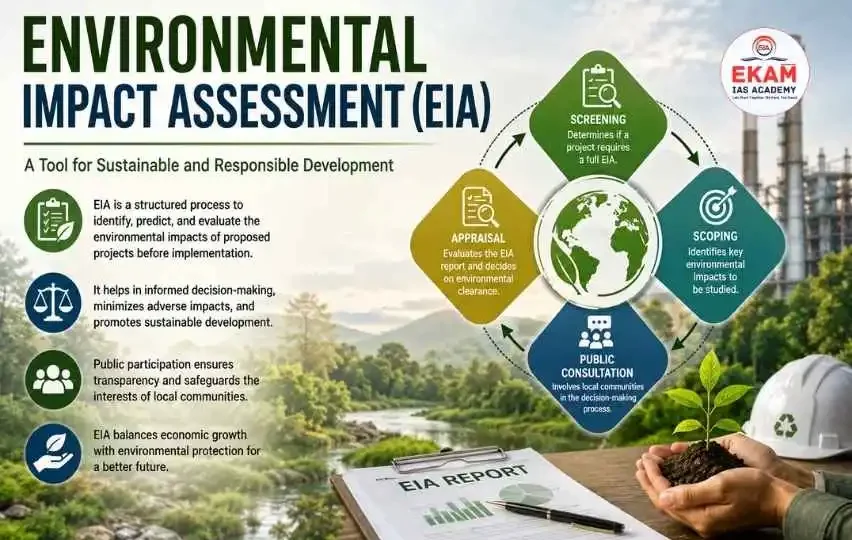
An Environmental Impact Assessment is a structured policy process used to evaluate the potential environmental consequences of a proposed industrial or developmental project. Rather than acting as a post-disaster remedy, the Environmental Impact Assessment UPSC syllabus emphasizes serves as a proactive decision-making tool. It helps anticipate, minimize, and mitigate adverse impacts on ecosystems, public health, and local livelihoods before any capital is deployed.
Historical Background and Legal Framework in India
The origin of the EIA process UPSC tracks dates back to the National Environmental Policy Act (NEPA) of 1969 in the United States. In India, the institutional journey began in 1976-77 when the Planning Commission directed the Department of Science and Technology to evaluate river valley projects.
[Environment (Protection) Act, 1986]
│
▼
Provides Parent Statutory Authority
│
▼
[EIA Notification, 1994]
│
▼
First formal, legally mandated framework
│
▼
[EIA Notification, 2006]
│
▼
Decentralized model dividing
Category A and Category B projects
Today, the primary legislative backbone of the EIA framework is the Environment (Protection) Act, 1986 (EPA). The first formal, legally mandated framework was established under the EIA Notification of 1994, which was later replaced by the decentralized EIA Notification 2006. This updated version shifted significant administrative powers to state-level authorities.
The 4 Operational Stages of the EIA Process
The EIA process UPSC modules highlight follows a sequential framework to filter out unsustainable projects before granting environmental clearance in India:
| Stage | Function |
|---|---|
| Screening | Need for EIA assessment |
| Scoping | Identification of environmental issues |
| Public Consultation | Stakeholder participation and feedback |
| Appraisal | Expert review and final decision on project clearance |
1. Screening
Determines whether a proposed developmental project requires a full-scale EIA study. This step classifies projects based on their scale and sector.
2. Scoping
Identifies the specific, high-priority environmental impacts that need detailed scientific analysis. This stage creates the customized Terms of Reference (ToR) for the upcoming assessment.
3. Public Consultation
A critical component of democratic environmental planning. It provides a formal, transparent platform for local communities and affected stakeholders to voice their concerns and objections regarding the project.
4. Appraisal
A detailed evaluation of the final EIA report and public hearing records conducted by the Expert Appraisal Committee (EAC). This committee makes the final decision to grant or deny environmental clearance.
Environmental Clearance Categories under the 2006 Notification
The EIA Notification 2006 decentralized governance by splitting industrial projects into two major regulatory categories:
- Category A Projects: Evaluated at the central level by the Ministry of Environment, Forest and Climate Change (MoEFCC). These projects mandate a comprehensive, full-scale EIA process without exception.
- Category B Projects: Screened at the state level by the State Environmental Impact Assessment Authority (SEIAA). This category is subdivided into Category B1 (which requires a detailed EIA report) and Category B2 (which is exempt from the formal EIA reporting requirement).
Key Policy Comparison: EIA vs. Strategic Environmental Assessment (SEA)
| Feature/Dimension | Environmental Impact Assessment (EIA) | Strategic Environmental Assessment (SEA) |
| Operational Scale | Applied to a specific, isolated project (e.g., a single highway, dam, or mine). | Applied at a macro scale to overarching policies, plans, or regional programs. |
| Temporal Nature | Reactive; evaluates the footprints of a project that has already been designed. | Proactive; integrates environmental guidelines into early policy stages. |
| Cumulative View | Fails to capture the combined long-term impacts of multiple nearby developments. | Excellent at evaluating the cumulative environmental impacts across an entire sector. |
Challenges, Criticisms, and Recent Developments
Despite its strong legal design, the practice of environmental clearance in India faces several systemic challenges. A major criticism is the lack of independent data. Project proponents often hire private consulting agencies directly to write their reports, creating a conflict of interest that can lead to downplayed environmental risks.
Additionally, the public hearing process is frequently weakened by executing it late in the cycle or providing poorly translated summaries to local communities. To address these gaps, recent changes focus on digitalization, introducing the integrated PARIVESH portal to track applications transparently and reduce bureaucratic delays.
The Environmental Management Plan (EMP) and Sustainable Development
The final output of a successful assessment is the Environmental Management Plan (EMP). The EMP is a legally binding blueprint that lists specific mitigation strategies—such as setting up green belts, running effluent treatment plants, and funding wildlife rehabilitation corridors. By turning abstract conservation goals into enforceable tasks, the EMP helps align industrial expansion with sustainable development.
Conclusion
Analyzing Environmental Impact Assessment UPSC study notes demonstrates that true economic security cannot be separated from ecological stability. Treating environmental checks as simple bureaucratic hurdles threatens biodiversity safety nets and local communities. By removing conflicts of interest from reporting, protecting the public consultation stage, and adopting macro-level Strategic Environmental Assessments, India can improve its environmental governance and secure long-term, eco-friendly growth for the future.
UPSC Prelims: PYQs & Practice Questions
Previous Year Questions (Prelims)
UPSC CSE Prelims 2020
Q: As per the rules and notifications in India, which of the following statements is/are correct regarding the Environmental Impact Assessment (EIA)?
1. The formal institutional framework for EIA in India is backed by the statutory authority of the Environment (Protection) Act, 1986.
2. The public consultation process is legally mandatory for all developmental projects listed under Category A and Category B2 without exception.
Select the correct answer using the code given below:
(a) 1 only
(b) 2 only
(c) Both 1 and 2
(d) Neither 1 nor 2
Answer: (a) 1 only
Explanation:
Statement 1 is correct because the parent legislative backbone for EIA notifications in India is the Environment (Protection) Act, 1986.
Statement 2 is incorrect because while public consultation is an important part of the EIA process, Category B2 projects are generally exempt from full EIA studies and public hearings.
UPSC CSE Prelims 2011
Q: Under the Environment (Protection) Act, 1986, the power to issue notifications mandating environmental clearances for industrial projects rests with:
(a) The National Green Tribunal
(b) The Central Pollution Control Board
(c) The Ministry of Environment, Forest and Climate Change (MoEFCC)
(d) The State Pollution Control Boards
Answer: (c) The Ministry of Environment, Forest and Climate Change (MoEFCC)
Explanation:
The Ministry of Environment, Forest and Climate Change (MoEFCC) is the nodal central agency empowered under the Environment (Protection) Act, 1986 to issue rules, formulate guidelines, and grant environmental clearances for major infrastructure and Category A industrial projects.
Practice Questions
Q: In the context of the decentralized regulatory architecture established under the EIA Notification, 2006, consider the following statements:
1. Category A projects require mandatory environmental clearance from the Ministry of Environment, Forest and Climate Change (MoEFCC) based on the recommendations of an Expert Appraisal Committee (EAC).
2. Category B projects are evaluated at the state level by the State Environmental Impact Assessment Authority (SEIAA), and are entirely exempt from central oversight regardless of potential trans-boundary impacts.
Which of the statements given above is/are correct?
(a) 1 only
(b) 2 only
(c) Both 1 and 2
(d) Neither 1 nor 2
Answer: (a) 1 only
Explanation:
Statement 1 is correct because Category A projects carry higher environmental risks and are appraised at the central level by the MoEFCC on the recommendation of the EAC.
Statement 2 is incorrect because of the General Condition. If a Category B project is located near an inter-state boundary, protected area, critically polluted industrial cluster, eco-sensitive area, or international border, it may be treated as a Category A project and brought under central review.
Q: Within the sequential phases of the EIA process, which stage involves formulating the explicit Terms of Reference (ToR) that define the scope of scientific data a project proponent must collect?
(a) Screening
(b) Scoping
(c) Public Consultation
(d) Appraisal
Answer: (b) Scoping
Explanation:
Scoping is the stage where the Expert Appraisal Committee studies the project design and identifies the major potential environmental impacts. It then issues a customized Terms of Reference (ToR), which acts as a checklist of environmental parameters to be studied in the final EIA report.
UPSC Mains – Previous Year & Practice Questions
Mains Previous Year Questions
Mains 2020
Question: How does the draft Environment Impact Assessment (EIA) Notification differ from the existing EIA Notification, 2006?
Directly tests knowledge of statutory updates in environmental rule-making.
Mains 2019
Question: Coastal regions of India are prone to cyclones. Discuss the role of mangroves in reducing the impact of such disasters.
Can be connected to how EIAs for coastal infrastructure must evaluate threats to mangrove buffer zones.
Mains 2016
Question: Environmental Impact Assessment (EIA) studies are increasingly becoming a mere bureaucratic formality rather than a tool for sustainable development. Critically comment.
Directly tests core analytical themes of environmental governance.
Mains 2014
Question: Enumerate the indirect services provided by an ecosystem. How do wetlands act as “Earth’s Kidneys”?
Mains 2013
Question: Enumerate the National Green Tribunal’s roles and responsibilities in handling environmental clearance disputes.
Mains Practice Questions
[15 Marks | 250 Words]
Question: The reliance on consultants paid directly by project proponents to draft EIA reports creates a fundamental structural conflict of interest. Discuss how this vulnerability undermines the credibility of environmental clearance in India and suggest institutional remedies.
[15 Marks | 250 Words]
Question: While an Environmental Impact Assessment (EIA) evaluates isolated project footprints, a Strategic Environmental Assessment (SEA) integrates ecological guardrails into macro-level policy-making. Analyze the advantages of shifting India’s environmental governance framework toward Strategic Environmental Assessments.
[10 Marks | 150 Words]
Question: Public consultation is the primary democratic component of the EIA process. Evaluate the operational challenges and systemic loopholes that frequently weaken the effectiveness of public hearings in ecologically sensitive areas.



Environmental Impact Assessment-FAQs
What is Environmental Impact Assessment?
Environmental Impact Assessment is a process used to evaluate the possible environmental effects of a proposed industrial or development project before approval is granted.
What are the main stages of the EIA process?
The four main stages of the EIA process are screening, scoping, public consultation, and appraisal. These stages help assess environmental risks before granting environmental clearance.
Why is EIA important in India?
EIA is important in India because it helps reduce environmental damage, protect biodiversity, safeguard public health, involve local communities, and promote sustainable development.
What is the EIA Notification 2006?
The EIA Notification 2006 is India’s key regulatory framework for environmental clearance. It classifies projects into Category A and Category B based on their scale and environmental impact.
What is the difference between EIA and SEA?
EIA evaluates the environmental impact of a specific project, while Strategic Environmental Assessment evaluates the broader impact of policies, plans, or regional development programmes.