Table of Contents
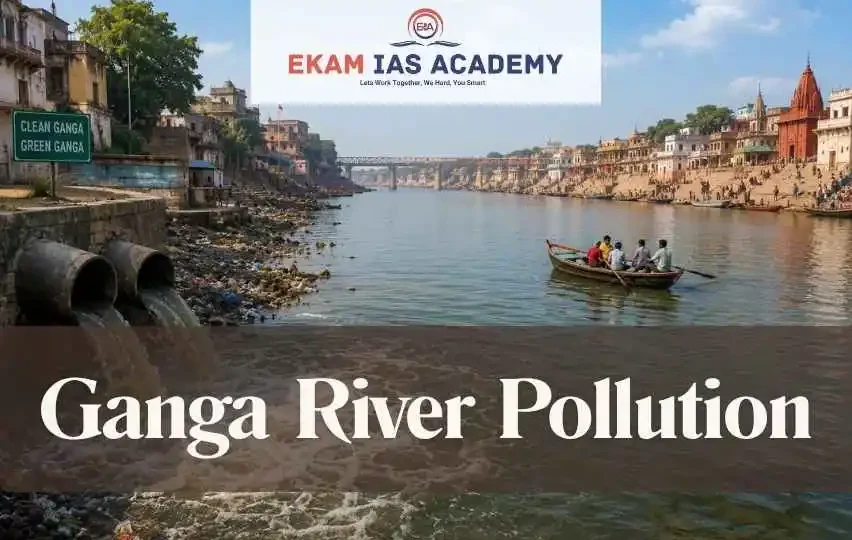
ToggleGanga River Pollution
The Ganga River originates from the Gangotri glacier at Gaumukh as the Bhagirathi, joining the Alaknanda at Devprayag to form the mainstream. Spanning over 2,525 km, the Ganga basin supports more than 40% of India’s population, making it the country’s economic and cultural lifeline.
However, the river faces severe anthropogenic stress. Ganga River pollution refers to the chemical, biological, and physical degradation of its water, which has driven pollution levels far past permissible limits for drinking, bathing, and aquatic survival.
Major Sources and Types of Pollutants
The primary causes of Ganga pollution can be split into point sources (identifiable pipes) and non-point sources (diffuse runoff):
| Source of Pollution | Major Pollutants |
|---|---|
| Industrial Effluents | Untreated toxic heavy metals (Cr, Pb, As) |
| Domestic Sewage | Millions of liters of raw municipal wastewater |
| Non-Point Source Runoff | NPK fertilizers, pesticides, and plastic waste |
Domestic Sewage
Over 60% of the total pollution load stems from untreated municipal wastewater flowing from major urban centers along the riverbanks.
Industrial Effluents
Highly toxic tanneries in Kanpur, chemical plants in Prayagraj, and paper mills in Varanasi dump heavy metals like chromium, lead, and arsenic directly into the stream.
Agricultural and Religious Runoff
Chemical NPK fertilizers leach into the basin, causing eutrophication. Additionally, the immersion of unburnt bodies, ashes, and religious offerings introduces massive amounts of organic waste.
Major Hotspots and Environmental Impacts
The river features severe pollution hotspots, most notably the Kanpur stretch (due to concentrated leather tanneries) and downstream stretches near Varanasi and Kolkata.
Key Ecological Footprints:
- Decimation of Aquatic Flora and Fauna: High organic loads trigger a sharp drop in Dissolved Oxygen (DO) and an exponential spike in Biological Oxygen Demand (BOD).
- Threat to Endangered Species: Toxic chemical bioconcentration endangers the Ganga River Dolphin (Platanista gangetica), a flagship species and India’s National Aquatic Animal, as well as the smooth-coated otter and the critically endangered Gharial.
Public Health and Socio-Economic Impacts
The accumulation of pathogenic waste poses severe risks to human health. High fecal coliform bacteria counts drive widespread waterborne diseases, including cholera, typhoid, and acute gastroenteritis. Downstream, the use of contaminated river water for crop irrigation introduces heavy metals into the human food chain, causing bioaccumulation and chronic kidney illnesses. Economically, this pollution ruins river-based tourism and collapses local freshwater inland fisheries.
Climate Change and the Ganga Basin
Climate change acts as a risk multiplier for the river basin. Accelerating glacial retreat in the Himalayas threatens the long-term perennial flow of the Ganga, risking a drastic reduction in its volume during dry summer months. Lower water volumes reduce the river’s natural dilution and self-purification capacity, concentrating pollutants and worsening toxic conditions across the plains.
Conservation Framework: The Namami Gange Programme
To shift away from older, fragmented attempts like the Ganga Action Plan (GAP), the government launched the Namami Gange Programme UPSC notes track as an integrated conservation mission.
| Core Pillar | Key Objective |
|---|---|
| Sewerage Treatment | Building decentralized STPs to stop raw waste. |
| River-Front Development | Modifying ghats to manage plastic and ritual waste. |
| Bio-Diversity | Conserving native species like dolphins. |
| Public Awareness | Engaging local communities (Ganga Praharis). |
Administered by the National Mission for Clean Ganga (NMCG) under the National Ganga Council, this flagship initiative works to ensure both Aviral Dhara (continuous flow) and Nirmal Dhara (unpolluted flow).
Operational Challenges in Cleaning the Ganga
Despite sustained funding, Ganga river conservation faces deep structural hurdles:
- Treatment Capacity Gaps: There is a large gap between the daily generation of urban sewage and the operational capacity of existing Sewage Treatment Plants (STPs).
- Low Environmental Flow (E-flow): Heavy water diversion for canal irrigation networks reduces the river’s natural current, trapping heavy pollutants along the riverbed.
- Inter-Agency Delays: Poor coordination between central funding bodies and local state municipalities slows down project completion and leads to neglected infrastructure maintenance.
Analytical Matrix: Causes vs. Solutions
| Core Identified Cause | Targeted Environmental Solution |
| Unregulated urban municipal sewage dumping. | Constructing decentralized STPs via Hybrid Annuity Models (HAM). |
| Toxic heavy metal industrial discharge. | Enforcing Zero Liquid Discharge (ZLD) mandates and online effluent monitoring. |
| Reduced river volumes due to irrigation canals. | Enforcing legally mandated minimum Environmental Flow (E-flow) regimes. |
Conclusion
Analyzing Ganga River pollution UPSC modules cover demonstrates that a river basin cannot be cleaned through engineering alone; it requires systemic socio-ecological management. Moving forward, Ganga river conservation must bridge the gap between building infrastructure and ensuring its long-term operational maintenance. By combining the infrastructure of the Namami Gange Programme with strict zero-liquid-discharge rules for factories and a shift toward water-saving micro-irrigation for agriculture, India can clean its holy river, secure regional public health, and preserve vital aquatic ecosystems for the future.
UPSC Prelims: PYQs & Practice Questions
Previous Year Questions (Prelims)
UPSC CSE Prelims 2014
Q: Which one of the following is the national aquatic animal of India?
(a) River dolphin
(b) Green sea turtle
(c) Gharial
(d) Dugong
Answer: (a) River dolphin
Explanation:
The Ganga River Dolphin (Platanista gangetica) is India’s National Aquatic Animal. It is a highly sensitive indicator species; because it can survive only in clean freshwater, its presence or absence reflects the health of river ecosystems and the success of Ganga conservation initiatives. Unregulated industrial effluents and sewage dumping have severely threatened its natural habitats.
UPSC CSE Prelims 2017
Q: Biological Oxygen Demand (BOD) is a standard criterion for:
(a) Measuring oxygen levels in blood
(b) Computing oxygen levels in forest ecosystems
(c) Pollution assay in aquatic ecosystems
(d) Assessing oxygen levels in high-altitude regions
Answer: (c) Pollution assay in aquatic ecosystems
Explanation:
Biological Oxygen Demand (BOD) measures the amount of dissolved oxygen required by aerobic organisms to break down organic matter present in a water sample. A high BOD value indicates a heavily polluted water body with low Dissolved Oxygen (DO) levels. It is a key parameter used to assess river pollution and aquatic ecosystem health in India.
Practice Questions
Q: In the context of the institutional framework governing the Namami Gange Programme, consider the following statements:
1. The National Ganga Council (NGC) operates under the chairmanship of the Union Minister of Jal Shakti to coordinate inter-state pollution control.
2. The National Mission for Clean Ganga (NMCG) serves as the formal implementation wing responsible for executing pollution abatement infrastructure.
Which of the statements given above is/are correct?
(a) 1 only
(b) 2 only
(c) Both 1 and 2
(d) Neither 1 nor 2
Answer: (b) 2 only
Explanation:
Statement 1 is incorrect because the National Ganga Council (NGC) is chaired by the Prime Minister of India, not the Union Minister of Jal Shakti. This reflects the high political importance of Ganga rejuvenation.
Statement 2 is correct because the National Mission for Clean Ganga (NMCG) is the main implementation agency responsible for executing pollution abatement projects, building sewage treatment infrastructure, and supporting river conservation measures.
Q: Which of the following best describes the ecological concept of Environmental Flow (E-flow) mandated along the mainstream of the Ganga?
(a) The maximum volume of chemical effluents a factory is permitted to dump during monsoon floods.
(b) The minimum quantity of water required to flow continuously through a river channel to sustain its native aquatic ecosystems and self-purification capacity.
(c) The speed at which tourist cruise vessels are allowed to navigate through dolphin sanctuaries.
(d) The total volume of water diverted into agricultural canals to prevent regional droughts.
Answer: (b) The minimum quantity of water required to flow continuously through a river channel to sustain its native aquatic ecosystems and self-purification capacity.
Explanation:
Environmental Flow (E-flow) refers to the minimum volume of water that must continuously flow through a river channel to maintain its ecological health. It prevents excessive diversion of river water for irrigation, hydropower, or other uses. Adequate E-flow helps maintain oxygenation, supports aquatic biodiversity, and strengthens the river’s self-purification capacity.
UPSC Mains – Previous Year & Practice Questions
Mains Previous Year Questions
Mains 2016
Question: Rehabilitation of human settlements is a major environmental and social concern in India. Discuss the challenges in implementing restoration programmes near major river basins.
Can be connected to clearing illegal encroachments along floodplains.
Mains 2015
Question: Industrial corridors are engines of economic growth but come with heavy environmental costs. Discuss.
Directly applies to dense clusters of tanneries and chemical units contributing to Ganga pollution.
Mains 2014
Question: Enumerate the indirect services provided by an ecosystem. How do wetlands act as “Earth’s Kidneys”?
Can be connected to how natural floodplains filter organic waste loads.
Mains 2018
Question: What is water stress? How and why does it differ regionally in India?
Mains 2013
Question: What do you understand by Universal Minimum Needs (UMN)? How far has India progressed in securing clean domestic energy and sanitation for its citizens?
Mains Practice Questions
[10 Marks | 150 Words]
Question: Achieving a clean Ganga requires a fine balance between Nirmal Dhara — unpolluted flow — and Aviral Dhara — continuous flow. Explain the significance of legally mandated Environmental Flows (E-flows) in restoring the self-purification capacity of river biomes.
[15 Marks | 250 Words]
Question: Despite massive financial allocations under the Namami Gange Programme, a significant gap persists between daily urban sewage generation and actual treated output. Critically analyze the structural and operational challenges hampering municipal waste treatment in India.
[15 Marks | 250 Words]
Question: Discuss how upstream industrial heavy-metal pollution along the Ganga basin leads to bioaccumulation in downstream food crops and aquatic life. What long-term public health and socio-economic risks does this create?



Ganga River Pollution-FAQs
What are the main causes of Ganga River pollution?
The main causes of Ganga River pollution are untreated domestic sewage, industrial effluents, agricultural runoff, religious waste, plastic pollution, and reduced river flow due to water diversion.
What is the Namami Gange Programme?
The Namami Gange Programme is a flagship government initiative launched to clean and rejuvenate the Ganga River through sewage treatment, riverfront development, biodiversity conservation, public awareness, and pollution control.
Why is Ganga River pollution a serious problem?
Ganga River pollution is serious because it affects drinking water quality, public health, aquatic biodiversity, agriculture, fisheries, tourism, and the overall ecological balance of the Ganga basin.
Which pollutants are found in the Ganga River?
Major pollutants found in the Ganga include untreated sewage, fecal coliform bacteria, heavy metals such as chromium, lead and arsenic, fertilizers, pesticides, plastic waste, and organic religious waste.
Why is Ganga River pollution important for UPSC?
Ganga River pollution is important for UPSC because it connects with environment, biodiversity, public health, river conservation, Namami Gange Programme, water governance, climate change, and sustainable development.