
Table of Contents
ToggleFAO Blue Transformation Report
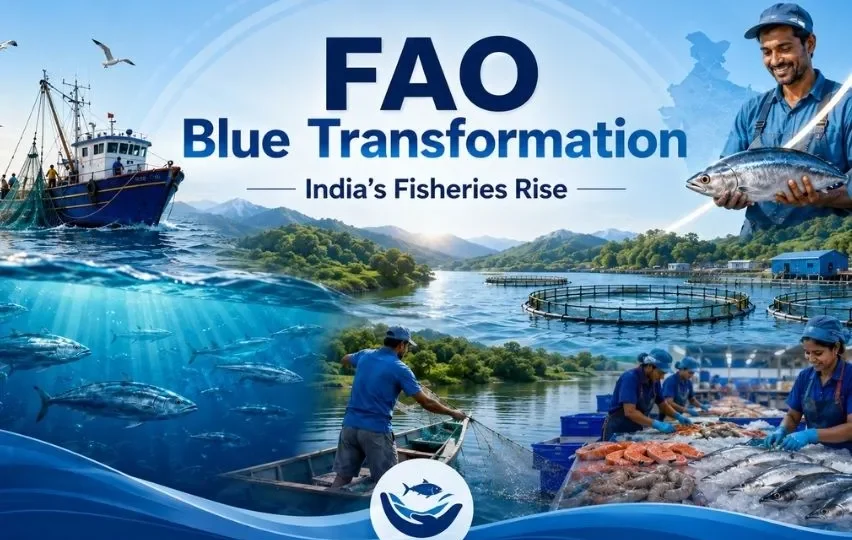
The Food and Agriculture Organization Report on Blue Transformation highlights the growing role of fisheries and aquaculture in building sustainable, inclusive and resilient aquatic food systems. For India, the report is highly significant because it shows the country’s rising position in global fisheries production, inland water catches and aquaculture growth.
The theme “Blue Transformation: Turning Vision into Impact” focuses on improving aquatic food systems through sustainability, resilience, better livelihoods and nutrition security. For UPSC aspirants, this topic is important under GS Paper 3, especially in areas related to agriculture, fisheries, blue economy, food security, rural development and sustainable resource management.
Why is the FAO Report in News?
India has emerged as the world’s second-largest producer of aquatic animals after China, contributing around 9% of global aquatic animal output in 2024. This reflects India’s rapid growth in fisheries, aquaculture and inland water production.
Another major highlight is that India ranked No. 1 in inland water catches, producing around 2.2 million tonnes from rivers, lakes and freshwater systems. This achievement shows the importance of India’s vast inland water resources, including rivers, ponds, reservoirs and wetlands.
India’s fisheries rise also highlights the growing importance of the blue economy, which includes fisheries, aquaculture, coastal livelihoods, marine resources, seafood exports and sustainable ocean-based development.
Key Findings of the Report
The report presents several important findings related to India and global fisheries.
India Leads in Inland Fisheries
India’s strong performance in inland fisheries shows the importance of freshwater systems in supporting food production and rural livelihoods. Rivers, lakes, ponds and reservoirs play a major role in India’s fish production.
India is Second in Aquaculture
India is also ranked second in aquaculture, contributing nearly 12% of global farmed aquatic animal output. Aquaculture has become one of the fastest-growing food production sectors and is crucial for meeting future protein demand.
Global Fisheries Production Reached Record Level
Global fisheries and aquaculture production reached around 235 million tonnes in 2024, showing the rising importance of aquatic food systems in global food security. This also indicates the need for sustainable management of fisheries resources.
Significance of Fisheries Sector in India
The fisheries sector plays a multi-dimensional role in India’s economy and society.
Food and Nutritional Security
Fish is a rich source of high-quality protein, omega-3 fatty acids, vitamins and micronutrients. It helps address malnutrition and improves dietary diversity, especially in coastal and riverine communities.
Livelihood Support
The fisheries sector provides employment and income support to millions of fishers, fish farmers, traders, processors and workers involved in allied activities. It is particularly important for small and marginal communities.
Rural Development
Fisheries create economic opportunities in inland, coastal and rural regions. They help diversify rural income beyond traditional agriculture and support local entrepreneurship.
Sustainable Food Systems
Aquaculture is a fast-growing source of future food supply. If managed properly, it can provide nutritious food while reducing pressure on overexploited marine fish stocks.
Export Competitiveness
India’s seafood exports contribute to foreign exchange earnings and strengthen India’s position in the global food market. Value addition, cold chain infrastructure and processing facilities can further improve export competitiveness.
Indian Initiatives for Fisheries Development
India has launched several schemes and initiatives to strengthen the fisheries sector.
Pradhan Mantri Matsya Sampada Yojana
The Pradhan Mantri Matsya Sampada Yojana is the flagship scheme for sustainable fisheries development. It aims to enhance fish production, improve productivity, strengthen infrastructure, reduce post-harvest losses and increase fishers’ income.
Fisheries and Aquaculture Infrastructure Development Fund
The Fisheries and Aquaculture Infrastructure Development Fund provides concessional finance for developing fisheries infrastructure. It supports fish landing centres, cold chains, processing units, aquaculture facilities and modern markets.
Kisan Credit Card for Fishers
The extension of Kisan Credit Card benefits to fishers and fish farmers enables them to access working capital for fishing, aquaculture, feed, seed and related activities. This improves credit access and reduces dependence on informal lenders.
Challenges in India’s Fisheries Sector
Despite its growth, India’s fisheries sector faces several challenges.
Overfishing
Unregulated and excessive fishing can reduce fish stocks and damage marine ecosystems. Sustainable fishing practices are needed to protect long-term productivity.
Climate Change
Rising sea temperatures, ocean acidification, changing rainfall patterns and extreme weather events affect fish breeding, migration and catch patterns.
Weak Marketing Linkages
Many fishers face poor market access, dependence on middlemen and lack of fair price realization. Better market networks are necessary to improve incomes.
Low Value Addition
India still needs stronger processing, packaging, branding and export-oriented value addition to increase earnings from the fisheries sector.
Limited Access to Finance and Credit
Small fishers often struggle to access institutional credit, insurance and modern equipment. Expanding affordable credit is essential for inclusive growth.
Policy and Regulatory Constraints
Fragmented regulations, weak enforcement and coordination gaps affect sustainable fisheries management.
Way Forward
India must promote sustainable aquaculture by encouraging responsible fish farming, scientific feed use, disease management and water quality monitoring. Infrastructure and cold chain facilities must be strengthened to reduce post-harvest losses.
The country should also improve value addition, branding and market access to increase fisher incomes and boost seafood exports. Affordable credit, insurance and digital market platforms can make fisheries more inclusive.
Climate-resilient fisheries must be supported through better research, early warning systems, diversified species farming and protection of coastal ecosystems such as mangroves and wetlands.
UPSC Relevance
The FAO Report on Blue Transformation is important for UPSC because it connects with blue economy, fisheries sector, aquaculture, food security, rural livelihoods, sustainable development, climate change and government schemes.
It can be used in Mains answers related to agriculture diversification, nutrition security, coastal economy, inclusive growth, sustainable resource management and climate-resilient livelihoods.
Conclusion
The FAO Report shows that India’s fisheries sector is emerging as a major pillar of the blue economy. India’s rise as the second-largest producer of aquatic animals and leader in inland water catches reflects the country’s potential in sustainable fisheries and aquaculture.
However, growth must be balanced with ecological responsibility. By promoting sustainable aquaculture, strengthening infrastructure, expanding credit access and supporting climate-resilient fisheries, India can transform its fisheries sector into a powerful driver of nutrition, employment, exports and sustainable development.



Frequently Asked Questions on FAO Blue Transformation Report
What is the FAO Blue Transformation Report?
The FAO Blue Transformation Report highlights the role of fisheries and aquaculture in building sustainable, inclusive and resilient aquatic food systems for food security and livelihoods.
Why is the FAO Blue Transformation Report in news?
The report is in news because India has become the world’s second-largest producer of aquatic animals after China and ranks No. 1 in inland water catches.
What is Blue Transformation?
Blue Transformation is FAO’s vision to improve aquatic food systems through sustainable fisheries, responsible aquaculture, better livelihoods, nutrition security and climate resilience.
What is India’s rank in global fisheries production?
India is the second-largest producer of aquatic animals globally and contributes around 9% of global aquatic animal output.
Why is the FAO Blue Transformation Report important for UPSC?
It is important for UPSC because it connects with blue economy, fisheries sector, aquaculture, food security, rural livelihoods, sustainable development, climate change and government schemes like PMMSY.