

Table of Contents
ToggleTHE HIDDEN ECONOMIC COST OF CLIMATE CHANGE
TOPIC: (GS3) ENVIRONMENT: THE HINDU
Recent World Bank projections and national analyses highlight how climate change is no longer just an environmental issue but is directly raising household living costs in India through food, energy, water, and healthcare expenses.
Climate Change as a Cost-of-Living Issue
- Rising temperatures, erratic monsoons, and extreme weather are already impacting daily essentials.
- The World Bank warns India’s GDP could shrink by 2.8% by 2050, affecting nearly half the population’s living standards.
- Climate change thus represents an economic and social challenge, not only an ecological one.
Impact on Food Prices
- Agriculture is highly climate-sensitive; weak monsoons or heatwaves reduce yields.
- Example: In 2023, a 6% rainfall deficit lowered sowing of pulses and oilseeds, pushing retail prices of rice, wheat, and pulses up by 6–15%.
- Since food and beverages form 45.86% of CPI basket, climate shocks quickly translate into food inflation.
- Repeated floods and heatwaves create supply bottlenecks, worsening household budgets.
Impact on Energy Costs
- Rising heat increases demand for cooling appliances, straining power grids.
- During the May 2026 heatwave, electricity demand hit a record 270.8 GW.
- Utilities rely on costly coal and imported fuels, leading to higher tariffs.
- Poor households often cut spending on food or education to pay electricity bills.
Impact on Water Security
- Erratic rainfall and groundwater depletion dry up local sources.
- Rural families spend more time and money fetching water.
- In cities, the rise of a “tanker economy” forces households to buy water from private vendors, raising monthly expenses.
- Vulnerable communities in water-stressed regions face the heaviest burden.
Impact on Health Expenditure
- Heat stress, poor air quality, and shifting disease patterns increase medical costs.
- Rural women are disproportionately affected due to water collection, outdoor work, and caregiving.
- Even small increases in health spending destabilize households near the poverty line.
Climate Change and Inequality
- Marginalised groups lack irrigation and resilient farming; only 18% of India’s gross cropped area is under assured irrigation (MoA&FW), leaving small farmers highly exposed.
- Highrisk states like Chhattisgarh, Madhya Pradesh, Rajasthan, Uttar Pradesh, and Maharashtra face steep declines in living standards — these states together account for over 40% of India’s rural poor (NITI Aayog SDG Index).
- Climate change acts as a regressive burden: in 2023, food inflation rose 6–15% due to rainfall deficit, disproportionately hurting lowincome households who spend 45.86% of their CPI basket on food.
Economic Implications for India
- Higher inflation: CPI food inflation touched 10.95% in July 2023 during erratic monsoon (MOSPI).
- Reduced farm productivity: A 6% rainfall deficit in 2023 cut sowing of pulses/oilseeds, lowering yields.
- Rising health costs: Heatwaves doubled from 21 days (2010) to 42 days (2023) (IMD), increasing heatrelated illnesses.
- Greater rural distress: Over 280 million internal displacements (2008–2023) were linked to weather disasters (IDMC).
- Slower growth: World Bank projects India’s GDP could shrink by 2.8% by 2050 due to climate shocks.
Way Forward
- Climateresilient agriculture: Andhra Pradesh’s Community Natural Farming (APCNF) covers 6.3 lakh farmers, showing scalable models.
- Urban heat action plans: Ahmedabad’s plan reduced heatwave mortality by 30% (2010–2015); similar models should expand nationwide.
- Water conservation: India’s groundwater depletion rate is 61% critical blocks (CGWB) — urgent recharge and watershed management needed.
- Affordable healthcare & social protection: Expand Ayushman Bharat, currently covering 55 crore beneficiaries, to include climatesensitive illnesses.
- Resilient infrastructure: Invest in renewable grids; India’s peak demand hit 270.8 GW in May 2026, showing the need for sustainable energy.
Conclusion
Climate change is silently eroding household stability in India , it is not just an environmental crisis but a hidden economic emergency.
THE SCIENCE BEHIND THE IRAN URANIUM DOWNBLENDING
TOPIC: (GS3) SCIENCE AND TECHNOLOGY: THE HINDU
The 2026 US Iran MoU commits Iran to never develop nuclear weapons in exchange for sanctions relief and a $300 billion development fund. A key clause requires downblending of Iran’s enriched uranium stockpile under IAEA supervision, making it central to global nonproliferation debates.
US–Iran Nuclear Deal (2026)
- Commitment Against Weapons: Iran agreed to never develop nuclear weapons in exchange for sanctions relief and a $300 billion development fund.
- Uranium Downblending: Iran must reduce its enriched uranium stockpile (some enriched up to 60%) to below 5% under IAEA supervision, extending the “breakout time” for weaponisation.
- Verification & Oversight: The deal relies on IAEA monitoring and diplomatic assurances, but critics highlight Iran’s past withdrawal from monitoring protocols, making trust and transparency crucial.
Uranium Basics
Enrichment means increasing the share of U235 in uranium.
- At 3–5% enrichment, uranium is suitable for nuclear power plants that generate electricity.
- At 20% enrichment, it is used in research reactors for medical isotopes and experiments.
- At 90% or more enrichment, uranium becomes weaponsgrade and can be used in bombs.
- U238 makes up about 99% of natural uranium. It cannot directly fuel a nuclear reaction, but in reactors it can be converted into plutonium239, which is usable as fuel.
- U235 is very rare, only about 0.7% of natural uranium. Unlike U238, it can split when hit by a neutron, releasing energy. This property makes it the key ingredient for both nuclear power and nuclear weapons.
- Iran’s uranium was enriched to 60%. This level is far above what is needed for civilian use and dangerously close to weaponsgrade, meaning Iran could potentially build a nuclear weapon within months if enrichment continued.
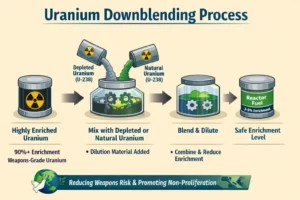
Downblending
- Reverse of enrichment: mixing HEU with depleted or natural uranium to reduce U235 concentration below 5%.
- Extends breakout time: the time needed to reenrich uranium for weapons.
- Example: The 2015 JCPOA capped enrichment at 3.67%, sufficient for reactors but not weapons.
Limitations of Downblending
- Monitoring gaps: Iran withdrew from IAEA protocols in 2018, causing a “loss of continuity of knowledge.”
- Technical capacity: Iran retains centrifuge technology and expertise to reenrich uranium.
- Stockpile remains domestic: MoU does not mandate transfer abroad; uranium stays in Iran.
- Trust deficit: Implementation depends on diplomatic assurances as much as technical safeguards.
Broader Implications
- Downblending reduces immediate risk but cannot erase Iran’s latent capability.
- Verification challenges highlight fragility of global nonproliferation regimes.
- For India, the deal underscores importance of IAEA safeguards, multilateral diplomacy, and vigilance against nuclear breakout risks.
- Example: India’s own nuclear programme remains under IAEA safeguards at Tarapur and Kudankulam, showing how international monitoring builds trust.
Conclusion
Downblending buys time, but lasting peace depends on trust, transparency, and sustained international oversight.
INDIA’S CHEAPEST POWER AND THE GRID EFFICIENCY
TOPIC: (GS3) ECONOMY: THE HINDU
India added 45 GW of solar and wind in 2025, equalling the US, making renewables the cheapest power source (~₹3.5/kWh). Yet, over 50 GW of clean energy capacity is stranded due to transmission delays, highlighting grid bottlenecks as the biggest barrier to India’s energy transition.
Current Status of Renewables
- Installed renewable capacity: ~250 GW.
- Under construction: ~100 GW.
- Target: ~2,000 GW by 2050 to meet rising demand and electrify industry/transport.
- Transmission mismatch: Renewable plants ready in 12–18 months, but grid lines take 3–5 years.
- India plans a 40% grid expansion in the next decade, costing $100+ billion (CEA).
Unlocking Clean Energy Superhighways
- Storage at Renewable Plants
- Transmission lines used only 25% of the time.
- Adding batteries can triple utilisation, enabling ~400 GW extra clean energy.
- Example: Gujarat’s solar parks piloting battery storage integration.
- Coal Corridors for Renewables
- India has 100 GW of old coal plants with underused transmission lines.
- Colocating solar/wind near coal plants allows dual use of corridors.
- Potential: ~100 GW clean energy.
- Example: NTPC exploring solarcoal hybrid corridors.
- Using Existing Substations
- Many substations can host new renewable connections.
- Coupled with batteries, they support peak demand supply.
- Potential: ~100 GW additional clean energy.
- Example: Rajasthan substations already integrating solarplusstorage projects.
- Modern Conductors
- Old wires sag under heat, limiting flow.
- Replacing with hightemperature, lowsag conductors can double transfer capacity.
- Reconductoring + storage can raise total potential to ~1,000 GW within existing corridors.
- Example: Power Grid Corporation piloting HTLS conductors in Delhi region.
Way Forward
- Regulatory push: CERC mandates solarplusstorage; states must adopt.
- Procurement norms: Reward advanced transmission technologies that cost slightly more but deliver lifetime efficiency gains.
- Renewable energy zones: Coordinated planning of zones and corridors to avoid delays.
- Industrial demand: Steel, aluminium, cement, and data centres need 24×7 reliable clean power at predictable prices.
Conclusion
India’s cheapest power is ready, but only a smart, futureproofed grid can unlock its full potential and drive the next phase of growth.
MOVING FROM DRONE PURCHASES TO DRONE PARTNERSHIPS
TOPIC: (GS3) SCIENCE AND TECHNOLOGY: THE HINDU
India has announced a $2 billion procurement plan for drones from domestic manufacturers.
Economics of Drones
- Cost advantage: Micro/nano drones cost $500–$2,000 each, compared to UCAVs like MQ9B Reaper (~$30 million/unit) or Bayraktar TB2 (~$5 million/unit).
- Global examples:
- Ukraine used FPV drones retrofitted with warheads costing ~$500, destroying tanks worth millions of dollars.
- Iran deployed swarms of cheap drones against US and Israeli assets, showing costeffective asymmetric warfare.
- Asymmetry in cost: Shooting down a drone often costs 10–20 times more than the drone itself (e.g., a $1 million missile vs. a $50,000 drone).
- Civil–military link: Civilian drones (quadcopters, FPV racing drones) are quickly adapted for battlefield use.
- China’s model: Strong collaboration between industry, academia, and military has made China the largest drone exporter globally, with DJI dominating commercial markets.
Challenge
- Rapid obsolescence: Tactical drones can become outdated in 2–3 years, unlike tanks/jets that last decades.
- Electronic warfare (EW): Enemy jammers adapt in 6–8 weeks to new drone signals.
- Ukraine’s innovation: Engineers replaced radio links with fiberoptic cables, bypassing EW threats.
- Indian frameworks:
- Defence Acquisition Procedure (DAP 2020): Allows purchase of commercialofftheshelf (COTS) drones.
- Defence Procurement Manual (DPM): Provides financial buffers for upgrades and repairs.
- Gap: Procurement remains transactional, assuming onetime purchase suffices, while drones need continuous iteration and upgrades.
Partnerships, Not Transactions
- Managed service model: Similar to IT contracts where hardware comes with maintenance, updates, and replacements.
- Advantages:
- Predictable demand for industry → stabilises domestic drone sector.
- Assured supply and upgrade pathways for armed forces.
- Surge capacity during conflicts.
- Continuous improvements against evolving EW threats.
- Policy direction: India’s drone industry has the technical base; structural changes in procurement can foster longterm collaboration.
- Example: The US Department of Defense uses longterm service contracts with drone makers to ensure adaptability and sustained capability.
Strategic Implications for India
- Strengthens Atmanirbhar Bharat in defence manufacturing.
- Supports dualuse innovation (civil + military applications).
- Provides scalable solutions for border surveillance, logistics, and combat support.
- Aligns with India’s Defence Production and Export Promotion Policy (DPEPP 2020), which targets $25 billion defence production and $5 billion exports by 2025.
- Enhances India’s ability to respond to emerging asymmetric threats, especially along contested borders.
Conclusion
India’s $2 billion drone push must evolve into sustained partnerships, ensuring drones remain relevant in fastchanging battlefields and strengthening longterm defence resilience.
EU PASSES LAW ALLOWING OFFSHORE DEPORTATION CENTRES
TOPIC: (GS2) INTERNATIONAL RELATIONS: THE HINDU
On June 17, 2026, the European Parliament passed the Return Regulation. The law permits EU states to set up offshore deportation centres (“return hubs”) in nonEU countries, sparking debate over human rights and migration policy.
What Is Deportation?
- Legal Definition: Deportation is the forced removal of foreign nationals from a country when they have violated immigration laws or pose a security threat. It is carried out by state authorities under legal frameworks.
- Grounds for Deportation:
- Entering or staying without valid documents/visa.
- Criminal offences or activities threatening national security.
- Overstaying visas or failing asylum claims.
- Example: In the EU, the Return Regulation (2026) allows deportation of irregular migrants to thirdparty countries.
- Process:
- Authorities issue a deportation order after due legal procedure.
- Migrants may be detained until removal is possible.
- International law requires respect for human rights and nonrefoulement (no sending back to unsafe countries).
Provisions of the Return Regulation
- Deportation to third countries: Irregular migrants denied stay in the EU can be sent to nonEU nations through bilateral agreements.
- Conditions: Agreements only with countries that uphold human rights, international law, and nonrefoulement.
- Detention rules: Maximum detention period raised from 6 months to 2 years. Unlimited detention allowed for those posing security risks.
- Exemptions: Only unaccompanied minors are exempt; families with children can still be deported.
- Punitive measures: Entry bans, fines, and criminal sanctions for noncooperation.
- Search powers: Authorities can search residences of irregular migrants, drawing comparisons with US ICE practices.
Rationale Behind the Law
- Low return rates: Only 28% of migrants ordered to leave are actually returned (Eurostat).
- Political pressure: Rising antiimmigrant sentiment has fuelled farright parties across Europe.
- Support base: Backed by centreright EPP, rightwing Conservatives and Reformists, and farright Patriots for Europe.
- Commission’s stance: Ursula von der Leyen called it “fair and firm,” promising stronger borders and solidarity among member states.
Link to EU Migration Pact
- The EU Pact on Migration and Asylum (2024), effective June 12, 2026, introduced 10 binding legislations.
- Key reforms: Mandatory border screening. Creation of an EU asylum and migration database.
- Asylum trends: 6 lakh applications in 2025, down 27% from 2024.
Comparative Models
- UK (Rishi Sunak govt): Proposed deportations to Rwanda, later scrapped by Keir Starmer.
- Italy (Meloni govt): Set up centres in Albania, but courts blocked deportations citing unsafe conditions.
- Denmark, Germany, Netherlands, Greece: Exploring similar offshore agreements postReturn Regulation.
Criticism and Concerns
- Human Rights Violations: Rights groups like Human Rights Watch argue the law shows “little regard for safety, dignity, and rights”, undermining the EU’s commitment to humanitarian values.
- Risk of Normalising Questionable Practices: The Socialists & Democrats group in EU Parliament warned that the regulation could legitimise practices that were previously considered legally unacceptable, eroding EU’s moral authority.
- Threat to Fundamental Values: Leaders such as Ana Catarina Mendes cautioned that the law undermines the EU’s core principles of human rights, solidarity, and nonrefoulement, which are central to its treaties.
- Concerns over Migrant Welfare in Return Hubs: Critics highlight that deportation centres in third countries may expose migrants to unsafe conditions, indefinite detention, and weak oversight, raising doubts about compliance with international law.
Conclusion
The Return Regulation reflects Europe’s toughest migration stance yet, but balancing border security with human rights will define its credibility in the years ahead.
SMART SEED COATING TECHNOLOGY
TOPIC: (GS3) ECONOMY: THE HINDU
The Indian Council of Agricultural Research – Indian Institute of Oilseeds Research (ICARIIOR), Hyderabad has recently developed a Smart Seed Coating Technology, aimed at improving crop establishment and resilience, especially in rainfed farming systems.
Seed Coating Technology
- Developed by ICARIIOR, Hyderabad.
- Based on biodegradable biopolymers that form a multifunctional protective layer around seeds.
- Designed as a delivery platform for nutrients, beneficial microbes, and cropprotection agents directly at the seedsoil interface.
Key Features
- Multifunctional Layer: Provides protection and acts as a carrier for inputs.
- Improved Germination: Creates a favourable microenvironment for faster sprouting and stronger seedlings.
- Stress Tolerance: Enhances resilience against biotic stresses (pests, diseases) and abiotic stresses (drought, heat, poor soils).
- Crop Versatility: Applicable to cereals, pulses, millets, vegetables, and horticultural crops.
- Rainfed Suitability: Particularly effective in rainfed agriculture, which covers ~55% of India’s net sown area (Agriculture Census).
Significance
- Climate Resilience: Supports adaptation to erratic rainfall and rising temperatures.
- Sustainable Agriculture: Aligns with national priorities under National Mission on Sustainable Agriculture (NMSA).
- Resource Efficiency: Reduces wastage of inputs by targeted delivery at the seed level.
- Seed System Strengthening: Improves seed quality and performance, critical for doubling farmers’ income and achieving SDG2 (Zero Hunger).
- Example: Similar seed enhancement technologies are being promoted under Pradhan Mantri Krishi Sinchayee Yojana (PMKSY) and ICAR seed hubs for pulses.
Conclusion
Smart Seed Coating Technology is a gamechanger for rainfed farming, combining science and sustainability to boost productivity and resilience.
STRAIT OF MESSINA
TOPIC: (GS1) GEOGRAPHY: THE HINDU
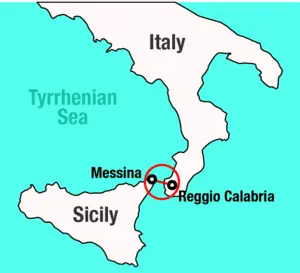
Japan’s Prime Minister recently highlighted bilateral cooperation with Italy in the ambitious plan to construct a bridge across the Strait of Messina, linking mainland Italy with Sicily.
Geographical position
- A narrow strait in southern Italy, part of the Mediterranean Sea.
- Separates mainland Italy (Calabria) from the island of Sicily.
- Named after the city of Messina, located on Sicily’s northeastern tip.
- Length: ~32 km; Narrowest width: 3.1 km.
- Depth: Average 90 m, deepest point 250 m.
- Connects the Tyrrhenian Sea (north) with the Ionian Sea (south).
Physical and Ecological Features
- Known for strong currents, whirlpools, and tidal flows.
- In antiquity, feared by sailors due to Scylla and Charybdis (mythical sea monsters).
- Unique marine ecosystem supported by:
- Alternating currents.
- High phosphorus and nitrogen levels.
- Low water temperature.
- Serves as a migratory route for fish species entering the Mediterranean.
- Important for bird migration, with several species crossing annually to breeding grounds in Europe.
Strategic and Economic Significance
- Proposed bridge project aims to improve connectivity between Sicily and mainland Italy.
- Expected to boost trade, tourism, and regional development.
- Reduces reliance on ferries, cutting travel time and improving logistics.
- Example: Similar large infrastructure projects like the Oresund Bridge (Denmark–Sweden) have transformed regional economies.
Conclusion
The Strait of Messina is both a geographical marvel and strategic corridor, and the proposed bridge could reshape connectivity and economic growth in southern Italy.

NATIONAL INTERNET EXCHANGE OF INDIA (NIXI)
TOPIC: (GS3) SCIENCE AND TECHNOLOGY: THE HINDU
The National Internet Exchange of India (NIXI) celebrated its 23rd Foundation Day on June 19, marking over two decades of contribution to India’s digital infrastructure and internet expansion.
About NIXI
- Nature: A notforprofit organization under the Ministry of Electronics and Information Technology (MeitY).
- Legal Status: Established under Section 8 of the Companies Act, 2013.
- Objective: To promote internet penetration and strengthen India’s digital ecosystem.
- Core Role: Facilitates exchange of domestic internet traffic among Internet Service Providers (ISPs), content players, and organizations with their own Autonomous System (AS) numbers.
Key Functions
- Internet Exchange Services: Operates 79 Internet Exchange Points (IXPs) across India for efficient domestic traffic routing.
- Domain Management: Manages India’s countrycode toplevel domains (.IN and .भारत), supporting domain names in 22 Indian languages.
- IP Address Allocation: Delegates IPv4 and IPv6 addresses through the Indian Registry for Internet Names and Numbers (IRINN).
- Digital Inclusion: Enhances internet accessibility and affordability, aligning with Digital India and BharatNet initiatives.
- Cyber Resilience: Supports a secure and robust internet ecosystem, reducing dependency on foreign routing networks.
Significance
- Strengthens national internet sovereignty and data localization.
- Promotes regional language internet adoption, aiding digital inclusion.
- Contributes to India’s vision of a selfreliant digital economy under Digital India 2.0.
- Example: NIXI’s multilingual domain initiative helps small businesses and rural users access the web in native scripts.
Conclusion
NIXI stands as a pillar of India’s digital infrastructure, enabling secure, inclusive, and localized internet growth across the nation.