Table of Contents
ToggleMosquito-Borne Diseases – Types, Risks, and Government Initiatives in India
Mosquito-borne diseases are no longer just seasonal health worries; they have turned into complex environmental crises driven by rapid urbanization, ecological shifts, and global warming.
Mosquito-Borne Diseases
Mosquito-borne diseases are infectious conditions transmitted to humans through the bites of infected female mosquitoes. Functioning as biological vectors, these mosquitoes do not cause the illnesses themselves; instead, they carry and transmit pathogenic microorganisms—such as viruses, parasites, and worms—from one host to another. These mosquito-borne infections cause significant global morbidity and place a heavy economic burden on developing tropical nations.
Types of Disease-Transmitting Mosquitoes
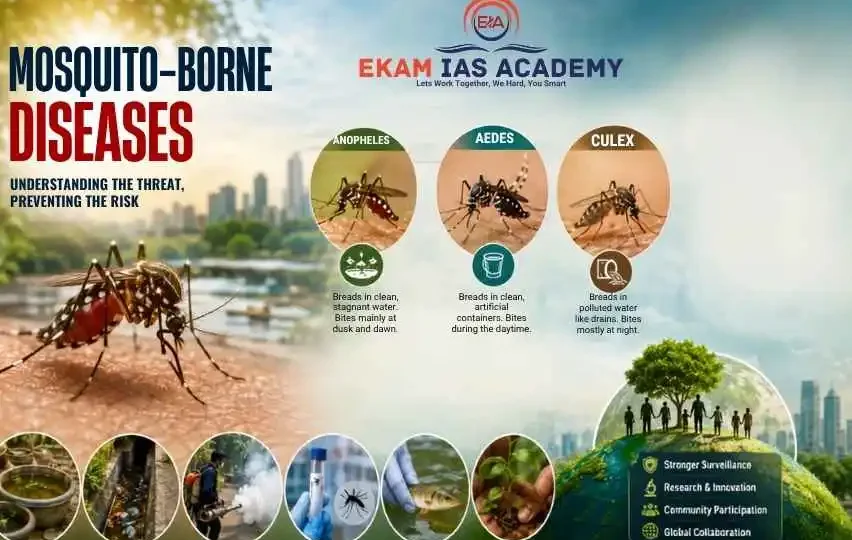
Understanding the specific vectors is essential for tackling vector-borne diseases in India. The three primary genera of mosquitoes responsible for transmitting major human pathogens are:
- Anopheles: Best known for transmitting the plasmodium parasite. They typically breed in clean, stagnant water bodies and bite predominantly between dusk and dawn.
- Aedes: Recognizable by the distinct black and white stripes on their legs. They are daytime biters that breed primarily in clean, artificial water containers found in and around urban households.
- Culex: These mosquitoes thrive in highly polluted water, such as open sewage drains. They are major vectors for neurological and lymphatic infections.
Major Mosquito-Borne Diseases
The global epidemiology of mosquito-borne diseases includes several high-risk infections, each presenting unique public health challenges:
| Pathogen Group | Disease(s) |
|---|---|
| Parasitic Protozoa | • Malaria (Anopheles) |
| Arboviruses – Flavivirus | • Dengue Fever (Aedes) , Zika Virus (Aedes), Japanese Encephalitis (Culex) |
| Nematode Roundworms | • Lymphatic Filariasis (Culex / Anopheles) |
- Malaria: Caused by the Plasmodium parasite and transmitted by female Anopheles mosquitoes. It triggers high-grade remittent fevers, severe anemia, and acute splenomegaly.
- Dengue Fever: A widespread arboviral infection transmitted by the Aedes aegypti mosquito. It causes a sharp drop in blood platelets and severe joint pain, earning it the common name “breakbone fever.”
- Chikungunya: An RNA virus belonging to the Togaviridae family, transmitted by Aedes mosquitoes. It is characterized by severe, debilitating, and often chronic joint pain (arthralgia).
- Zika Virus: Transmitted primarily by Aedes mosquitoes. It poses a severe risk to pregnant women as it can cause congenital microcephaly and neurological complications like Guillain-Barré syndrome in newborns.
- Japanese Encephalitis: A flavivirus transmitted by Culex mosquitoes, heavily linked to flooded paddy fields. It attacks the central nervous system, leading to acute encephalitis and high mortality rates among children.
- Lymphatic Filariasis: Commonly known as Elephantiasis, this infection is caused by filarial worms (Wuchereria bancrofti) and transmitted by Culex and Anopheles mosquitoes. It causes severe, permanent swelling in limbs and lymphatic tissues.
Causes for the Rising Incidence
The rapid spread of vector-borne diseases is deeply tied to modern environmental degradation and climate shifts:
- The Climate Change Accentuation: Rising global temperatures and erratic monsoon patterns extend the active breeding seasons of mosquitoes. Warmer ambient temperatures also accelerate the replication rate of viruses inside the mosquito vector.
- Unplanned Rapid Urbanization: Inadequate solid waste management and poor drainage networks create endless artificial breeding grounds. Intermittent water supplies also force citizens to store water in open containers, inadvertently inviting Aedes breeding.
- Vector Resistance: Decades of intensive chemical spraying have led mosquitoes to develop metabolic and behavioral resistance to common synthetic pyrethroids and DDT, rendering traditional chemical mosquito control less effective.
Mosquito-Borne Diseases in India & Government Initiatives
India experiences a heavy structural burden from mosquito-borne diseases in India. In response, the Ministry of Health and Family Welfare coordinates several focused domestic programs:
National Vector Borne Disease Control Programme (NVBDCP): The overarching nodal agency responsible for formulating technical guidelines, distributing insecticide-treated bed nets (ITNs), and managing outbreaks of malaria, dengue, and kala-azar.
National Framework for Malaria Elimination (NFME): Aligned with global milestones, this strategy aims to eliminate malaria across all districts in India, shifting the country from reactive treatment to zero indigenous transmission.
Mera India (Malaria Elimination Research Alliance): A specialized research coalition established by the Indian Council of Medical Research (ICMR) to drive bench-to-field innovations in vector diagnostics and genomic surveillance.
Global Initiatives & Integrated Prevention Measures
On the international stage, the World Health Organization (WHO) drives the Global Vector Control Response (GVCR), a framework that encourages nations to upgrade local health systems through Integrated Vector Management (IVM).
Advanced Prevention and Control Measures:
- Biological Control: Deploying larvivorous fish like Gambusia affinis in ornamental ponds and open wells to consume mosquito larvae naturally.
- Genetic Control Technologies: Introducing sterile male mosquitoes or utilizing the Wolbachia bacteria method, which stops viruses from replicating inside the Aedes host.
- Immunization Progress: Scaling up the use of breakthrough vaccines, such as the RTS,S/AS01 and R21/Matrix-M malaria vaccines, to safeguard vulnerable pediatric populations in high-transmission zones.
Conclusion
Tackling the threat of mosquito-borne diseases requires moving away from emergency chemical spraying toward long-term, climate-resilient environmental management. Because vectors adapt rapidly to changing ecosystems, countries must strengthen real-time bio-surveillance, invest in genomic research, and promote community-led sanitation efforts. For India, combining advanced biomedical tools like new vaccines with localized urban planning will be essential to protect public health and ease the burden of vector-borne infections.
UPSC Prelims: PYQs & Practice Questions
Previous Year Questions (Prelims)
Q: Consider the following statements: (UPSC CSE Prelims 2017)
1. In tropical regions, Zika virus disease is transmitted by the same mosquito that transmits dengue.
2. Sexual transmission of Zika virus disease is possible.
Which of the statements given above is/are correct?
(a) 1 only
(b) 2 only
(c) Both 1 and 2
(d) Neither 1 nor 2
Answer: (c) Both 1 and 2
Explanation:
Both statements are correct. The Zika virus is primarily transmitted by the Aedes aegypti mosquito, which is the same biological vector responsible for spreading dengue and chikungunya in tropical regions. Additionally, medical evidence confirms that Zika can also be transmitted from person to person through sexual contact.
Q: Which of the following diseases are transmitted from one person to another through the bite of Aedes mosquitoes? (UPSC CSE Prelims 2014)
1. Chikungunya
2. Dengue
3. Malaria
Select the correct answer using the code given below:
(a) 1 and 2 only
(b) 2 and 3 only
(c) 1 and 3 only
(d) 1, 2 and 3
Answer: (a) 1 and 2 only
Explanation:
Chikungunya and Dengue are viral infections transmitted to humans through the bites of infected Aedes mosquitoes, mainly Aedes aegypti. Malaria, however, is caused by Plasmodium parasites and is transmitted by infected female Anopheles mosquitoes, not Aedes mosquitoes.
Practice Questions
Q: With reference to advanced biological innovations in Mosquito Control, consider the following statements regarding the Wolbachia Method:
1. It involves infecting mosquitoes with a naturally occurring bacterium that restricts viruses like dengue from replicating effectively inside the insect.
2. Wolbachia-infected mosquitoes are genetically modified organisms developed through recombinant DNA and CRISPR technologies.
Which of the statements given above is/are correct?
(a) 1 only
(b) 2 only
(c) Both 1 and 2
(d) Neither 1 nor 2
Answer: (a) 1 only
Explanation:
Statement 1 is correct. Wolbachia is a naturally occurring bacterium found in many insect species. When introduced into Aedes aegypti mosquitoes, it limits the replication of arboviruses such as dengue, thereby reducing transmission. Statement 2 is incorrect because the Wolbachia method does not alter the mosquito's genes. It introduces a natural symbiotic bacterium, making it a biocontrol strategy rather than a GMO technique.
Q: In the context of public health administration in India, the National Vector Borne Disease Control Programme acts as the nodal implementation framework for preventing which combination of diseases?
(a) Malaria, Dengue, Chikungunya, Japanese Encephalitis, Kala-azar, and Lymphatic Filariasis
(b) Tuberculosis, Malaria, Dengue, Cholera, and Typhoid
(c) Zika Virus, Ebola, Swine Flu, and Japanese Encephalitis
(d) Malaria, Kala-azar, Scrub Typhus, and Leptospirosis
Answer: (a) Malaria, Dengue, Chikungunya, Japanese Encephalitis, Kala-azar, and Lymphatic Filariasis
Explanation:
The NVBDCP is a centrally sponsored programme under India's National Health Mission, Ministry of Health and Family Welfare. It focuses on six major vector-borne diseases: Malaria, Dengue, Chikungunya, Japanese Encephalitis, Kala-azar, and Lymphatic Filariasis. Water-borne diseases like cholera and bacterial diseases like tuberculosis do not fall under its vector-borne disease mandate.
UPSC Mains – Previous Year & Practice Questions
Mains Previous Year Questions
Mains 2022
Question: Discuss the various third-generation multi-sectoral strategies required to completely eliminate Malaria from tribal and high-burden pockets of India.
Directly correlates to the National Framework for Malaria Elimination.
Mains 2019
Question: How is global warming turning seasonal vector-borne diseases into perennial public health threats across urban microclimates? Analyze with specific reference to India.
Mains 2017
Question: Give an account of the growth and development of nuclear science and technology in India. How has it been applied to field-level insect pest and mosquito population controls?
Allows for references to Sterile Insect Technique.
Mains 2015
Question: Vector-borne disease research in India has remained stagnant for decades owing to administrative apathy and lack of proper policies. In light of this statement, examine why reviving research in vector-borne diseases is important for a country like India.
Mains 2013
Question: Analyze the linkages between poor municipal solid waste management in expanding smart cities and the cyclical outbreaks of dengue fever during post-monsoon phases.
Mains Practice Questions
[15 Marks | 250 Words]
Question: Global climate change acts as an environmental threat multiplier by altering the geographic range, reproductive speed, and seasonal timelines of mosquito vectors. Elaborate on this statement with reference to the rising incidence of Vector-Borne Diseases in India.
[10 Marks | 150 Words]
Question: The deployment of the RTS,S and R21/Matrix-M vaccines marks a watershed moment in the global battle against Malaria. Evaluate the operational and logistical challenges India faces in scaling up vector immunizations across its complex rural landscape.
[15 Marks | 250 Words]
Question: Traditional chemical interventions like DDT and synthetic pyrethroids are facing diminishing returns due to vector mutations and metabolic resistance. Argue the case for a shift toward an Integrated Vector Management paradigm in urban smart city designs.



Mosquito-Borne Diseases-FAQs
What are mosquito-borne diseases?
Mosquito-borne diseases are infections transmitted to humans through the bite of infected female mosquitoes carrying viruses, parasites or worms.
What are the major mosquito-borne diseases in India?
Major mosquito-borne diseases in India include malaria, dengue, chikungunya, Japanese encephalitis, Zika virus and lymphatic filariasis.
Which mosquitoes spread malaria, dengue and filariasis?
Anopheles mosquitoes spread malaria, Aedes mosquitoes spread dengue, chikungunya and Zika, while Culex mosquitoes spread Japanese encephalitis and lymphatic filariasis.
Why are mosquito-borne diseases increasing?
They are increasing due to climate change, rising temperatures, erratic monsoons, urban water stagnation, poor drainage, open water storage and insecticide resistance.
Why are mosquito-borne diseases important for UPSC?
They are important for UPSC because they connect with public health, climate change, vector-borne diseases, urbanization, NVBDCP, malaria elimination, disease surveillance and disaster preparedness.