

Table of Contents
ToggleThe Right to a Fair Trial at the Crossroads
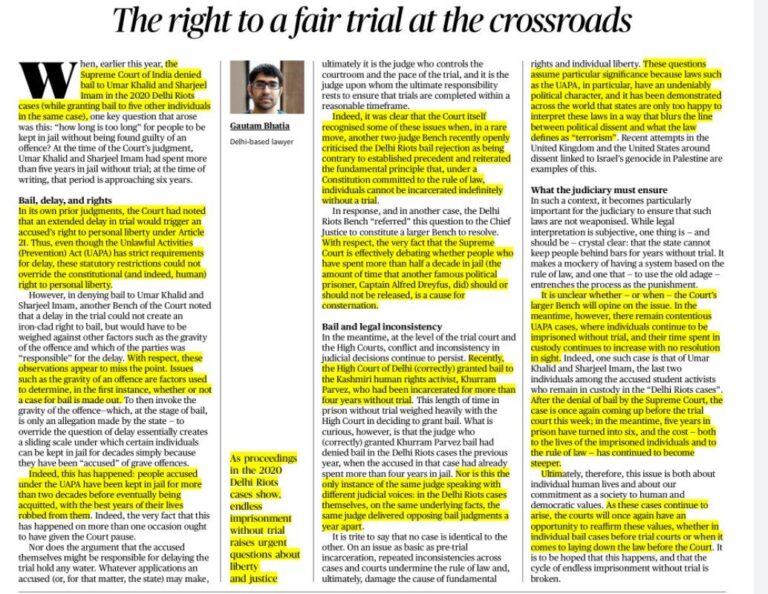
The right to a fair trial is one of the most important principles of Indian constitutional democracy. It is closely connected with Article 21, which protects life and personal liberty. The debate has gained renewed importance after the Supreme Court denied bail to Umar Khalid and Sharjeel Imam in the 2020 Delhi Riots case, while questions continue over long imprisonment without trial under laws like the UAPA. The Supreme Court Observer records that their bail was denied on January 5, 2026, while some co-accused were granted bail.
Why Fair Trial Matters
A fair trial ensures that no person is punished before being proven guilty. In criminal justice, the accused is presumed innocent until conviction. However, when people remain in prison for years without trial, the process itself begins to look like punishment.
This becomes more serious under special laws such as the Unlawful Activities Prevention Act, where bail conditions are strict and trials often take a long time. The question is simple but important: how long can a person remain in jail before guilt is legally established?
Bail, Delay and Article 21
Liberty vs Security
Courts must balance individual liberty with national security. But constitutional courts have repeatedly held that excessive delay in trial can violate Article 21. The concern is not only about one case, but about the credibility of the justice system.
Judicial Responsibility
The pace of trial is controlled by the court, not by the accused alone. Therefore, if the trial is delayed for years, continued imprisonment raises serious constitutional concerns.
UAPA and Legal Inconsistency
Need for Clear Judicial Standards
Recent bail decisions in UAPA cases show inconsistency. In some cases, prolonged incarceration has been treated as a ground for bail, while in others it has not. This creates uncertainty and weakens trust in judicial protection of liberty.
Importance for Democracy
Fair trial is not only a legal issue; it is also a democratic value. If people can be imprisoned endlessly without trial, the rule of law becomes fragile.
Conclusion
The right to a fair trial in India must remain central to constitutional justice. Courts must ensure that strict laws are not used in a way that converts pre-trial custody into punishment. For UPSC aspirants, this topic is important under Polity, Article 21, criminal justice reforms, UAPA, judicial accountability, and human rights.
Vocabulary Boost
• Pre-trial Detention → Imprisonment before completion of trial.
• Personal Liberty → Freedom protected under Article 21.
• Process as Punishment → Suffering caused by prolonged legal proceedings.
• Judicial Consistency → Uniform application of legal principles.
• Rule of Law → Governance according to established law.
Frequently Asked Questions (FAQs)
What is the right to a fair trial?
The right to a fair trial means every accused person must get a timely, impartial, and lawful trial before being punished.
Which Article protects fair trial in India?
The right to fair trial is protected under Article 21, which guarantees life and personal liberty.
Why is delay in trial a serious issue?
Long delay can turn imprisonment before conviction into punishment, violating personal liberty and rule of law.
What is the concern with UAPA cases?
UAPA has strict bail provisions, so accused persons may remain in jail for years even before guilt is proven.
Why is this topic important for UPSC?
It is important for UPSC Polity because it covers Article 21, criminal justice, bail, UAPA, human rights, and judicial accountability.
Source From : The Hindu
Air Pollution Plan Needs Political Will, Not Election-Cycle Thinking
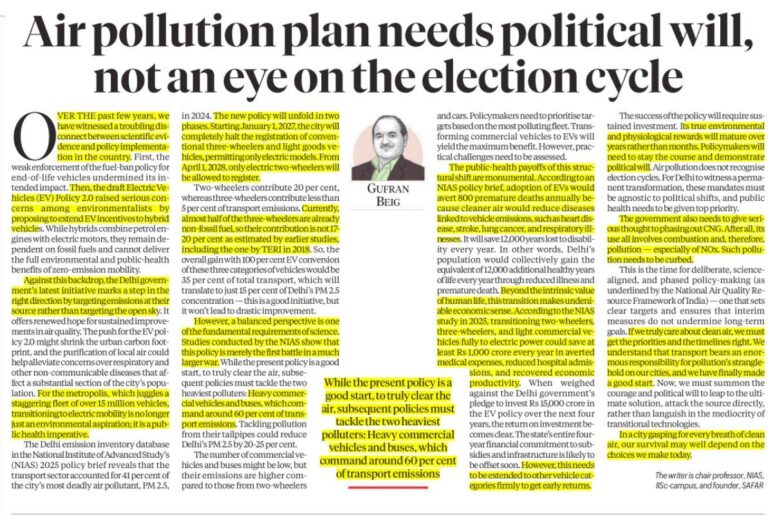
Delhi’s battle against air pollution requires long-term political will, scientific planning, and consistent implementation. The recent draft Electric Vehicles Policy 2.0 aims to reduce vehicular emissions by pushing the city towards cleaner mobility. However, the article argues that policy success depends not merely on announcing ambitious targets, but on tackling the biggest sources of pollution with seriousness.
Why Delhi Needs Strong Air Pollution Control
Delhi suffers from severe air pollution every year, especially during winter. Vehicular emissions are one of the major contributors to PM2.5 pollution, nitrogen oxides, and respiratory diseases. Poor air quality increases the risk of asthma, lung cancer, heart disease, stroke, and premature deaths.
A clean air policy must therefore focus on public health, not political convenience.
Delhi EV Policy 2.0: Key Focus
Shift Towards Electric Vehicles
The draft policy proposes a phased transition towards electric mobility. It gives importance to electric two-wheelers, three-wheelers, and light goods vehicles. The aim is to reduce dependence on petrol and diesel vehicles and promote zero-emission transport.
Need to Target Bigger Polluters
The article highlights that two-wheelers and three-wheelers alone cannot solve Delhi’s pollution crisis. Heavy commercial vehicles and buses contribute a major share of transport emissions. Therefore, the policy must give priority to electrifying buses, trucks, and commercial fleets.
Public Health and Economic Benefits
Cleaner Air, Healthier Citizens
Reducing vehicular emissions can save thousands of lives and reduce disease burden. Cleaner air means fewer hospital admissions, lower healthcare costs, and improved productivity.
Long-Term Investment
EV transition needs charging infrastructure, financial incentives, fleet conversion, and strong enforcement. The benefits may take years, but they are essential for Delhi’s future.
Political Will Is the Key
Beyond Election Cycles
Air pollution does not follow election timelines. Governments must avoid short-term announcements and focus on sustained implementation. Policies must be science-based, transparent, and regularly monitored.
Conclusion
Delhi’s air pollution control plan must move beyond symbolic steps. A successful strategy requires targeting the largest polluters, phasing out dirty fuels, strengthening public transport, and investing in clean mobility. For UPSC aspirants, this topic is important under environment, public health, urban governance, electric vehicles, and sustainable development.
Vocabulary Boost
• Source-Based Regulation → Controlling pollution at its origin.
• Electric Mobility → Transport powered by electricity.
• Emission Inventory → Database of pollution sources and emissions.
• PM2.5 → Fine particulate matter smaller than 2.5 micrometres.
• Policy Continuity → Sustaining policies across political cycles.
Frequently Asked Questions (FAQs)
Why does Delhi need a strong air pollution plan?
Delhi needs a strong air pollution plan to reduce PM2.5, vehicular emissions, respiratory diseases, and premature deaths.
What is the aim of Delhi EV Policy 2.0?
The aim is to promote electric vehicles, reduce petrol and diesel dependence, and improve urban air quality.
Why are commercial vehicles important in pollution control?
Commercial vehicles and buses contribute a large share of transport emissions, so electrifying them can bring bigger air quality benefits.
Why is political will important for clean air?
Air pollution requires long-term action, strict enforcement, and sustained investment beyond election-cycle promises.
Why is this topic important for UPSC?
It is important for UPSC because it links environment, public health, urban governance, EV policy, and sustainable development.