Table of Contents
ToggleIndia economic prospects West Asian crisis
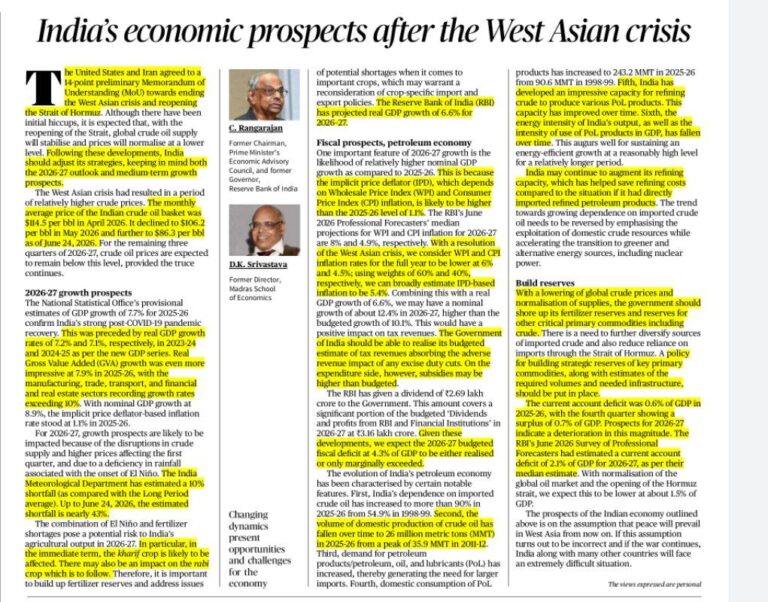
The easing of the West Asian crisis after the United States and Iran agreed to a preliminary understanding has brought relief to the global economy. The reopening of the Strait of Hormuz, one of the world’s most important oil transit routes, has reduced immediate fears of a crude oil supply shock. For India, which depends heavily on imported crude oil, this development has important implications for GDP growth, inflation, fiscal stability and external trade.
Impact of Falling Crude Oil Prices on India
Relief for Inflation and Growth
The West Asian crisis had pushed average crude oil prices sharply higher in early 2026. However, with tensions easing, crude prices are expected to remain more stable if the truce continues. Lower crude oil prices can help India reduce inflationary pressure, especially in fuel, transport and essential commodities.
This is important because India’s growth outlook for 2026-27 depends partly on stable energy prices. A decline in crude prices can support private consumption, reduce production costs and improve overall economic sentiment.
India’s 2026-27 Growth Prospects
GDP Growth Outlook
India’s economy has shown strong momentum in recent years, with high growth in manufacturing, trade, transport and financial services. The RBI has projected real GDP growth of 6.6% for 2026-27, while lower oil prices may improve fiscal space and support higher nominal growth.
However, risks remain. A possible rainfall deficiency linked to El Niño, fertilizer shortages and disruptions in agriculture could affect kharif output. This makes food inflation and rural demand key areas to watch.
Petroleum Economy and External Balance
Refining Capacity and Energy Dependence
India has expanded its petroleum refining capacity significantly over the decades. This helps the country process imported crude and export petroleum products. However, dependence on imported crude oil continues to remain a strategic vulnerability.
Fiscal and Current Account Impact
Lower crude prices can reduce India’s import bill, improve the current account deficit, and ease pressure on the rupee. It can also support government finances by reducing subsidy pressures and creating room for investment.
Need for Strategic Reserves
India should use the period of lower crude prices to build strategic reserves of oil, fertilizers and other critical commodities. This will strengthen economic resilience against future geopolitical shocks.
Conclusion
India’s economic prospects after the West Asian crisis appear cautiously positive. Stable crude prices can support growth, reduce inflation and improve external balances. However, India must focus on energy security, agricultural preparedness and strategic reserves. For UPSC aspirants, this topic is important under economy, energy security, inflation, external sector and geopolitics.
Vocabulary Boost
• Strategic Petroleum Reserve (SPR) → Emergency crude oil storage.
• Current Account Deficit (CAD) → Excess of imports over exports.
• Implicit Price Deflator (IPD) → Broad measure of economy-wide inflation.
• Energy Security → Reliable and affordable energy supply.
• Refining Capacity → Ability to process crude oil into petroleum products.
India economic prospects West Asian crisis-FAQs Answered
How does the West Asian crisis affect India’s economy?
It affects India mainly through crude oil prices, import bills, inflation, fiscal deficit and the current account balance.
Why is the Strait of Hormuz important for India?
The Strait of Hormuz is a key oil transit route, and any disruption can raise crude prices and impact India’s energy security.
How do lower crude oil prices benefit India?
Lower crude prices reduce inflationary pressure, lower the import bill, improve fiscal space and support economic growth.
What are the major risks to India’s 2026-27 growth outlook?
Key risks include crude oil volatility, El Niño-related rainfall deficiency, fertilizer shortages, food inflation and geopolitical uncertainty.
Why should India build strategic reserves?
Strategic reserves of oil, fertilizers and critical commodities can protect India from future supply shocks and global price volatility.
Source From : The Hindu
For the Indo-Pacific, a ‘G Minus 2’ Strategy
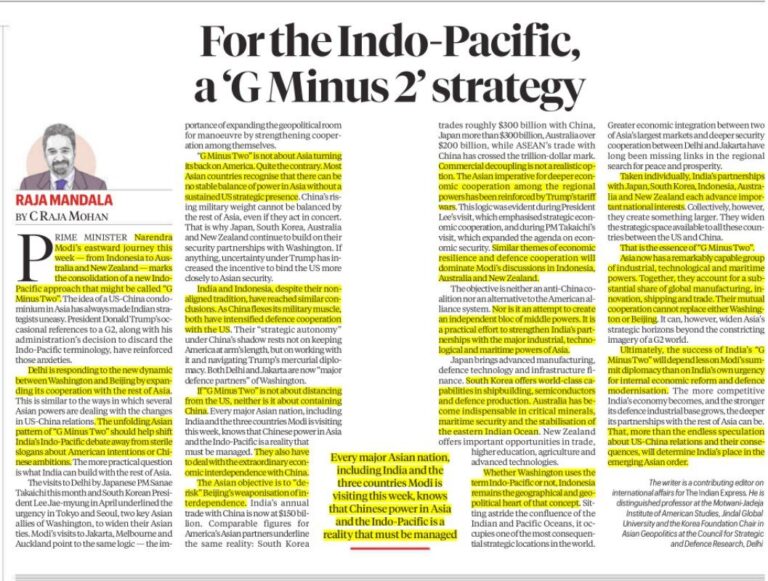
The idea of a ‘G Minus 2’ strategy for the Indo-Pacific highlights India’s need to strengthen cooperation with Asian middle powers without making the region entirely dependent on either the United States or China. Prime Minister Narendra Modi’s outreach to countries such as Indonesia, Australia and New Zealand reflects India’s growing focus on building a wider Indo-Pacific partnership based on strategic autonomy, economic cooperation and regional stability.
What is the ‘G Minus 2’ Strategy?
Beyond US-China Rivalry
The term G Minus 2 does not mean ignoring the United States or China. Instead, it suggests that Asian countries should not allow their regional choices to be trapped within the framework of US-China competition. The Indo-Pacific has its own strategic logic shaped by geography, trade, maritime security and economic interdependence.
Countries such as India, Japan, South Korea, Australia, Indonesia and New Zealand have strong individual partnerships with the US and China. However, collectively, they can also build an independent regional framework that protects their interests.
Why the Indo-Pacific Matters for India
Strategic Location and Maritime Security
India sits at the heart of the Indian Ocean and plays a key role in connecting the Indian and Pacific Oceans. This gives India a natural advantage in shaping maritime security, sea-lane protection and regional connectivity.
Middle Power Cooperation
The article highlights that countries like Japan, South Korea and Australia bring strengths in technology, defence, manufacturing, critical minerals and maritime security. Indonesia and New Zealand also offer opportunities in trade, agriculture, education and regional diplomacy.
India’s Opportunity
Building Asian Partnerships
India’s Indo-Pacific policy should focus on strengthening bilateral and multilateral partnerships with like-minded Asian nations. These partnerships can help India expand its strategic space, reduce overdependence on great powers and balance China’s growing influence.
Economic and Defence Modernisation
The success of India’s Indo-Pacific strategy depends on domestic reforms, defence modernisation, stronger manufacturing and deeper economic integration with Asian partners.
Conclusion
A G Minus 2 strategy offers India a practical path to navigate the Indo-Pacific without being locked into US-China rivalry. By building stronger ties with Asian middle powers, India can expand its diplomatic influence, strengthen maritime security and support a stable regional balance of power. For UPSC aspirants, this topic is important under India’s foreign policy, Indo-Pacific, QUAD, strategic autonomy and India-China relations.
Vocabulary Boost
• G Minus 2 → Asian cooperation beyond U.S.-China rivalry.
• Strategic Autonomy → Independent foreign policy decisions.
• De-risking → Reducing strategic dependence without full decoupling.
• Economic Resilience → Ability to withstand external shocks.
• Indo-Pacific → Strategic region linking the Indian and Pacific Oceans.
For the Indo-Pacific, a ‘G Minus 2’ Strategy-FAQs Answered
What is the ‘G Minus 2’ strategy?
The ‘G Minus 2’ strategy means building Indo-Pacific cooperation without making the region dependent only on the United States or China.
Why is the ‘G Minus 2’ strategy important for India?
It helps India protect strategic autonomy, expand regional partnerships and avoid being trapped in US-China rivalry.
Which countries are important in this strategy?
Countries such as Japan, South Korea, Australia, Indonesia and New Zealand are important partners for India in the Indo-Pacific.
How does this strategy support the Indo-Pacific?
It strengthens maritime security, trade, technology cooperation, defence partnerships and regional stability.
Why is this topic important for UPSC?
It is important for UPSC International Relations because it covers Indo-Pacific strategy, QUAD, strategic autonomy, China’s rise and India’s foreign policy.