Table of Contents
ToggleViksit Bharat Gramin Act 2025
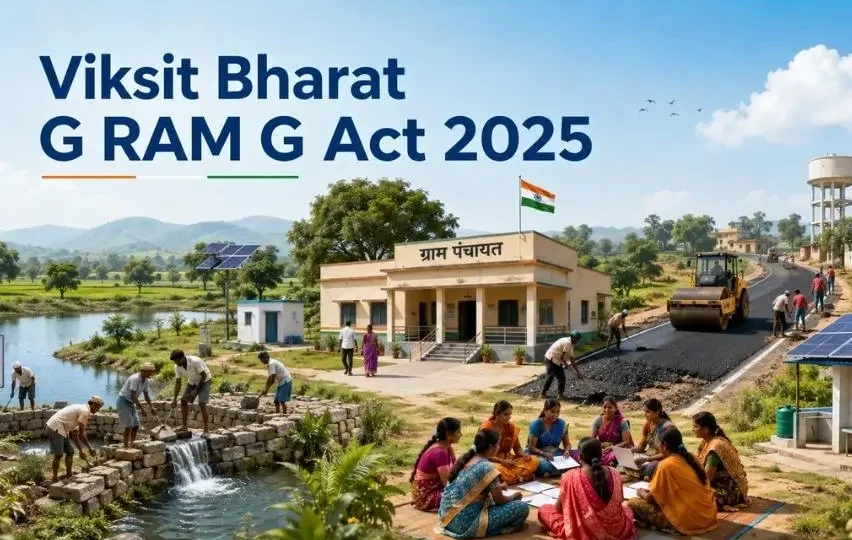
The Viksit Bharat – Guarantee for Rozgar and Ajeevika Mission (Gramin) Act, 2025, also known as VB-G RAM G Act, 2025, is a new rural employment guarantee framework aimed at strengthening livelihood security, village economies and durable rural asset creation.
The Act came into force on 1 July 2026 and replaces the earlier MGNREGA, 2005 framework. It seeks to align rural employment with the long-term national vision of Viksit Bharat @2047.
For UPSC Current Affairs, the topic is important under Economy, Rural Development, Welfare Schemes, Governance and Inclusive Growth.
What is VB-G RAM G Act, 2025?
The VB-G RAM G Act provides a statutory wage employment guarantee to eligible rural households. It aims to provide income security while also creating productive and climate-resilient rural assets.
The Act focuses on:
- Guaranteed wage employment
- Rural livelihoods
- Durable asset creation
- Village-level development planning
- Digital monitoring and transparency
- Strengthening rural infrastructure
Evolution of Rural Employment Programmes in India
India’s rural employment framework has evolved gradually through several programmes:
- 1960s: Rural Manpower Programme
- 1971: Crash Scheme for Rural Employment
- 1977: Maharashtra Employment Guarantee Act
- 1993: Jawahar Rozgar Yojana
- 1999: Sampoorna Grameen Rozgar Yojana
- 2005: MGNREGA
- 2025: VB-G RAM G Act
This evolution reflects India’s shift from temporary wage support to a more structured rural development and livelihood guarantee framework.
Key Features: Work and Wages
125 Days Employment Guarantee
The Act expands the employment guarantee from 100 days to 125 days of wage employment for eligible rural households.
Wage Floor
A wage floor of Rs 300 per day has been introduced. No state wage under the programme can fall below this level.
Weekly Payment Rule
The Act emphasizes timely wage payment. Wages are to be paid weekly, with a maximum payment window of 14 days.
60-Day Pause During Peak Agricultural Seasons
A 60-day no-work period may be followed during peak sowing and harvesting seasons. This helps balance wage employment with farm labour availability.
Financial Architecture
The financial structure is based on shared Centre-State responsibility.
Fund Sharing Pattern
The funding pattern varies across regions:
- North-Eastern and Himalayan States: 90:10 between Centre and State
- Normal States: 60:40 between Centre and State
- Union Territories without Legislature: 100% central funding
Normative Allocation
The Centre sets state-wise expenditure ceilings based on Finance Commission horizontal devolution principles.
State Responsibility
States are responsible for unemployment allowance and delay compensation wherever applicable.
Four Strategic Verticals for Durable Rural Assets
The Act focuses on four major asset-creation verticals.
Water Security
This includes water conservation, irrigation support, pond restoration, watershed development and water management works.
Core Rural Infrastructure
This includes rural roads, community assets, basic facilities and other infrastructure needed for village development.
Livelihood Infrastructure
The Act supports Self-Help Groups, farms, local enterprises and village-level income-generating assets.
Climate Resilience
Special works may be taken up to protect rural communities from extreme weather events, droughts, floods and climate-related vulnerabilities.
Digital Planning and Monitoring
The Act gives importance to digital governance in rural employment.
Key digital mechanisms include:
- Viksit Gram Panchayat Plans
- PM Gati Shakti integration
- Unified digital asset mapping
- National Rural Infrastructure Stack
- Real-time monitoring of works and assets
These tools aim to improve transparency, reduce leakages and ensure better planning of rural assets.
Significance of VB-G RAM G Act
The Act is significant because it combines wage employment with long-term rural development.
It can help in:
- Strengthening rural income security
- Reducing distress migration
- Creating productive rural assets
- Supporting women’s participation in rural work
- Improving climate resilience
- Strengthening Gram Panchayat-level planning
- Linking employment with Viksit Bharat @2047 goals
Challenges
Despite its ambitious goals, implementation may face several challenges.
Key concerns include:
- Timely wage payment
- Accurate job demand registration
- Quality of rural assets
- Centre-State coordination
- Digital exclusion in remote areas
- Monitoring of fund utilization
- Ensuring social audit and transparency
Effective implementation will decide whether the Act can improve upon the limitations of MGNREGA.
UPSC Relevance
GS Paper 2
- Welfare schemes
- Governance
- Social justice
- Rural development
- Decentralisation
GS Paper 3
- Inclusive growth
- Employment
- Rural economy
- Infrastructure
- Climate resilience
Prelims
- VB-G RAM G Act, 2025
- MGNREGA replacement
- 125 days employment guarantee
- Rs 300 wage floor
- Rural asset creation
- Fund sharing pattern
Conclusion
The Viksit Bharat Rozgar & Ajeevika Mission (Gramin) Act, 2025 marks a major shift in India’s rural employment policy. By expanding wage employment to 125 days, ensuring a wage floor, promoting durable rural assets and using digital planning tools, the Act seeks to strengthen income security and rural development.
Its success will depend on timely payments, transparent implementation, quality asset creation and strong coordination between the Centre, States and Gram Panchayats.



Frequently Asked Questions on Viksit Bharat G RAM G Act 2025
What is the Viksit Bharat G RAM G Act 2025?
The Viksit Bharat G RAM G Act 2025 is a rural employment guarantee law that replaces MGNREGA and provides statutory wage employment to eligible rural households.
When did the Viksit Bharat G RAM G Act come into force?
The Act came into force on 1 July 2026 across rural India.
How many days of work are guaranteed under the Act?
The Act provides 125 days of guaranteed wage employment to eligible rural households.
What is the wage floor under the Viksit Bharat G RAM G Act?
The Act introduces a wage floor of Rs 300 per day, ensuring no state wage under the programme falls below this level.
Why is the Viksit Bharat G RAM G Act important for UPSC?
It is important for UPSC because it connects with rural development, welfare schemes, employment, inclusive growth, fiscal federalism, Gram Panchayats and Viksit Bharat @2047.