Table of Contents
ToggleGross Domestic Product (GDP) in India: Concepts, Methods, and Insights
Gross Domestic Product (GDP) is the primary headline metric used to assess the overall health, scale, and performance of an economy. For Civil Services Examination candidates, understanding Gross Domestic Product UPSC concepts is vital for analyzing macroeconomic trends, fiscal policies, and economic growth patterns under GS Paper III. Mastering aggregate output calculations forms a foundational pillar of comprehensive GDP Notes for UPSC and broader Indian Economy Notes.
What is Gross Domestic Product (GDP)
Gross Domestic Product (GDP) represents the total monetary or market value of all final goods and services produced within a nation’s geographical boundaries during a specified accounting period, typically one financial year. GDP in India measures output produced domestically, regardless of whether the manufacturing assets are owned by domestic residents or foreign entities.
Formula for GDP & Methods of Measuring GDP
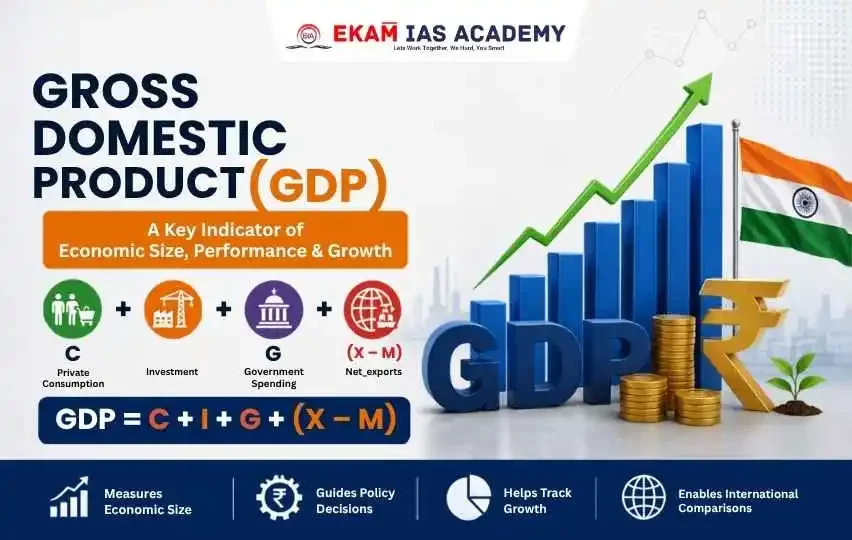
The standard expenditure-side GDP Formula is expressed as:
Where C is Private Consumption, I is Gross Private Investment, G is Government Spending, and (X – M) represents Net Exports.
Methods of GDP Calculation
- Expenditure Method: Sums all final spending across private households, corporate capital investments, public projects, and net exports.
- Income Method: Aggregates primary factor earnings across the economy, including wages, land rent, capital interest, and business profits.
- Output/Production Method: Calculates value added at each sequential stage of production to compute net national aggregate output.
GDP and Value Addition
To avoid double-counting intermediate inputs, modern statistical systems evaluate national production through Gross Value Added (GVA). Gross Value Added (GVA) measures sector-specific output from the supply side. GDP at Market Price is directly derived from GVA using the following formula:
Types of GDP
Navigating Types of GDP requires distinguishing between price bases and valuation frameworks:
- Nominal GDP: Evaluates domestic production at current prevailing market prices without adjusting for general inflation.
- Real GDP: Measures total output using constant base-year prices, isolating real physical production growth from price volatility.
- GDP Deflator: A broad-based price index tracking overall inflation, calculated as:

Difference Between Key National Income Concepts
| Metric | Boundary Focus | Adjustment / Scope |
| Gross Domestic Product (GDP) | Domestic geographical territory | Includes foreign factor earnings inside domestic borders |
| Gross National Product (GNP) | National resident ownership | Adds Net Factor Income from Abroad (GDP + NFIA) |
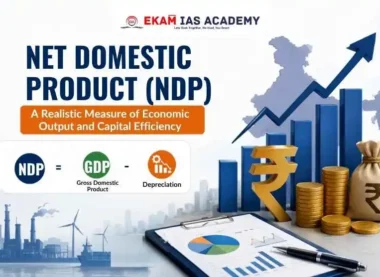
| Net Domestic Product (NDP) | Capital asset accounting | Subtracts capital consumption allowances (GDP – Depreciation) |
Importance & Factors Affecting GDP
- Importance of GDP: Serves as a key indicator of aggregate economic size, guides fiscal and monetary interventions, determines debt-to-GDP ratios, and influences international sovereign credit ratings.
- Factors Affecting GDP: Influenced by aggregate consumer demand, capital expenditure (I), foreign direct investment inflows, structural trade balances, demographic dividend trends, and technological adoption.
Limitations of GDP
Despite its wide usage, Gross Domestic Product (GDP) has several key structural limitations:
- Excludes non-market activities, such as unpaid caregiving and informal domestic work.
- Ignores income inequality, wealth distribution, and regional economic disparities.
- Fails to capture environmental degradation, natural resource depletion, and broader human well-being metrics.
GDP in the Indian Context & Recent Developments
In Gross Domestic Product in India accounting, the National Statistical Office (NSO) under MoSPI periodically updates baseline methodologies and datasets. Recent updates incorporate high-frequency economic indicators, real-time GST portal transaction data, corporate MCA-21 filings, and e-Way bill logs to improve GDP Calculation precision across both unorganized and organized sectors.
Way Forward
- Adopt double-deflation frameworks across manufacturing and agricultural supply chains to refine inflation adjustments.
- Expand statistical coverage of rural MSMEs, gig economy platforms, and informal service providers.
- Integrate environmental and natural resource metrics alongside GDP data to support sustainable economic growth.
Conclusion
Understanding GDP UPSC principles provides essential context for analyzing economic growth and public policy performance. As India pursues the vision of Viksit Bharat 2047, generating accurate, transparent, and comprehensive GDP metrics will remain vital for shaping long-term fiscal policies and driving sustainable, inclusive development.
UPSC Prelims: PYQs & Practice Questions
Previous Year Questions (Prelims)
Q: With reference to the Indian economy, consider the following statements:
1. The rate of growth of Real Gross Domestic Product has steadily increased in the last decade.
2. The Gross Domestic Product at market prices in rupees has steadily increased in the last decade.
Which of the statements given above is/are correct?
(a) 1 only
(b) 2 only
(c) Both 1 and 2
(d) Neither 1 nor 2
Answer: (b) 2 only
Explanation:
Statement 1 is incorrect because the growth rate of Real GDP fluctuated over the decade due to global and domestic economic factors, including events such as the 2008 global financial crisis.
Statement 2 is correct because, despite fluctuations in annual percentage growth rates, positive annual growth meant that total GDP at market prices in absolute rupee terms continued to expand steadily year after year.
Q: With reference to the Indian economy, consider the following statements:
1. An increase in Real GDP implies that the production of goods and services in the economy has increased.
2. Nominal GDP is calculated at constant base-year prices.
Which of the statements given above is/are correct?
(a) 1 only
(b) 2 only
(c) Both 1 and 2
(d) Neither 1 nor 2
Answer: (a) 1 only
Explanation:
Statement 1 is correct because Real GDP adjusts output values for inflation using constant base-year prices. Therefore, an increase in Real GDP reflects a real expansion in the physical production of goods and services.
Statement 2 is incorrect because Nominal GDP is evaluated at current market prices, whereas Real GDP is calculated at constant base-year prices.
Practice Questions
Q: Which of the following components are included when deriving GDP at Market Prices from Gross Value Added (GVA) at basic prices?
(a) Subtracting product taxes and adding product subsidies.
(b) Adding net factor income from abroad (NFIA).
(c) Adding product taxes and subtracting product subsidies.
(d) Subtracting physical capital depreciation from GVA.
Answer: (c) Adding product taxes and subtracting product subsidies.
Explanation:
According to national income accounting standards adopted by the NSO, GDP at Market Prices = GVA at Basic Prices + Product Taxes - Product Subsidies.
NFIA is used to convert domestic aggregates into national aggregates, while depreciation is used to convert gross output into net output.
Q: Consider the following statements regarding the GDP Deflator:
1. The GDP Deflator is a broad-based inflation index covering all final goods and services produced within an economy.
2. Unlike the Consumer Price Index (CPI), the GDP Deflator includes prices of imported consumption goods.
Which of the statements given above is/are correct?
(a) 1 only
(b) 2 only
(c) Both 1 and 2
(d) Neither 1 nor 2
Answer: (a) 1 only
Explanation:
Statement 1 is correct because the GDP Deflator reflects price changes across all domestically produced final goods and services. It is calculated as (Nominal GDP / Real GDP) × 100.
Statement 2 is incorrect because the GDP Deflator covers only domestically produced goods and services and excludes imports. In contrast, the CPI basket may include consumer goods imported from abroad.
UPSC Mains – Previous Year & Practice Questions
Mains Previous Year Questions
UPSC CSE 2017 | GS-3
Question: Industrial growth rate has lagged behind in the overall growth of Gross Domestic Product (GDP) in the post-reform period. Give reasons. How far are the recent changes in Industrial Policy capable of increasing the industrial growth rate?
UPSC CSE 2019 | GS-3
Question: Do you agree with the view that steady GDP growth and low inflation have left the Indian economy in good shape? Give reasons in support of your arguments.
UPSC CSE 2020 | GS-3
Question: Define potential GDP and explain its determinants. What are the factors that have been inhibiting India from realizing its potential GDP?
UPSC CSE 2021 | GS-3
Question: Explain the difference between computing methodology of India's Gross Domestic Product (GDP) before the year 2015 and after the year 2015.
UPSC CSE 2023 | GS-3
Question: Faster economic growth requires increased share of the manufacturing sector in GDP, particularly of MSMEs. Comment on the present policies of the Government in this regard.
Mains Practice Questions
Question: Gross Domestic Product (GDP) remains the central metric for macroeconomic measurement, yet it fails to account for environmental degradation, informal labor, and income distribution. Evaluate the need for complementary metrics like Green GDP and Human Development Index.
Question: Discuss how the adoption of high-frequency data such as GST filings, corporate databases, and e-Way bills has enhanced the accuracy of GDP estimation in India. What challenges persist in recording informal sector contributions?
Question: In the context of the Viksit Bharat @ 2047 framework, analyze how raising capital expenditure (I) and enhancing Total Factor Productivity can help elevate India's potential GDP growth trajectory.



Gross Domestic Product (GDP)-FAQs
What is Gross Domestic Product?
Gross Domestic Product is the total market value of all final goods and services produced within a country’s domestic territory during a specific accounting year.
What is the GDP formula?
The expenditure-side GDP formula is:GDP = C + I + G + (X - M)
What are the methods of GDP calculation?
The three methods are the Expenditure Method, Income Method, and Output or Production Method.
What is the difference between nominal GDP and real GDP?
Nominal GDP measures output at current prices, while real GDP measures output at constant base-year prices after adjusting for inflation.
Why is GDP important for UPSC GS 3?
GDP is important for GS Paper III because it helps analyze economic growth, fiscal policy, inflation, investment, employment, debt ratios and development planning.