Table of Contents
TogglePersonal Income (PI): Concept, Calculation and Importance in Indian Economy
Personal Income (PI) is a vital macroeconomic metric that evaluates the actual purchasing power and financial health of households within an economy. For Civil Services Examination candidates, mastering Personal Income UPSC concepts is crucial for analyzing household consumption trends, income distribution patterns, and welfare schemes under GS Paper III. Understanding these household-level dynamics forms an essential part of Personal Income Notes for UPSC and broader Indian Economy Notes.
What is Personal Income (PI)
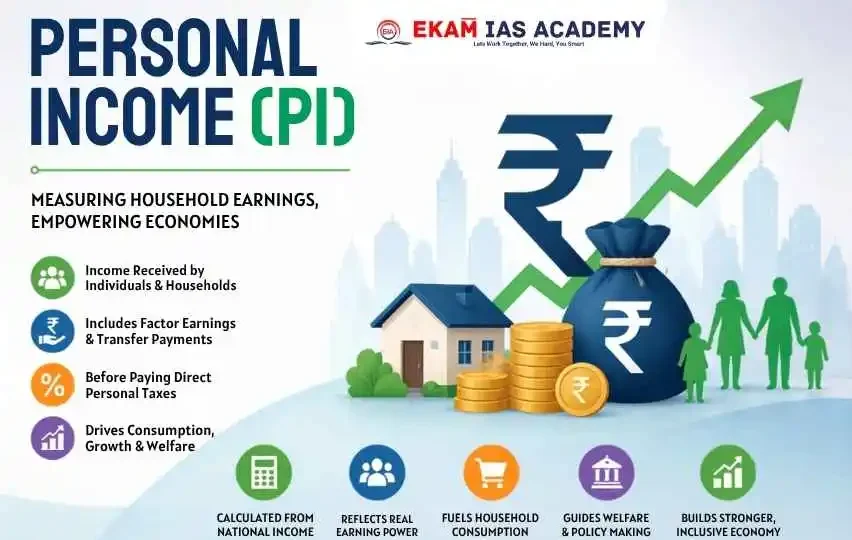
Personal Income (PI) represents the total income actually received by individuals and households from all sources before paying direct personal taxes. Unlike macro-aggregates that track total production, Personal Income in India measures earnings that flow directly into private hands, including both factor earnings and unearned transfer payments.
Formula for Personal Income & Components
Calculating household earnings requires adjusting national production metrics for retained earnings and non-factor receipts:
Key Components
- Factor Earnings: Wages, salaries, land rent, capital interest, and dividends accruing to households.
- Transfer Payments: Government support payments (such as PM-KISAN, pensions, and scholarships) and private gifts received without providing any current economic output.
- Deductions: Corporate profits retained for investment, corporate taxes, and social security payments withheld before reaching individuals.
Relationship Between National Income Concepts
Understanding Personal Income vs National Income is fundamental for analyzing household purchasing power:
- National Income (NI): Measures total factor income earned across the economy during production (NNP_FC).
- Personal Income (PI): Measures income actually received by households, adding transfer payments and deducting undistributed corporate earnings.
- Disposable Personal Income (DPI): Measures actual spendable income remaining after deducting direct personal taxes:Disposable Personal Income (DPI) = Personal Income – Personal Direct Taxes
Importance & Factors Affecting Personal Income
- Importance of Personal Income: Serves as a key indicator of Household Income in India, drives aggregate private final consumption expenditure (PFCE), and guides policies in Welfare Economics.
- Factors Affecting Personal Income: Influenced by formal wage levels, employment rates, government welfare transfer volumes, tax structure policies, and general Economic Growth in India.
Advantages & Limitations of Personal Income
- Advantages: Offers a direct measure of living standards, household spending potential, and domestic market demand.
- Limitations: Masking income inequality across socioeconomic groups and failing to capture non-monetary or informal self-employment earnings.
Personal Income in the Indian Context & Recent Developments
In evaluating Household Income in India, tracking household earnings accurately is essential due to the country’s large unorganized labor market. The National Statistical Office (NSO) under MoSPI periodically updates survey baselines to capture gig economy earnings, rural household non-farm incomes, and digital transfer flows. Key Economic Indicators show that expanding Direct Benefit Transfer (DBT) networks has significantly stabilized household earnings across rural regions.
Way Forward
- Formalize unorganized employment to boost steady wage growth across MSMEs.
- Expand digital public infrastructure to lower remittance costs and ensure targeted welfare delivery.
- Balance direct personal taxation to raise household disposable income and spur private domestic investment.
Conclusion
A clear understanding of Personal Income (PI) dynamics is essential for analyzing consumer demand and household welfare. As India advances toward Viksit Bharat 2047, raising individual earning potential and narrowing income gaps will remain central to driving inclusive economic expansion.
UPSC Prelims: PYQs & Practice Questions
Previous Year Questions (Prelims)
Q: Which of the following is/are included in the Personal Income of households?
1. Transfer payments from the government
2. Undistributed corporate profits
3. Corporate taxes
4. Net interest payments received by households
Select the correct answer using the code given below:
(a) 1 and 4 only
(b) 1, 2 and 3 only
(c) 2 and 3 only
(d) 1, 2, 3 and 4
Answer: (a) 1 and 4 only
Explanation:
Personal Income (PI) measures the income actually received by households. Transfer payments, such as pensions and welfare payouts, are added because households receive them without providing immediate production.
Net interest payments received by households are also included. However, undistributed corporate profits and corporate taxes remain at the firm level or are paid by firms and do not directly reach households.
Q: With reference to the Indian economy, consider the following statements:
1. Personal Disposable Income is equal to Personal Income minus Direct Personal Taxes minus Miscellaneous Receipts of Government.
2. An increase in Personal Disposable Income always leads to a proportionate increase in Private Final Consumption Expenditure.
Which of the statements given above is/are correct?
(a) 1 only
(b) 2 only
(c) Both 1 and 2
(d) Neither 1 nor 2
Answer: (a) 1 only
Explanation:
Statement 1 is correct because Disposable Personal Income (DPI) is calculated as Personal Income - Direct Personal Taxes - Non-tax payments/fees.
Statement 2 is incorrect because households do not spend 100% of additional income on consumption. A part of the additional income may be saved depending on the Marginal Propensity to Consume (MPC).
Practice Questions
Q: Which of the following equations correctly illustrates the relationship between Personal Income (PI) and Disposable Personal Income (DPI)?
(a) DPI = Personal Income + Indirect Taxes - Subsidies
(b) DPI = Personal Income - Personal Direct Taxes - Non-Tax Payments (Fees/Fines)
(c) DPI = National Income - Transfer Payments
(d) DPI = Personal Income - Corporate Taxes - Undistributed Profits
Answer: (b) DPI = Personal Income - Personal Direct Taxes - Non-Tax Payments (Fees/Fines)
Explanation:
Disposable Personal Income (DPI) represents the actual income available with households for consumption and saving after deducting personal direct taxes such as income tax and compulsory non-tax payments like government fees and fines.
Q: Consider the following items:
1. Social Security Contributions
2. Old-Age Pensions paid by the state
3. Undistributed Corporate Profits
4. Dividends received by shareholders
Which of the above are added to National Income (NNPFC) while calculating Personal Income (PI)?
(a) 1 and 3 only
(b) 2 and 4 only
(c) 2 only
(d) 1, 2 and 4 only
Answer: (c) 2 only
Explanation:
Old-Age Pensions are government transfer payments and are added while calculating Personal Income because households receive them without providing current productive services.
Social Security Contributions are deducted as they are payments made by individuals. Undistributed Corporate Profits remain with companies and do not directly reach households. Dividends are already included in National Income as part of corporate income and cannot be added again.
UPSC Mains – Previous Year & Practice Questions
Mains Previous Year Questions
Question: Distinguish between National Income and Personal Income. Explain why an increase in National Income does not automatically translate into a proportionate rise in Personal Disposable Income. (Mains 2014)
Question: Examine the impact of Direct Benefit Transfer (DBT) and public transfer payments on boosting Personal Income and domestic demand in rural India. (Mains 2017)
Question: How does personal income tax policy influence household savings and private consumption expenditure in an economy? Discuss with reference to recent tax reforms. (Mains 2019)
Question: Critically analyze the distribution of Personal Income across urban and rural sectors in India. What measures are needed to bridge the widening wage gap? (Mains 2021)
Question: High corporate profitability alongside stagnant household personal income growth creates a consumption constraint. Evaluate this statement in the context of Indian economic growth. (Mains 2023)
Mains Practice Questions
[15 Marks | 250 Words]
Question: While GDP growth reflects national aggregate output, Personal Disposable Income dictates actual household well-being. Analyze the factors preventing macroeconomic growth from translating into higher real personal incomes in India.
[10 Marks | 150 Words]
Question: In an economy with a large unorganized workforce, accurately estimating household Personal Income remains a statistical challenge. Evaluate how digital transactions and NSO household surveys can improve measurement.
[15 Marks | 250 Words]
Question: Discuss the role of progressive personal direct taxation and universal social welfare transfers in narrowing Personal Income inequalities under the Viksit Bharat @ 2047 vision.



Personal Income-FAQs
What is Personal Income?
Personal Income is the total income actually received by individuals and households from all sources before paying direct personal taxes.
What is the formula for Personal Income?
Personal Income = National Income – Corporate Undistributed Profits – Corporates Taxes – Social Security Contributions +Transfer Payments
What is Disposable Personal Income?
Disposable Personal Income is the income left with households after paying direct personal taxes.DPI = Personal Income - Personal Direct Taxes
What is the difference between Personal Income and National Income?
National Income measures total factor income earned in production, while Personal Income measures income actually received by households after adjustments.
Why is Personal Income important for UPSC GS 3?
It is important because it helps analyze household consumption, welfare schemes, income distribution, direct taxation, DBT and private demand in the economy.